A folder of photographs contains views of a building, but usually no precise record of where the photographer stood. COLMAP's reconstruction pipeline has to recover that missing geometry. Before its standard workflow can produce a dense surface, it estimates camera positions, viewing directions, and a sparse constellation of scene points. Following the handoffs between those stages explains both the software's usefulness and the failures a finished model can conceal.[1]
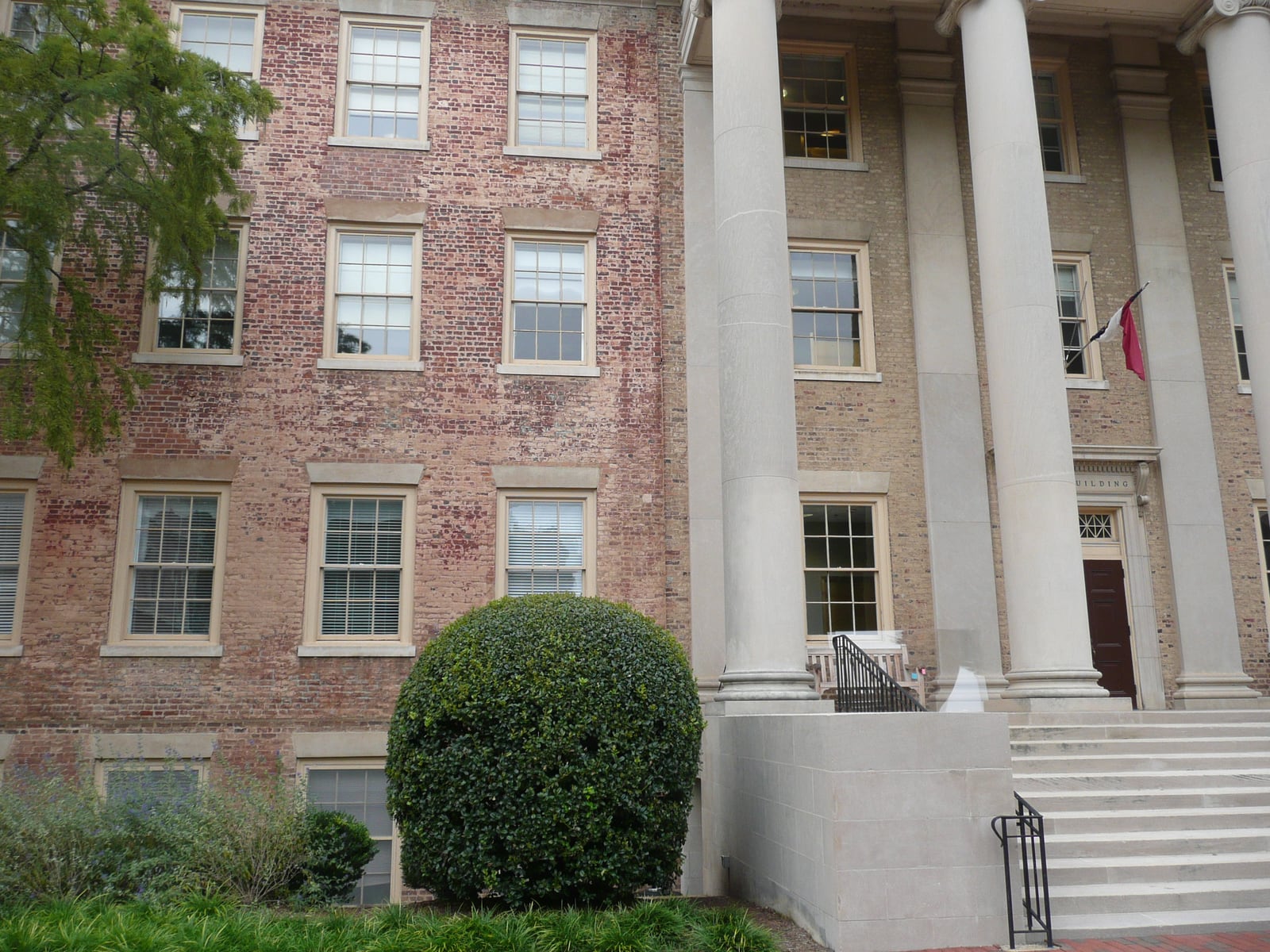
Consider the project's South Building example: 128 photographs of a building at the University of North Carolina at Chapel Hill, supplied by Christopher Zach.[8] A person recognizes the building across the pictures immediately. The software needs correspondences it can test.
A match is a proposal
COLMAP keeps extracted features and their relationships in a SQLite database. A keypoint records a location in an image; its descriptor represents local appearance. Matching proposes that features in two pictures depict the same scene detail. The database makes the next distinction explicit: proposed matches live in matches, while geometrically verified relationships live in two_view_geometries. Reconstruction uses the latter.[2]
Imagine two similar windows on the facade. Resemblance alone is weak evidence that two image patches show the same window. Geometric verification tests whether correspondences fit a plausible relationship between views. The original COLMAP paper describes robust estimation that tolerates incorrect matches while looking for a consistent explanation.[3]
The database also distinguishes a camera model from an image. Several images can share one set of intrinsic parameters, such as focal length and lens distortion, while each has its own position and orientation.[2] This is why “one camera” does not mean “one viewpoint.”
The building and the viewpoints grow together
In the incremental approach described by Schönberger and Frahm, reconstruction begins with a selected image pair. Further images join through correspondences with existing 3D points; triangulation adds scene points from observations across views. Bundle adjustment then refines camera parameters and point positions together, reducing disagreement between the observed image features and where the estimated geometry projects them.[3]
The implication is easy to miss when watching a point cloud emerge: the cameras are part of the answer being revised. They are not simply fixed scaffolding around a growing object. A feature can help locate a camera, and that camera can help constrain further features.
Capture therefore matters upstream. COLMAP's tutorial recommends textured subjects, substantial overlap, and photographs taken from different positions. Rotating in place is not a substitute for moving between shots. It also warns about reflections and inconsistent illumination.[1] An empty patch in a reconstruction can begin with information that never reached the camera.
The saved model has a coordinate convention
A sparse reconstruction is a collection of linked records. The documented output includes cameras, images, and points3D, with rigs and frames in newer models. Binary and text representations are available. In images.txt, the pose transforms world coordinates into camera coordinates. Its translation vector is therefore not directly the camera's world position: the camera center is -Rᵀt.[4]
That distinction becomes consequential when exporting a trajectory or placing a virtual camera. The same numbers can produce a wrong scene if the receiving program interprets them differently.
Nerfstudio offers an independent integration perspective. Its data-conventions guide explicitly contrasts its OpenGL-style camera axes with COLMAP's: the two systems agree on the rightward X axis but reverse the Y and Z directions.[7] My engineering inference is that a reconstruction handoff should name both the transform direction and the axis convention. A file that parses successfully has passed only the first test.
Dense reconstruction starts another computation
The command-line workflow exposes the next handoff through image_undistorter, which prepares images and the sparse model for dense processing. patch_match_stereo estimates depth and surface normals; stereo_fusion combines compatible estimates into a point cloud such as fused.ply. Meshing is a subsequent operation.[1][5]
This gives an operator useful stopping places. Inspect the registered views before preparing the dense workspace. Inspect the fused cloud before judging a mesh. These are my suggested checkpoints: each separates a different kind of disagreement instead of treating the final surface as the only observable result.
The computational requirements change too. COLMAP's built-in dense reconstruction requires CUDA. Its FAQ suggests reducing PatchMatchStereo.max_image_size or the number of source images when stereo exhausts GPU memory. Completing sparse reconstruction does not establish that the dense stage will fit.[6]
There is also a sequencing constraint. The FAQ warns that dense reconstruction must be recomputed after running the mapper or bundle adjustment, because the model's coordinate frame can change.[6] Retaining old depth results after revising the cameras breaks the relationship that made those results meaningful.
Detail does not supply a ruler
Ordinary monocular structure from motion, without metric reference information, leaves the reconstruction ambiguous in overall scale. Ceres Solver's documentation describes the broader ambiguity as a similarity transform.[9] The intuition is geometric: enlarge the building and move the cameras proportionally farther away, and the same projected image positions can remain unchanged. More visible brickwork does not resolve that freedom.
COLMAP provides a route to an external coordinate frame through model_aligner. Its documented georegistration procedure uses known camera-center positions for at least three registered images to estimate the transformation.[6] Those reference measurements contribute information the photographs alone did not contain.
For a small research or visualization team, the practical payoff is an inspectable reconstruction: keep the source images, database, sparse model, software version, and processing settings together. When something looks wrong, the architecture supplies a place to investigate—correspondences, camera geometry, coordinate conversion, dense depth, or external scale. The building becomes convincing through accumulated evidence, and each saved stage lets another person examine how it got there.
Sources
- COLMAP, “Tutorial”—capture guidance and the sparse-to-dense reconstruction sequence; live documentation consulted October 12, 2026.
- COLMAP, “Database Format”—SQLite tables, camera/image relationships, and geometrically verified matches.
- Johannes L. Schönberger and Jan-Michael Frahm, “Structure-from-Motion Revisited,” CVPR 2016, sections 2 and 4—incremental reconstruction and bundle adjustment.
- COLMAP, “Output Format”—sparse-model files, world-to-camera poses, and the camera-center formula.
- COLMAP, “Command-line Interface”—explicit undistortion, stereo, fusion, and meshing commands.
- COLMAP, “Frequently Asked Questions”—CUDA requirements, dense-memory controls, recomputation after pose changes, and georegistration.
- Nerfstudio, “Data conventions”—independent integration documentation explaining its camera-axis differences from COLMAP.
- COLMAP, “Datasets”—South Building at UNC Chapel Hill, 128 photographs provided by Christopher Zach, with a link to the downloadable image collection.
- Ceres Solver, “Covariance Estimation,” subsection “Gauge Invariance”—the similarity-transform ambiguity of structure from motion.