A computer can recognize a USB programmer while the microcontroller at the other end of its ribbon cable remains unreachable. AVRDUDE's architecture makes room for that awkward situation: the programmer and the target chip have separate identities, and a memory operation specifies what should pass between them. Following those distinctions turns a terse upload command into a description of the workbench. This account uses the AVRDUDE 8.1 manual and configuration.[1][2]
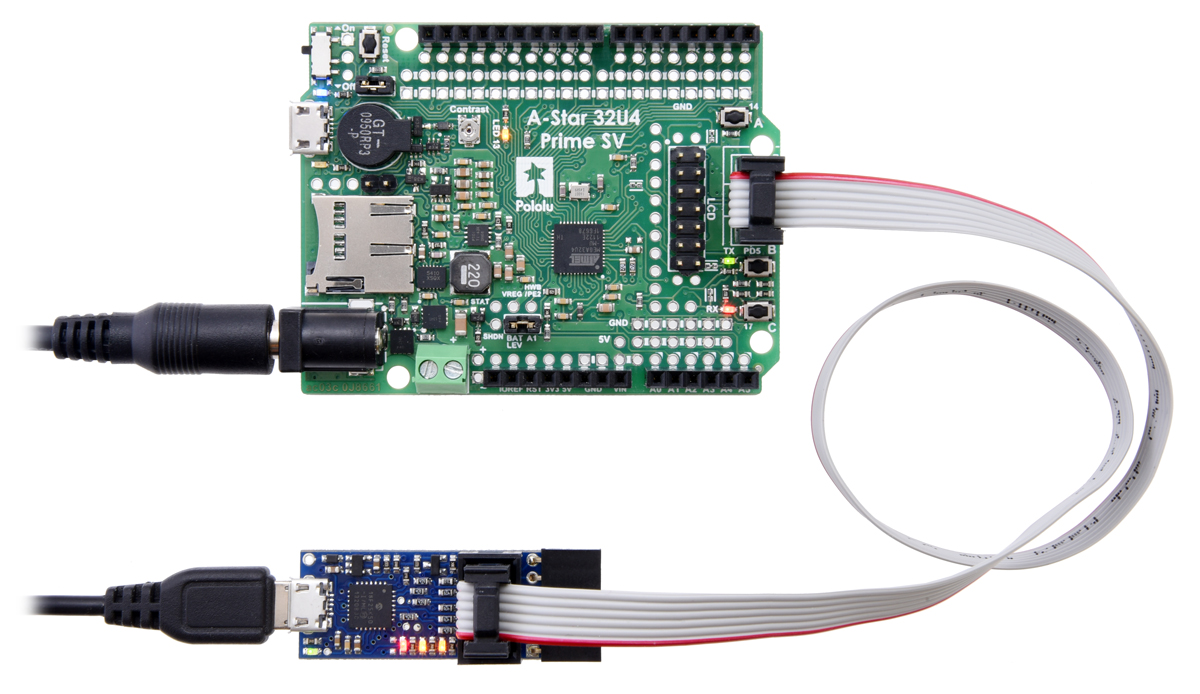
The file arrives after the compiler
AVRDUDE works with the memories of AVR microcontrollers. Depending on the chip and programming interface, it can read or write flash, EEPROM, fuses and lock bits. It can reach a target through a separate hardware programmer or through a bootloader already running on the chip. The available operations depend on that combination.[1]
The preceding build has its own responsibilities. Pololu's command-line example compiles C with AVR GCC, links an executable, and uses avr-objcopy to produce an Intel HEX file before invoking AVRDUDE. Its sample program also specifies which pin drives an LED and the clock frequency assumed by the delay routine.[3]
That division matters when a newly programmed board sits motionless. The upload stage cannot establish that the source selected the right LED pin. A perfectly transferred program can still embody the wrong assumptions about its surroundings. The investigation then belongs partly to the build and circuit, even if the last visible action was an upload.
Two identities and an address
Consider a flash read from an ATmega32U4 through a Pololu v2 programmer. With /dev/ttyACM0 standing for the programmer's actual Linux programming port, the command has this shape:[1][2][3]
avrdude -c stk500v2 -p m32u4 -P /dev/ttyACM0 \
  -U flash:r:before.hex:i
Here -c selects the programmer protocol, -p identifies the target microcontroller, and -P selects the host connection. The final operation reads flash into before.hex in Intel HEX format. A different memory, such as EEPROM, requires its own selection.[1]
The names come from a concrete arrangement. Pololu's programmer presents an STK500-compatible interface to the computer. Its guide uses stk500v2 for AVRDUDE and distinguishes the programming port from a second port used for ordinary serial communication. Selecting the second port because it appeared beside the first would address a different service on the same USB device.[3]
Reading flash also has a useful limit: the resulting file records the selected memory. A reconstruction of the board's full state would have to account separately for its other memories and configuration. The command itself tells us how narrow the record is.
A part name opens a hardware description
The configuration gives those short names substance. In the 8.1 source, the stk500v2 programmer entry specifies a driver type and a serial connection. The separate m32u4 part entry identifies the ATmega32U4, supplies its signature bytes, and describes flash and EEPROM. Its flash definition specifies 0x8000 bytes and 256 pages; the EEPROM definition specifies 1,024 bytes.[2]
More generally, AVRDUDE's part definitions can contain memory sizes, page sizes, programming instructions and timing information. Programmer definitions describe the communication mechanism and supported programming modes. These are distinct descriptions because a chip's memory geometry and the route used to reach it answer different questions.[1]
This separation also sets a limit on extensibility. Adding a part description can express another device's requirements when the necessary mechanism already exists. It cannot give an attached adapter a programming interface its hardware lacks. The manual explicitly cautions that support for a programmer and support for a part do not guarantee that every pairing works.[1]
The cable carries another clock
Pololu's troubleshooting guide separates failure to connect to the programmer from failure to connect to the target AVR. On the target side, it calls out power, wiring and programming speed. For the classic ISP connection discussed here, it specifies an ISP frequency below one-quarter of the target's clock frequency.[3]
AVRDUDE reflects the two links in different options: -b controls the serial connection's baud rate, while -B sets the programming-interface bit clock for supported programmers. Changing one does not necessarily change the other.[1]
Imagine that USB communication works and the programmer answers, but the chip is running more slowly than expected. Retrying the same firmware file leaves the timing mismatch untouched. The useful question is what the programmer can exchange with the target under the target's actual conditions. A successful conversation with the adapter has established only the first part of that path.
Verification has a precise meaning
AVRDUDE normally verifies data after writing; -V disables that check. An explicit v memory operation compares the selected device memory with a file. Erasure is another distinct operation: classic AVR flash writes can trigger a chip erase, whose effects can include EEPROM unless the device's fuse configuration preserves it.[1]
Fuses therefore deserve their own place in the explanation. SparkFun's independently authored bootloader tutorial separates fuse settings, the flash image and lock bits. Its worked example ties fuse values to a particular board configuration, including the clock arrangement, and warns that those values do not transfer unchanged to its 3.3-volt, 8 MHz counterpart.[4]
Taken together, these sources explain why verification is valuable and bounded. It supplies evidence about stored data. A functional check supplies different evidence: whether the program starts, drives the intended pin and behaves with the attached hardware. For a small team maintaining an AVR fixture, preserving the exact part, programmer, build assumptions and memory operations alongside the firmware makes that distinction easier to revisit.
The photograph's two boards are a useful place to end. One provides the programming interface; the other must eventually run the result. AVRDUDE exposes enough of the route between them to identify which conversation succeeded—and which still needs an answer.
Sources
- AVRDUDE 8.1 User Manual — introduction, command-line options, programmer definitions and part definitions.
- AVRDUDE v8.1, src/avrdude.conf.in — pinned programmer and part configuration, including stk500v2 and m32u4.
- Pololu, USB AVR Programmer v2 User's Guide — connections, separate serial ports, the AVRDUDE build example and target-side troubleshooting; especially sections 4.5 and 5.1–5.6.
- SparkFun Learn, “Installing an Arduino Bootloader” — independent practical explanation of bootloader installation, fuse settings, flash and lock bits.
- Pololu, USB AVR Programmer v2.1 picture gallery — source photograph and identification of the pictured v2 programmer connected to an A-Star 32U4 Prime SV.