Suppose an aircraft manufacturer needs support for a new sensor. A volunteer has a patch. A maintainer needs evidence that the change behaves properly beyond the machine on the workbench. ArduPilot, the open-source autopilot project, brings these interests together through a revealing division of work: sponsorship supports the project, funding proposals allocate resources, and code review and release testing decide what reaches users.[1][3][5][6]
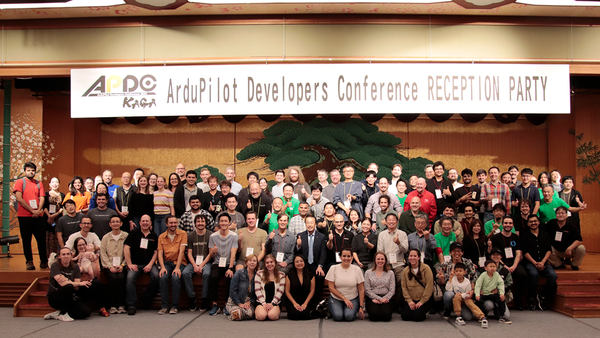
The people making those decisions occasionally occupy the same room. Reporting on the October 2024 developers conference in Kaga, Japan, Impress's Drone Journal described roughly a hundred participants and interviewed core developer Randy Mackay and organizer Kiichiro Katsumata. Some presenters arrived days early to program together, with the results subsequently shared at the conference.[2] That detail gives the gathering a useful scale: a shared codebase advances through concentrated time spent with other people who understand it.
The question is how to sustain that time between gatherings. ArduPilot's published procedures, checked on November 4, 2026, offer a concrete answer—and expose the places where money alone cannot finish the job.
What a partner supports
The Partners Program pays for infrastructure such as build, testing, wiki, and forum servers. It also funds part-time support engineers, documentation maintenance, and program coordination. Partners receive private support channels and a monthly meeting with developers; more extensive specialist work may lead to a separate consulting arrangement.[1]
This gives a company something useful to purchase: access to people who can examine a log, discuss a feature, or explain an integration problem. The project openly says that partners help guide priorities. It also says that code contributions are assessed on technical merit regardless of their origin.[1]
Read together, these commitments describe a negotiated relationship. Sponsors can make needs visible and support the capacity to address them. The public acceptance standard still asks whether a change belongs in the shared software. A product deadline can explain the urgency of a request; it cannot explain whether the patch is correct.
A proposal has to account for other people's time
The funding overview invites anyone to submit a proposal through the project's forum. The requested information goes beyond a price: applicants should identify the benefit, required resources, relevant experience, timetable, and any support needed from core developers. Longer projects should include milestones. The page explicitly favors specific tasks and light administration for small requests.[3]
The request for core-developer support deserves attention. Buying a sensor or paying someone to write its driver may create work for an experienced reviewer. A proposal that names that dependency makes its real demands easier to judge. In this reading, the form is also an early conversation about who will help finish the work.
Funding submissions are treated as public information. The overview says the committee weighs benefit to ArduPilot and likelihood of success.[3] An attractive idea therefore needs a plausible path to completion, including the attention it will require from people already maintaining the project.
Spending authority has a route outward
The governing document linked by the project, version 1.2 from May 2023, gives the committee direct approval authority for proposals totaling US$2,000 or less over the following twelve months. Larger requests go to the development team for a vote. A development-team member can also take a proposal of any size directly to the team; a rejected proposal from a team member can be escalated there.[4]
The committee consequently provides a manageable route for ordinary decisions while leaving another route available. That matters when the body judging a proposal is small and its members may also be contributors with their own priorities.
Development-team members employed by partner companies can stand for committee membership, with applications limited to one person per partner. The rules also address recusal when a committee member's vote on their own proposal would create a real or perceived conflict.[4] These are procedures for handling overlapping roles. Whether they work well in a particular decision still depends on how the people involved apply them.
The patch brings a different kind of evidence
Once work produces code, the contribution guide asks authors to make it reviewable. Commits should be organized by subsystem, expected behavior should be explained, and the pull request should include testing evidence. Contributors are directed toward software-in-the-loop simulation, relevant builds, and automated tests; changes can also be discussed on weekly development calls.[5]
Consider the hypothetical sensor request again. A successful reading from one device would answer a narrow question. A reviewer also needs to understand the affected code and the consequences for other configurations. Clear scope and reproducible evidence make that investigation possible.
The guide acknowledges that review capacity can delay contributions and that larger changes commonly need revision.[5] A funded developer can complete an initial implementation while the wider project still has work to do. Planning for that interval is part of making the contribution useful. Treating the first working demonstration as the finish line leaves its integration costs for someone else.
The release has to wait for experience
Release procedures add another judgment. Automated testing runs after commits, while developers and testers exercise the development branch. During beta testing, the release manager helps investigate reported problems and track them. The stable-release decision is discussed on a development call, including a review of outstanding issues.[6]
The documented expectation is weeks or months of beta testing, with stable release normally waiting until two weeks have passed without unexplained crashes. “Normally” matters: this is a description of the project's process, not a guarantee that every possible failure has been found.[6]
The governance lesson is visible across these stages. A budget decision establishes that work deserves resources. A review establishes whether its implementation is suitable for the codebase. A release decision considers the accumulated experience of testing it. Each asks for evidence the previous stage cannot supply on its own.
For a small engineering team building on ArduPilot, the practical implication is to budget time for those handoffs: someone who can reproduce a fault, respond to review, and test the resulting firmware on the intended hardware. A sponsor helps keep shared maintenance possible. A useful contribution keeps helping until other people can take responsibility for it.
Sources
- ArduPilot, “Partners Program” — support, shared costs, commercial influence, and technical-merit standard; checked November 4, 2026.
- Drone Journal editorial staff, report on the ArduPilot Developers Conference in Kaga, Impress, December 25, 2024 — independent Japanese-language interviews, collaborative programming, and group photograph.
- ArduPilot, “Funding Committee” — public proposals, requested resources, and evaluation criteria; checked November 4, 2026.
- ArduPilot, “Partners Funding Committee,” version 1.2, May 2023 — spending authority, direct team proposals, committee eligibility, and conflicts of interest; current governing document linked by the project, read November 4, 2026.
- ArduPilot, “Submitting Patches Back to Master” — review scope, testing evidence, development calls, and maintainer capacity; checked November 4, 2026.
- ArduPilot, “Release Procedures” — automated checks, beta reports, and the stable-release decision; checked November 4, 2026.