As of 2026-06-07 17:33 UTC, Chinese President Xi Jinping is due to begin a June 8-9 state visit to North Korea, his first trip to Pyongyang in nearly seven years. The formal announcement is simple: Xi is going at Kim Jong Un's invitation.[3] The strategic question is not simple. Beijing wants to pull Pyongyang closer after years in which Kim built more leverage through Russia, nuclear weapons, and sanctions-defying military production; Pyongyang wants Chinese backing without giving Beijing control over its nuclear line.[1][2][4]
That makes this less a ceremonial ally visit than a balance-of-leverage test. China remains North Korea's most important economic and diplomatic partner, but Kim is no longer arriving as a leader with only one patron. Reuters reported that Kim enters the meeting with stronger Russia ties, a nuclear arsenal, and little visible appetite for renewed talks with Washington.[2] AP's current explainer frames the same trip as a moment in which China is expected to reassert influence over a neighbor that has moved closer to Moscow.[1]
Fact File
| Timestamp | Source | Key claim | Confidence note |
|---|---|---|---|
| June 5, 2026 | Chinese government / Xinhua | Xi will pay a state visit to the DPRK from June 8 to 9 at Kim Jong Un's invitation.[3] | High for the announced schedule and official framing. |
| June 7, 2026 | AP | Xi is traveling to North Korea for the first time in nearly seven years, while China tries to reinforce influence over its nuclear-armed neighbor.[1] | High for current trip context; outcomes remain unknown before the meetings. |
| June 7, 2026 | Reuters | Kim is receiving Xi from a stronger position, with Russia ties, nuclear capability, and reduced interest in Washington-facing engagement.[2] | High for reported diplomatic framing; some motives are necessarily interpretive. |
| June 6, 2026 | 38 North | Pyongyang has signaled support for Beijing on Taiwan and Japan while also warning that its nuclear status is not negotiable.[4] | Medium-high; expert media analysis based on North Korean state messaging, not a summit result. |
| June 7, 2026 | AP | Kim Yo Jong rejected U.S. denuclearization language shortly before Xi's arrival and said North Korea would continue expanding its arsenal.[5] | High for the reported statement; policy durability depends on later official action. |
| June 6, 2026 | AP | Kim showcased naval modernization before the visit, including attention to the destroyer Kang Kon and nuclear-deterrent rhetoric.[6] | High for reported KCNA-linked activity; military capability claims require independent caution. |
Why The Visit Lands Differently Now
The last Xi trip to Pyongyang, in June 2019, came after the Hanoi breakdown between Donald Trump and Kim Jong Un. At that point, China could present itself as a stabilizing broker beside a stalled U.S.-North Korea negotiation. The 2026 visit lands in a harder landscape. North Korea has tightened military cooperation with Russia, advertised naval and nuclear advances, and made denuclearization language politically toxic at home.[2][5][6]
China's official line emphasizes continuity and socialist-party friendship. The Xinhua dispatch hosted by China's State Council says this year marks the 65th anniversary of the China-DPRK Treaty of Friendship, Cooperation and Mutual Assistance, and frames Xi's trip as a way to deepen the party-to-party and state-to-state relationship.[3] That matters because Beijing is presenting the visit as historical stewardship, not crisis management.
Pyongyang's signals are more tactical. 38 North's Rachel Minyoung Lee argues that North Korea has been doing two things at once before Xi arrives: leaning closer to Beijing's regional positions on Taiwan and Japan, while making clear that nuclear status is non-negotiable.[4] In plain terms, Kim is offering alignment where China wants solidarity, but resisting any Chinese attempt to make denuclearization the price of that solidarity.
That is the core tension. China does not want an uncontrolled nuclear crisis on its border, and it does not want North Korea to become so Russia-centered that Beijing loses veto power over peninsula dynamics. North Korea does not want to be treated as a junior dependent again. The meeting is therefore likely to be judged less by communique warmth than by what remains unsaid: whether China publicly avoids denuclearization pressure, whether North Korea moderates its military signaling, and whether either side mentions concrete economic corridors, tourism, transport, or border projects.[1][2][4]
Beijing's Problem
For Beijing, the strategic upside is obvious. A leader-level visit reminds Washington, Seoul, Tokyo, and Moscow that China remains a necessary actor on the Korean Peninsula. AP cites analysts who read Xi's choice of Pyongyang as a strategic move after his recent high-level diplomacy with Trump and Putin, while Reuters describes the trip as an effort to draw North Korea back into China's orbit.[1][2]
The problem is that orbit is not obedience. If Kim uses the visit mainly to secure diplomatic cover while continuing nuclear and naval expansion, China gets the photo but not necessarily the restraint. AP reported that Kim recently used a warship appearance to call for stronger naval forces with a larger nuclear-deterrent role.[6] AP also reported Kim Yo Jong's fresh rejection of U.S. denuclearization language on June 7.[5] Those signals narrow Beijing's room to play mediator, because any public Chinese endorsement of denuclearization could irritate Pyongyang, while silence looks like tacit acceptance.
This is why Seoul will read the trip closely. South Korea does not need China to solve the peninsula in two days; it needs to know whether Beijing is willing to dampen North Korean risk-taking or whether it will mostly protect the relationship from U.S.-aligned pressure. Reuters reported hopes among South Korean voices that Xi could play a mediating role in inter-Korean relations, but the pre-visit messaging from Pyongyang points first toward leverage management, not peace-process revival.[2][4]
Pyongyang's Problem
Kim's advantage is also not absolute. Russia gives North Korea a powerful second partner, but China remains the larger economic gateway and diplomatic shield. Al Jazeera noted, citing National Committee on North Korea statistics, that North Korea depends heavily on China for trade and exports, and that Beijing remains central even as Pyongyang has strengthened Moscow ties.[7] That means Kim can bargain harder than before, but he cannot simply replace China.
The timing shows that Kim understands this. Accepting Xi in Pyongyang gives North Korea prestige and practical leverage. It tells domestic audiences that the world's second-largest economy is coming to him. It tells Moscow that Pyongyang has options. It tells Washington and Seoul that pressure has not isolated the regime. But it also invites Chinese expectations: more coordination, fewer surprises, and possibly a ceiling on provocations that could destabilize the region at a moment when Beijing is managing broader U.S. competition.[1][2][4]
The most important near-term outcome may therefore be behavioral rather than textual. If North Korea emerges from the visit with more economic openings and less immediate military theater, Beijing can claim influence. If Pyongyang takes the photo, banks the political support, and keeps escalating nuclear and naval messages, the visit will look like evidence that China is adapting to Kim's leverage more than disciplining it.[4][5][6]
Decision Impact
Next 24 hours: watch the arrival choreography and the first official readouts. The key words are not only "friendship" and "cooperation." Watch for "denuclearization," "peace and stability," "regional security," "economic cooperation," "treaty," and "sovereignty." Their presence or absence will show how much room Beijing had to shape the agenda.[3][4]
Next 7 days: watch whether South Korea, Japan, and the United States respond as if China has opened a channel or merely staged an alignment ceremony. If Seoul talks about a constructive Chinese role, that implies some diplomatic opening. If the response centers on deterrence and sanctions enforcement, the region is reading the visit as bloc consolidation.[2][7]
Next 30 days: the practical test is whether China-North Korea movement changes at the border, in air and rail links, tourism, aid, or infrastructure. Symbolic summits are cheap. Sustained reopening is costly and observable. Reuters has already pointed to resumed passenger rail and air services as part of the thaw; further movement would show that the visit had operational content.[2]
What To Watch
- Whether the Chinese readout mentions denuclearization directly or uses softer peninsula-stability language.
- Whether North Korean state media emphasizes Chinese friendship, anti-U.S. alignment, or acceptance of its nuclear status.
- Whether Seoul treats the visit as a possible mediation channel or as another reason to strengthen trilateral deterrence with Washington and Tokyo.
- Whether any economic deliverable follows: tourism, rail, air service, border trade, port access, bridge use, or joint development language.
- Whether Kim pauses military signaling after the visit or quickly returns to missile, naval, or nuclear-production messaging.
Falsifier: this report's balance-of-leverage reading would weaken if the two governments produce a concrete, public agenda that combines economic reopening with visible Chinese language limiting North Korean nuclear escalation. That would suggest Beijing gained more than a photo opportunity. Without that, the safer read is that Xi's Pyongyang stop shows influence being negotiated, not assumed.
The visit can still matter even if it produces no breakthrough. It may define the regional baseline for the next cycle: China wants its seat back at the center of peninsula diplomacy; North Korea wants Chinese backing without surrendering the nuclear posture that now structures its foreign policy; and everyone else has to decide whether Beijing is restraining Kim, accommodating him, or simply making sure it is not the last great power in the room.[1][2][4][5]
Sources
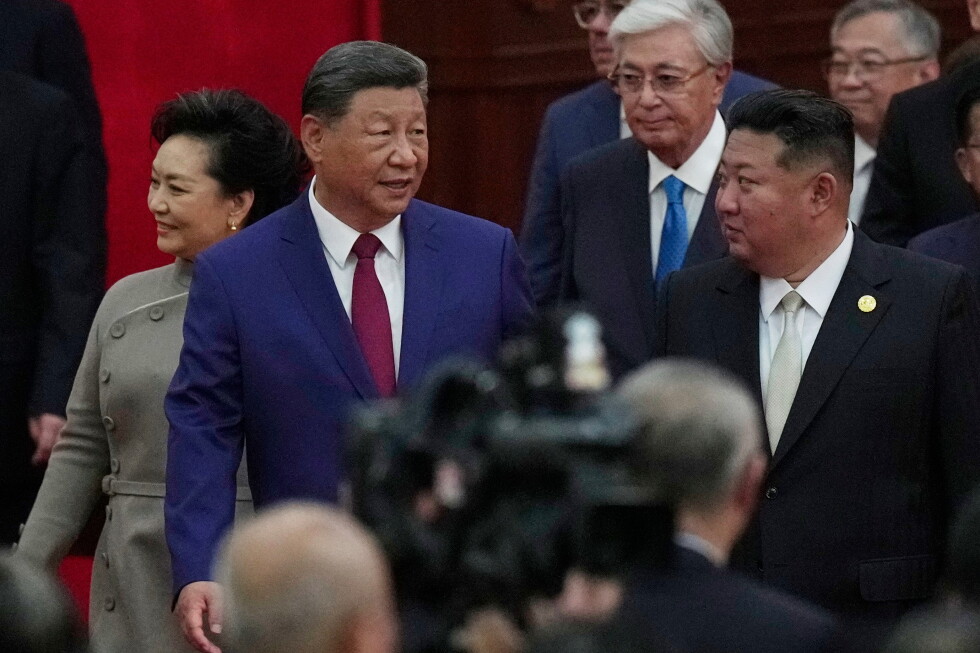
- Associated Press, "What to know about a rare visit by China's Xi to North Korea for talks with Kim Jong Un" (June 7, 2026), including the AP file photograph used for this article image.
- Reuters via Internazionale, "With China's Xi in North Korea, Kim to project confidence, defiance" (June 7, 2026).
- State Council of the People's Republic of China / Xinhua, "Xi to pay state visit to DPRK from June 8 to 9" (June 5, 2026).
- Rachel Minyoung Lee, 38 North, "North Korea's Posturing Toward China Ahead of Xi's Visit" (June 6, 2026).
- Associated Press, "North Korea calls the US push for its denuclearization 'anachronistic dream'" (June 7, 2026).
- Associated Press, "North Korean leader Kim showcases new warship ahead of visit by China's Xi" (June 6, 2026).
- Al Jazeera, "China's Xi headed to North Korea in bid to shore up ties" (June 5, 2026).