As of 2026-06-07 09:03 UTC, Armenians are voting in a parliamentary election that has been widely framed as a choice between Russia and the West. That framing is not wrong, but it is too neat. The live question is whether Prime Minister Nikol Pashinyan's Civil Contract party can convert a westward campaign message into a usable mandate after years of war trauma, pressure from Moscow, peace negotiations with Azerbaijan, and a fragmented opposition field.[1][2][4]
Associated Press reported from Yerevan that voting was underway Sunday as Pashinyan sought support for a new geopolitical course, while opposition forces included parties openly friendlier to Russia.[1] Reuters, in a pre-election dispatch, described the vote as a test of Pashinyan's effort to pursue peace with Azerbaijan and deepen ties with Western countries after the loss of Nagorno-Karabakh and the rupture of older security assumptions.[2]
The result will matter beyond the headline winner. Armenia does not need only a symbolic preference poll. It needs a parliament that can sustain hard votes: peace architecture, constitutional questions, Russian economic retaliation risk, EU cooperation, security-sector reform, and public trust after a campaign shadowed by allegations of outside pressure and domestic legal pressure on the opposition.[3][4][6]
Fact File
| Timestamp | Source | Key claim | Confidence note |
|---|---|---|---|
| June 7, 2026 | Associated Press | Voting is underway in Armenia's parliamentary election, with Pashinyan seeking a mandate for closer cooperation with the West while stressing that relations with Russia remain institutional.[1] | Strong for the live voting frame and reported statements; the final result was not known at this article's timestamp. |
| June 4, 2026 | Reuters | The election tests Pashinyan's peace drive with Azerbaijan and his attempt to move Armenia away from its traditional patron Russia toward Western partners.[2] | Strong for the campaign framing; implementation depends on the post-election parliamentary arithmetic. |
| June 6, 2026 | Reuters | Armenian authorities arrested six candidates from the pro-Russian Strong Armenia opposition party one day before the vote, according to state media; the party's leader Samvel Karapetyan rejects charges against him as politically motivated.[3] | Strong for the reported arrests and attribution; the legal merits remain contested. |
| June 2026 | European Parliament Research Service | The election is consequential for Armenia's geopolitical positioning, with undecided or unresponsive voters and in-country voting by Armenians living abroad identified as possible result-shaping factors.[4] | Strong for institutional analysis; it is a briefing, not an election result. |
| June 7, 2026 | Xinhua | Voting began with more than 2.48 million registered voters eligible to cast ballots at 2,005 polling stations, citing Armenia's Central Electoral Commission.[5] | Strong for current election-day scale; live turnout and final results require later CEC reporting. |
| June 2026 | OSCE ODIHR | ODIHR deployed an election observation mission after a needs assessment, covering campaign, media, election administration, voting, counting, and post-election process.[6] | Strong for observation scope; the final assessment will come after the election process. |
What Makes This Vote Different
The usual shortcut is to ask whether Armenia is choosing Moscow or Brussels. The harder reading is that voters are choosing how much political risk they are willing to assign to the next stage of independence. Pashinyan's government has pushed toward the European Union and the United States while trying to reduce dependence on Russian security guarantees that many Armenians now view as failed or conditional.[1][2] Moscow's counter-message, according to AP and European Parliament analysis, has been that a turn toward the EU could carry economic and strategic costs.[1][4]
That is why mandate size matters. A narrow Civil Contract victory would not mean Armenia can easily execute a western course. It could leave Pashinyan with enough authority to stay in office but not enough social permission to carry painful compromises. A larger victory would not remove pressure from Russia, Azerbaijan, domestic opposition, or the Armenian diaspora, but it would give the government more room to argue that voters knowingly accepted the costs of a changed alignment.
The opposition story is also more complicated than "pro-Russian bloc gains or loses." Reuters reported that six Strong Armenia candidates were arrested the day before the vote, and that the bloc is led by Russian-Armenian billionaire Samvel Karapetyan, already under house arrest on charges he rejects as politically motivated.[3] Even if the government argues the cases are legal rather than political, the timing means the result will be read through an election-integrity lens by both supporters and critics. A clean administrative vote can still carry a legitimacy dispute if major political actors believe the field was shaped by enforcement decisions.
The Mandate Is The Mechanism
For Armenia, the post-election test is not just foreign-policy branding. Peace with Azerbaijan, constitutional reform, EU cooperation, and reduced Russian leverage all require sequenced domestic decisions. Some are technical; some touch national memory and security identity. A government can sign statements abroad faster than it can build consent at home.
European Parliament researchers flagged two result-shaping uncertainties: high undecided or unresponsive voter shares in polling, and the fact that Armenians living abroad must be physically present in Armenia on election day to vote.[4] That second point matters because diaspora opinion can be loud in national debates while still being constrained inside the formal count. The electorate that votes inside Armenia may reward a pragmatic peace-and-Europe message, punish it as capitulation, or split the difference by producing a parliament too divided for fast movement.
Xinhua's election-day report, citing Armenia's Central Electoral Commission, gives the scale: more than 2.48 million registered voters and 2,005 polling stations.[5] Those numbers are not just administrative trivia. They remind us that this is a regular parliamentary election with local mechanics, precinct work, observers, proxies, voter lists, and turnout timing. The geopolitical interpretation will be written by outsiders within minutes, but the mandate will be built from ordinary ballots and later tested through the National Assembly's discipline.
Decision Impact
Next 24 hours: the key signal is not only the first vote-share headline. Watch for turnout, the margin between Civil Contract and the leading opposition forces, complaints from major parties, and whether preliminary results show a governable bloc or a fragmented chamber. Claims about a decisive east-west turn should be treated cautiously until the Central Electoral Commission and observer missions publish more complete information.[5][6]
Next 7 days: watch the legitimacy frame. If losing parties focus on the arrests, administrative pressure, or foreign interference claims, the next government may face a contest over process before it can govern on substance.[3][6] If the observation mission's early signals are broadly calm, the policy debate can move more quickly toward peace, EU cooperation, and Russian retaliation risk.
Next 30 days: the test becomes whether campaign language turns into parliamentary scheduling. A real mandate should show up in committee assignments, coalition discipline, constitutional planning, and concrete engagement with Brussels, Washington, Moscow, and Baku. If the election produces only a narrow survival result, foreign-policy ambition may outpace domestic bandwidth.
Scenarios
Base case: Civil Contract remains the central governing force but with a mandate that is strong enough to continue the westward and peace agenda only carefully. The government claims voter authorization; critics argue the country is being pushed too fast. Policy advances, but each step requires visible domestic management.[1][2][4]
Upside case: Pashinyan wins a clearer-than-expected parliamentary mandate, opposition fragmentation limits obstruction, and observer feedback is not dominated by process concerns. That would let Yerevan move faster on EU cooperation and peace implementation while telling Moscow that the shift has electoral backing.[4][6]
Downside case: the vote produces a narrow or contested result, the arrests become the organizing grievance for the opposition, and Russia finds openings to pressure Armenia economically or politically. In that version, the election does not reverse the westward course, but it weakens the government's ability to execute it.[3][4]
Action Checklist
- Treat the first result alerts as provisional until official CEC reporting and observer statements catch up.
- Separate vote outcome from mandate quality: a win, a majority, and a durable reform mandate are different things.
- Watch whether opposition complaints center on normal campaign argument or on claims that the field itself was distorted.
- Track Russian economic and diplomatic reactions before assuming the election alone settles Armenia's external alignment.
- Revise the read if ODIHR or other observers report serious voting, counting, media, or administrative problems.[6]
The election is therefore less a clean geopolitical switch than a stress test of Armenia's political carrying capacity. Voters can endorse a direction, but parliament has to absorb the costs. The country may wake up Monday with a winner; it will still need to find out whether that winner has enough authority to govern through the next round of pressure.[1][2][4][6]
Sources
- Associated Press, "Armenians go to the polls under Russian pressure aimed at preventing a drift toward West" (June 7, 2026).
- Reuters via Internazionale, "Armenia's election to test Pashinyan's peace drive after war defeat" (June 4, 2026).
- Reuters via MarketScreener, "Armenia arrests six candidates for pro-Russian opposition day before vote" (June 6, 2026).
- European Parliamentary Research Service, "Armenia's choice: High stakes ahead of the 7 June 2026 parliamentary elections" (June 2026).
- Xinhua, "Voting underway in Armenia's parliamentary elections" (June 7, 2026).
- OSCE ODIHR, "Armenia, Parliamentary Elections, 7 June 2026" (election observation mission page).
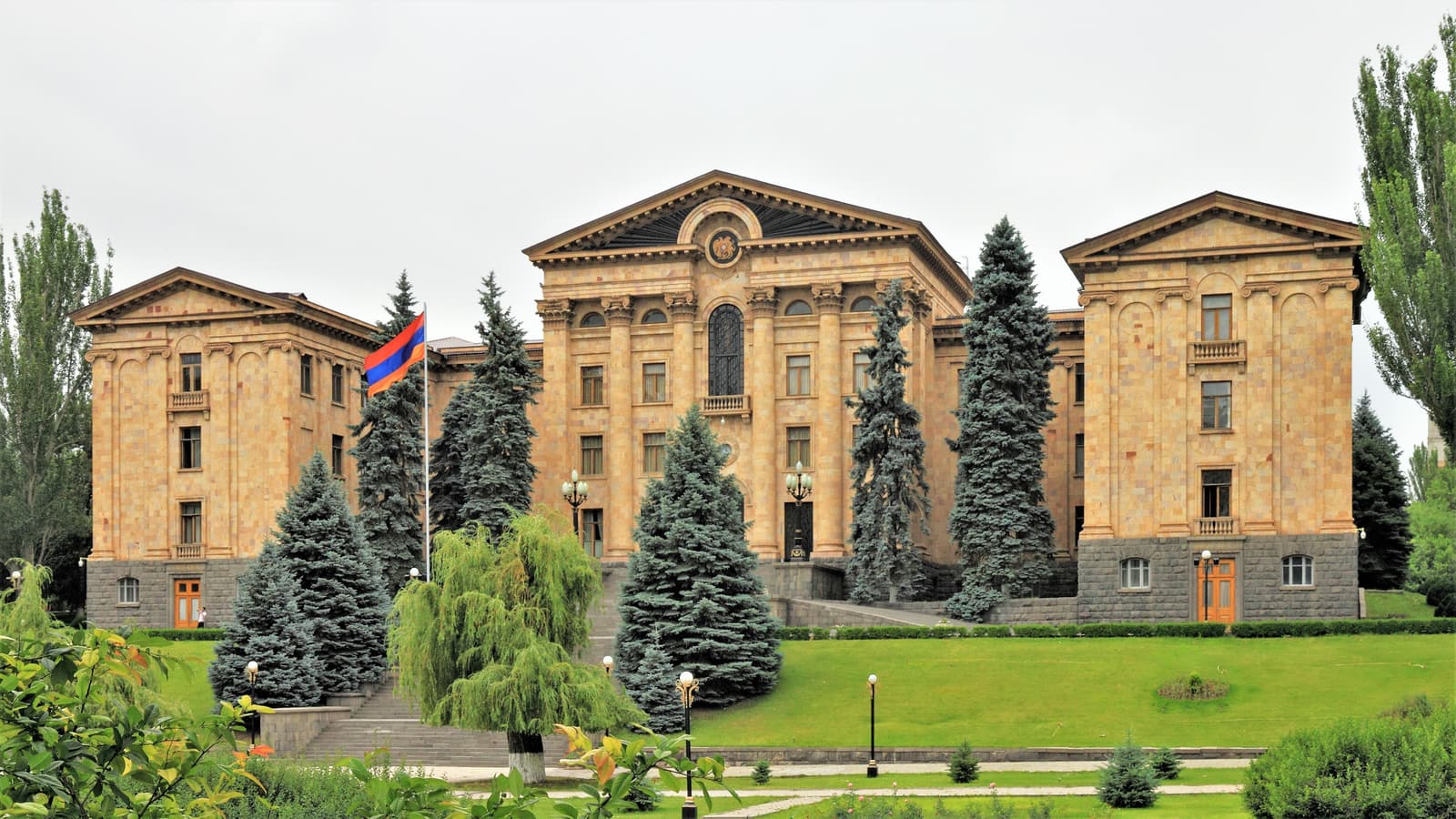
- Wikimedia Commons, "File:2014 Erywan, Budynek Zgromadzenia Narodowego Republiki Armenii.jpg" (2014 photograph by Marcin Konsek).