As of 2026-05-16 12:03 UTC, the Vatican's newest artificial-intelligence move is not another abstract warning about technology. Pope Leo XIV has approved an Interdicasterial Commission on Artificial Intelligence, a cross-office body meant to coordinate how the Holy See studies, governs, and speaks about AI across doctrine, education, communications, science, social teaching, and human development.[1][2]
That matters because the announcement lands in the same week as two other signals. On May 14, Leo used a visit to Sapienza University of Rome to warn that AI and high-tech weapons can deepen the tragedy of war when humans are allowed to treat machine-assisted decisions as if they were morally weightless.[3][4] AP also reports that the pope has signed his first encyclical, expected to address AI through the lens of human dignity, labor, justice, and peace.[1] The commission is the institutional piece of that sequence: it turns a papal theme into a standing coordination problem inside the Vatican bureaucracy.
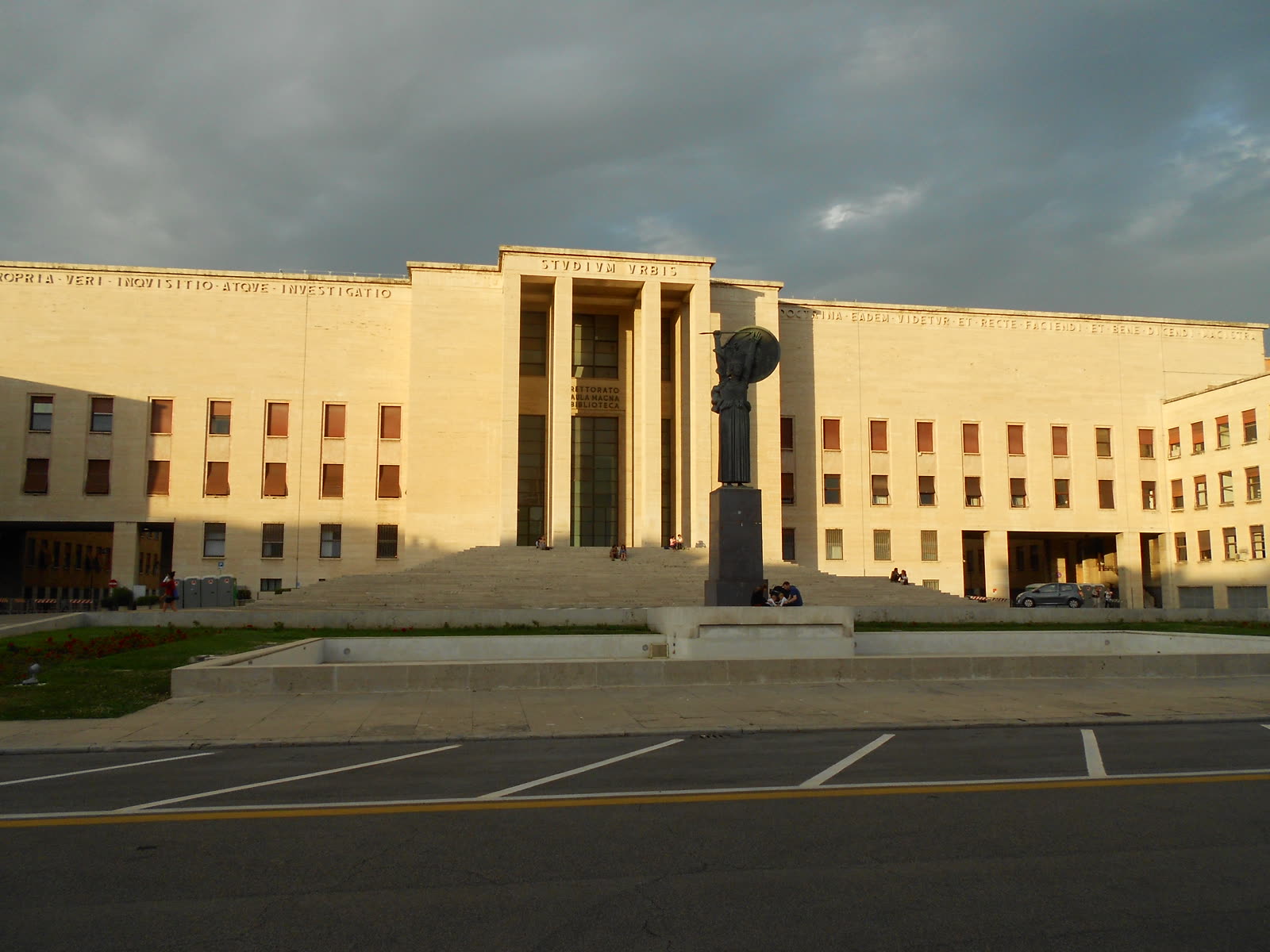
Image context: the cover uses a real photograph of Sapienza University of Rome's headquarters by Góngora.[7] It fits this report because Leo's May 14 campus speech supplied the public moral frame for the May 16 AI commission: universities, research, war, and human responsibility belong in the same argument, not in separate rooms.[3][4]
Fact File
| Item | Verified now | Confidence note |
|---|---|---|
| New body | Pope Leo XIV approved an Interdicasterial Commission on Artificial Intelligence; Vatican News reported the rescript on May 16, 2026.[2] | High; Vatican News is an official Vatican media outlet. |
| Coordinator | The Dicastery for Promoting Integral Human Development will coordinate the commission for its first year.[2] | High; direct Vatican News report. |
| Membership | Seven Vatican bodies are represented, including Doctrine of the Faith, Culture and Education, Communication, the Pontifical Academy for Life, the Pontifical Academy of Sciences, and the Pontifical Academy of Social Sciences.[2] | High; direct Vatican News report. |
| Immediate context | AP says the Vatican described the commission as a response to AI's accelerating use and its possible effects on human beings and humanity as a whole.[1] | High; AP report based on Vatican announcement. |
| Public warning | Two days earlier, Leo warned at Sapienza that AI in military and civilian contexts must not erase human responsibility or intensify conflict.[3][4] | High; Vatican Press Office transcript and AP report. |
| Policy boundary | The commission is a coordination mechanism, not a public AI law, product rule, or final encyclical text.[1][2] | Medium-high; this is an inference from what the announced body is and is not. |
What Changed Today
The Vatican already had language on AI. In January 2025, the Dicastery for the Doctrine of the Faith and the Dicastery for Culture and Education published Antiqua et Nova, a long note distinguishing human intelligence from artificial intelligence and warning against reducing people to functional outputs.[6] Pope Leo also made AI part of his papal program shortly after his 2025 election, identifying it as a major challenge for human dignity, justice, and labor.[5]
What changed on May 16 is the machinery. Vatican News says the new commission is designed to facilitate collaboration and information exchange among the participating Vatican bodies, including work on AI-related activities, projects, and policies within the Holy See.[2] That is narrower than a global AI regulator and broader than a one-off study paper. It gives the Vatican a place to reconcile doctrine, education, media practice, biomedical ethics, scientific advice, and social teaching before the pope's AI language becomes scattered across separate offices.
The structure also hints at the Vatican's theory of the problem. This is not being treated only as a communications issue, only as a doctrine issue, or only as a technical issue. The member offices map the Vatican's main AI concerns: what AI claims about the human person, how it changes schooling and culture, how it affects health and life sciences, how it shapes public communication, and how it should be understood in social and economic terms.[2][6]
The Sapienza Signal
Leo's Sapienza speech made the commission easier to read. The pope did not frame AI as a novelty gadget. He placed it inside a wider argument about war, young people's future, universities, education budgets, and the moral burden of research.[3] In the Press Office transcript, the AI section follows a warning about rising military spending and precedes a call for study, research, and investment to move toward life rather than destruction.[3]
AP's account sharpened the news edge: Leo linked AI-directed warfare and advanced weaponry to an escalating pattern of conflict, while calling for better monitoring of AI in military and civilian uses.[4] The important word there is monitoring. The pope's argument is not that every AI system is intrinsically illegitimate. It is that AI becomes dangerous when it helps institutions evade responsibility, speed up violence, or turn human judgment into a technical afterthought.[3][4][6]
Sapienza was also an unusually apt stage. It is one of Europe's largest universities, and the Vatican Press Office account emphasized the campus as a place of research, encounters, and public responsibility.[3] By making the speech there, Leo put the AI issue in front of students and scholars rather than only diplomats or church officials. The new commission now pulls that same concern back into Vatican governance.
Why The Commission Is Broader Than "AI Safety"
The Vatican's vocabulary overlaps with secular AI-safety debates, but it is not identical. In Antiqua et Nova, the central distinction is anthropological: current AI systems can imitate certain outputs of human intelligence, but they do not share the embodied, relational, moral, and spiritual dimensions of human knowing.[6] That is why the commission's membership matters. Doctrine, education, communication, life ethics, science, and social sciences are all needed if the concern is not only whether a model fails, but whether institutions start treating people as replaceable components.
AP's May 16 report says the expected encyclical will likely connect AI to Catholic social teaching, including labor, justice, peace, and human dignity.[1] That fits Leo's first papal framing in 2025, when he identified AI as a major challenge for humanity and connected it to human dignity, justice, and labor.[5] The analogy to Leo XIII's industrial-era social teaching can be overplayed, but it explains the Vatican's posture: AI is being treated less as a sectoral technology story and more as a social-order story.
The commission's first-year coordination by the Dicastery for Promoting Integral Human Development reinforces that reading.[2] The point is not simply to ask whether the Holy See may use chatbots or automation internally, though internal policy is part of the brief. The larger question is how AI affects development, work, education, peace, health, and the claim that technology should serve the person rather than define the person.[1][2][6]
What Remains Unclear
The main uncertainty is timing. AP reports that Leo has signed his first encyclical and that it is expected to be released in the coming weeks.[1] Until the text is public, the commission should not be mistaken for the encyclical itself.
It is also unclear how operational the body will become. A commission can coordinate policy, collect expertise, and prevent offices from contradicting one another. It cannot by itself force governments, companies, militaries, or universities to accept Vatican principles. The Vatican's leverage is moral, diplomatic, educational, and institutional, not regulatory in the way the European Union's AI Act is regulatory.[1]
Still, the hard news is that Leo is building an internal lane before the encyclical reaches the public. That sequencing matters. If the encyclical becomes a major papal statement on AI, the Vatican will already have a body charged with making the topic legible across its own offices. If the encyclical is more restrained than expected, the commission still signals that AI is no longer a side issue for the Holy See.
What To Watch
The next checkpoint is the expected encyclical release window.[1] The key question is whether Leo writes mainly in broad moral language or gives sharper tests for labor displacement, autonomous weapons, education, healthcare, data-center resource use, and institutional accountability.
The second checkpoint is membership practice. If the commission produces public notes, internal rules, educational guidance, or Vatican procurement/use policies, it will become more than a symbolic body. If it only convenes occasionally, the May 16 announcement will matter chiefly as a sign of papal priority.
The third checkpoint is diplomatic uptake. Leo's Sapienza speech connected AI to Ukraine, Gaza and the Palestinian territories, Lebanon, and Iran.[3][4] That makes future Vatican interventions on autonomous weapons, military targeting, and human responsibility especially important. The commission's real test is whether it can keep those questions joined: not AI ethics over here and war over there, but one argument about who remains answerable when technology accelerates consequential choices.
Sources
- Associated Press, "Vatican prepares for Pope Leo XIV's AI-focused first encyclical" (May 16, 2026).
- Vatican News, "Pope approves creation of Interdicasterial Commission on Artificial Intelligence" (May 16, 2026).
- Holy See Press Office, "Pastoral Visit of the Holy Father Leo XIV to 'La Sapienza' University of Rome" (May 14, 2026).
- Associated Press, "Pope Leo XIV warns of AI and weaponry leading to global annihilation" (May 14, 2026).
- Associated Press, "Pope Leo XIV identifies AI as a main challenge for humanity" (May 10, 2025).
- Dicastery for the Doctrine of the Faith and Dicastery for Culture and Education, Antiqua et Nova: Note on the Relationship Between Artificial Intelligence and Human Intelligence (Jan. 28, 2025).
- Wikimedia Commons, "File:La Sapienza.jpg" - source page for the Sapienza University of Rome photograph by Góngora.