As of 2026-06-19 21:31 UTC, the Terzan 5 story has shifted from classification cleanup to a live argument about how the Milky Way's central bulge formed. NASA and ESA say new analysis combining Webb's near-infrared observations with 12 years of Hubble data shows that Terzan 5 is not a normal globular cluster, but a rarer "bulge fossil fragment": a dense, self-enriching stellar system that preserved multiple generations of stars instead of dissolving into the galaxy's crowded center.[1][3]
The headline matters because globular clusters are usually treated as old, compact systems with broadly coeval stars. Terzan 5 has now broken that simple category. The new study reports two well-measured populations at 12.5 and 4.7 billion years old, plus evidence for later star-formation episodes at about 3.8 and 2.5 billion years ago.[2] That age spread changes the interpretation. Terzan 5 is no longer just a picturesque star ball in Sagittarius. It becomes a surviving shard of the kind of massive early clumps that may have helped build the Milky Way's bulge.
Fact File
| Item | What is known now | Confidence note |
|---|---|---|
| Current finding | NASA says Webb plus Hubble data show Terzan 5 is not a globular cluster as once classified, but a bulge fossil fragment.[1] | Strong for the release claim; scientific interpretation rests on the published A&A analysis. |
| Star generations | The A&A paper identifies old and younger components at 12.5 +/- 0.5 and 4.7 +/- 0.5 billion years, with signs of additional younger components around 3.8 and 2.5 billion years.[2] | Strong for measured components; the youngest evidence is described more cautiously. |
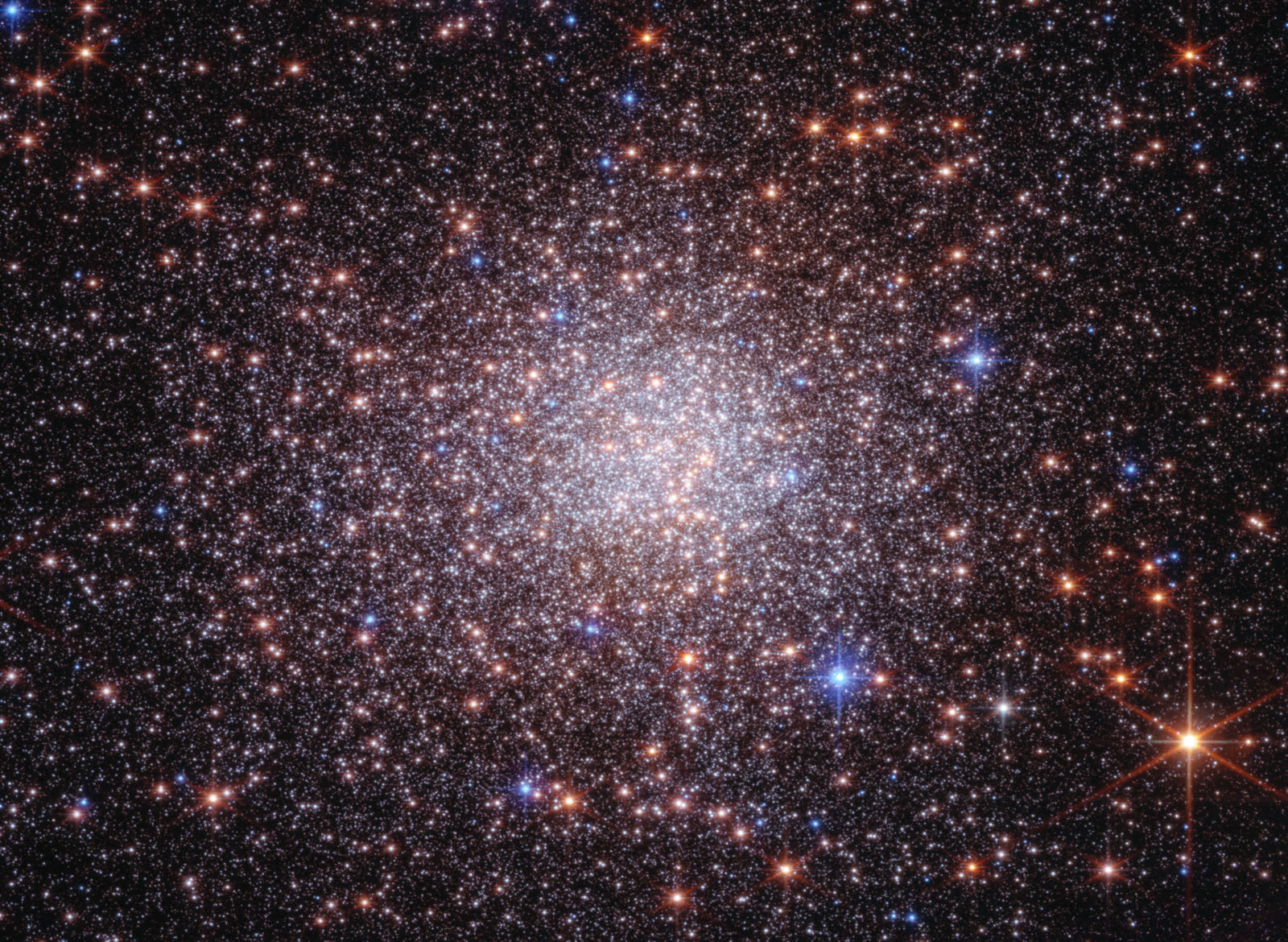
| Location and scale | NASA's image page places Terzan 5 22,000 light-years away in Sagittarius and says it contains about 2 million solar masses in a system only a few tens of light-years across.[4] | Strong for object metadata from the image release. |
| Method | Webb's infrared view helps see through dust, while the long Hubble baseline lets researchers separate Terzan 5 members from foreground and bulge stars by proper motion.[1][3] | Strong; this is the core observational logic. |
| Prior baseline | ESA/Hubble's 2016 release already framed Terzan 5 as a rare fossil relic with two stellar populations, making the 2026 result an expansion rather than a brand-new suspicion.[5] | Strong historical baseline; the new claim adds more populations and a firmer class label. |
What Changed
The key change is not that astronomers noticed Terzan 5 for the first time. They have been uneasy about it for years. In 2016, Hubble-based work already found two stellar populations and argued that Terzan 5 looked like a fossil survivor from the Milky Way's early bulge assembly.[5] That was suggestive, but two populations left a loophole. A later interaction with another cluster or molecular cloud could, in principle, have delivered gas and triggered another round of star formation.
The new Webb and Hubble analysis tightens that loophole. With evidence for up to four star-formation episodes, the simpler external-fueling explanation becomes harder to keep. NASA's release says the four-generation pattern rules out explanations based only on a later interaction with another object.[1] The more coherent reading is that Terzan 5 began as a much larger structure, deep enough gravitationally to hold onto gas and supernova-enriched material, then made new stars in separate episodes while most similar clumps merged into the bulge.[1][2][3]
That is why the phrase "self-enriching" matters. In small systems, supernova explosions can blow enriched material away. In a sufficiently massive system, some of that material can remain available for later stars, leaving a chemical and age record. The 2026 paper's abstract describes Terzan 5 as having distinct populations with iron abundances spanning roughly from sub-solar to super-solar values, and it frames the object as a possible remnant of primordial bulge-building clumps.[2] In plain English: Terzan 5 may have kept a local memory of galactic construction that most of the bulge has mixed beyond easy reconstruction.
Why It Matters
The public image is a crowded snow-globe field of stars, but the scientific value is membership sorting. The Milky Way bulge is full of unrelated foreground and background stars, with dust complicating optical observations. Webb contributes infrared depth; Hubble contributes time. By comparing observations separated by years, researchers can measure small proper motions and decide which stars move with Terzan 5 rather than with the surrounding bulge.[1][3] Without that sorting step, the image would be beautiful but much less diagnostic.
This also links local astronomy to deep-time galaxy formation. ESA/Webb's release states the broader hypothesis plainly: early galaxies may have contained massive gas clumps that migrated inward and merged to form bulges.[3] Terzan 5 is useful because it is nearby enough to resolve individual stars but ancient enough to speak to that clumpy assembly process. If it really is a surviving bulge fossil fragment, it offers a local, star-by-star analog for structures that Webb sees in much more distant young galaxies.[3]
The uncertainty boundary is important. This is not a claim that Terzan 5 alone explains the Milky Way's entire bulge. It is one object, with one unusually rich history, and the team plans to examine 40 to 50 additional bulge clusters to see whether more examples exist.[1][3] The story gets stronger if those surveys find a family of similar fossil fragments. It gets narrower if Terzan 5 remains almost alone.
What To Watch
Next 30 days: watch for how the A&A paper is cited by follow-up reporting from the American Astronomical Society meeting and by observatory teams. The strongest secondary coverage should preserve the distinction between "not a normal globular cluster" and "direct proof of every bulge-formation mechanism."[1][2]
Next research phase: the object list matters. If Ferraro's team finds more multi-age systems among the inner bulge's globular-cluster-like objects, "bulge fossil fragment" becomes a population category rather than a special label for Terzan 5 and Liller 1.[3]
Falsifier: the article's interpretation would weaken if future proper-motion, chemical, or photometric work showed that the apparent younger populations are mostly contamination from unrelated bulge stars, or if the age spread could be explained without self-enrichment. For now, the combined Webb-Hubble method is precisely aimed at reducing that contamination problem.[1][2][3]
The useful takeaway is compact: Terzan 5 is newsworthy because it turns a star cluster label into a formation record. The same image that looks like a dense pile of lights is now being read as a stratified archive: old stars from the Milky Way's assembly era, younger stars made after enrichment, and a surviving object that did not fully mix into the galactic center around it.[1][2][4]
Sources
- NASA Science, "NASA Webb, Hubble Reveal History of Relic of Milky Way's Formation" (June 16, 2026).
- G. Zullo et al., "The multi-age stellar populations of Terzan 5 as revealed by JWST," Astronomy & Astrophysics 709, A212 (2026).
- ESA/Webb, "Webb and Hubble reveal history of relic of the Milky Way galaxy's formation" (June 16, 2026).
- NASA Science, "Bulge Fossil Fragment Terzan 5 (Webb and Hubble Image)" image asset page (release date June 16, 2026).
- ESA/Hubble, "Hubble discovers rare fossil relic of early Milky Way" (Sept. 7, 2016).