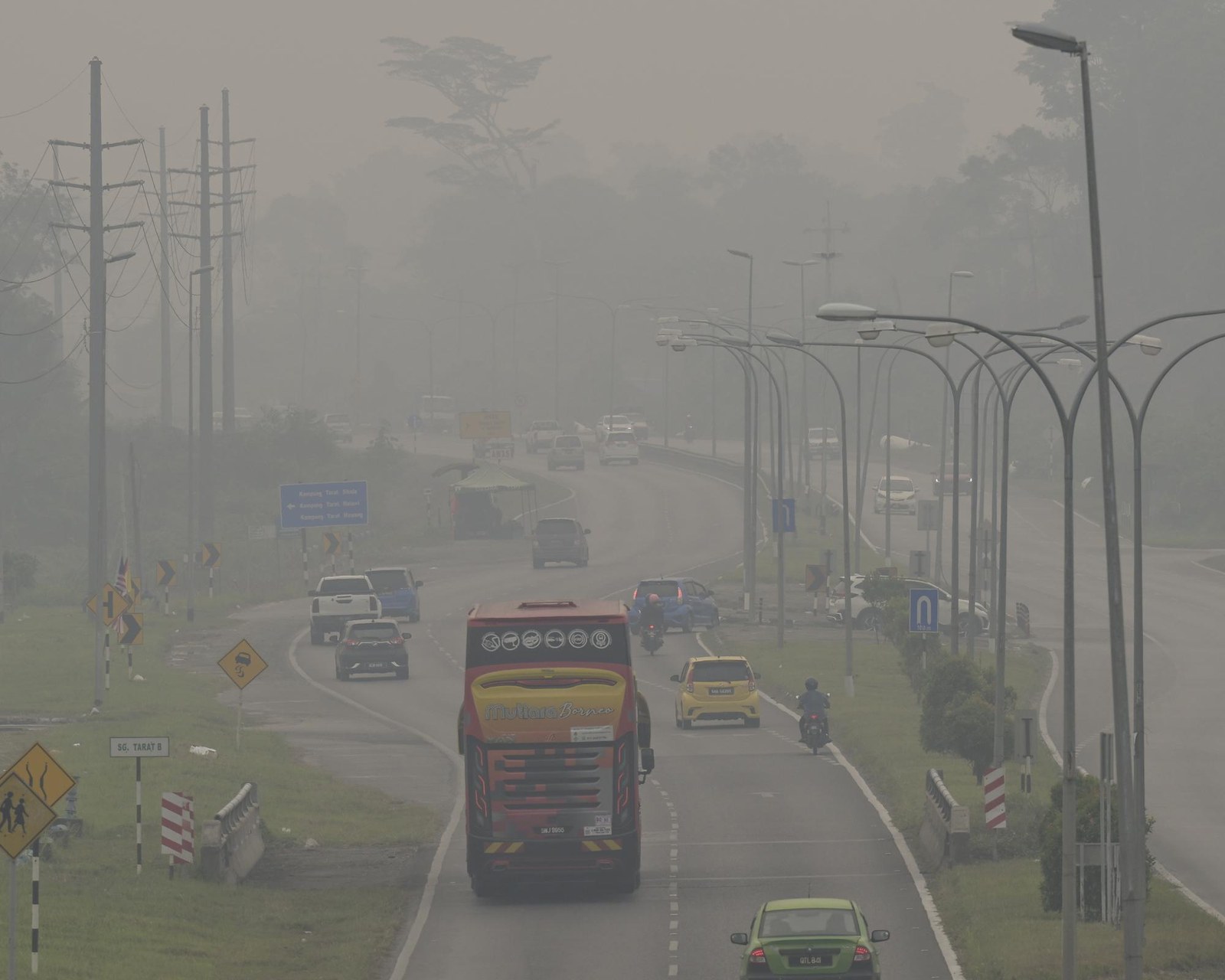
As of 2026-09-04 18:37 UTC (2026-09-05 02:37 MYT), a haze emergency was in force across Serian Division in the Malaysian state of Sarawak. Malaysia's king consented to the declaration on Friday after the Air Pollutant Index at Serian crossed the government's emergency trigger of 500.[1][2]
The number moved quickly. The Department of Environment's hourly history records 408 at 8 p.m. Thursday. Serian first passed 500 at 8 a.m. Friday, with a reading of 502, reached 521 at 2 p.m. and stood at 515 at 5 p.m. By 2 a.m. Saturday it had fallen to 435.[3][11] That was a substantial decline, not an all-clear: it was still above 400, and no source reviewed for this report said the emergency had been revoked.[4][11]
The live question has therefore shifted from whether Serian touched a threshold to what the declaration changes on the ground. Sarawak's disaster chief said detailed rules would specify which activities, premises and services could operate. In parallel, environmental enforcement was being intensified and 647 schools across 12 Sarawak education districts were scheduled to close for five days from Monday.[1][4][5]
What was verified at the cutoff
| Local time and source | Verified development | Confidence and uncertainty boundary |
|---|---|---|
| Thursday, 8 p.m. — Department of Environment | Serian's API was 408, already above 400.[3] | High for that snapshot. API is updated through the day, so the figure should not be detached from its time. |
| Friday, 8 a.m. to 5 p.m. — DOE / CNA / AP | DOE's hourly history records 502 at 8 a.m., the first reading above 500, and a 2 p.m. peak of 521. CNA described 510 at 9 a.m. as the first breach and reported 515 at 5 p.m.; AP also reported 521.[2][10][11] | High for the official series. CNA's “first” is one hour later than DOE's record, so this report uses the DOE chronology. |
| Friday afternoon — PMO / Sarawak SDMC | The king consented to an emergency throughout Serian Division after advice from federal and state authorities. Officials said implementation details would follow in emergency standard operating procedures.[1] | High for the declaration. At the cutoff, the reviewed public account did not contain the complete activity-by-activity rule set. |
| Friday evening — Sarawak Education Department | 647 primary and secondary schools under 12 district offices were ordered to close from September 7–11 and switch to home-based teaching.[5] | High for the announced school plan. The order extends beyond Serian and can be revised if the department issues a later notice. |
| Saturday, 2 a.m. — Department of Environment | DOE's fixed hourly series showed Serian at 435. The department had raised monitoring and preparedness to its highest level and intensified patrols and open-burning enforcement.[4][11] | High for the latest fixed reading available at the cutoff, not proof of sustained improvement. One lower reading neither removes smoke already present nor cancels an emergency order. |
The declaration is a switch, not a clean-air reading
Five hundred matters because Malaysia's National Haze Action Plan uses it as the point at which a disaster emergency may be declared. It is an administrative threshold for considering a declaration; the declaration, not the reading alone, moves authorities into emergency rules and protective measures. It is not a border between harmful and harmless air.
That distinction is easy to lose when an index falls from 521 to 435. The later figure was below the declaration trigger but remained above 400. Malaysia's occupational-safety guidance warns that readings above 400 increase the likelihood of adverse health effects for everyone and says outdoor work should stop when its risk cannot be adequately controlled.[9][11] Officials had said the higher, 500-point threshold would activate emergency workplace closure except for essential services.[1][2]
Nor is the API a head count of fires or an instantaneous particle measurement. DOE calculates it from the highest sub-index among monitored pollutants; its particulate readings use 24-hour averages, while some gases use shorter windows.[12] A photograph can show lost visibility, and a satellite can locate likely hotspots, but neither substitutes for a time-stamped reading at Serian's monitoring station. The useful public record keeps those three kinds of evidence separate.
The same care applies to the scope of closure. Before the declaration, Sarawak officials said an emergency would close public- and private-sector activity except essential services. After the declaration, the state disaster chief said this was not the same as a COVID-era movement-control order and that forthcoming procedures would identify the activities, premises and services allowed to operate.[1][2] Until those procedures are published, “emergency declared” should not be rewritten as a guessed list of closed businesses.
Three response tracks are already visible
Exposure control is moving first. Residents were advised to stay home, reduce outdoor activity and use an N95 or equivalent when they must go out. Malaysia's occupational-safety guidance tells employers to minimize outdoor work, reassign susceptible workers where possible, provide and fit-test suitable respirators for necessary outdoor work, and stop an activity if risk above API 400 cannot be mitigated.[1][9] CNA found a Serian pharmacy sold out of masks and reported residents seeking care for breathing problems, which turns “wear a respirator” into a supply question as well as advice.[2]
Schools now have a dated plan. Sarawak's Education Department said 563 primary schools serving 108,477 pupils and 84 secondary schools serving 90,082 pupils would close from September 7 through 11. The affected districts include Serian, Kuching, Samarahan and nine others; home-based teaching is supposed to continue.[5] This is broader than the legal geography of the Serian emergency because smoke and unhealthy readings do not stop at a division boundary.
Monitoring and suppression are being widened. DOE said it would strengthen field operations under the haze plan, patrol high-risk peatland, forest, landfill and agricultural locations, and investigate local open burning. It also identified two fires in Mukah—not Serian—under observation, a reminder not to assign every plume to one source without transport evidence.[4] NADMA, the national disaster agency, was coordinating cloud seeding in Sarawak, Kedah and Perlis from September 3–5.[6] Cloud seeding is a mitigation attempt dependent on suitable clouds; a flight or a brief shower is not evidence that the regional fire load has ended.
The smoke problem is larger than Serian
Regional observations support a substantial transboundary component while leaving room for local sources and measurement limits. On August 26, the ASEAN Specialised Meteorological Centre activated its highest alert level for the southern ASEAN region after observing moderate-to-dense smoke from Kalimantan hotspot clusters and transboundary haze drifting north from West Kalimantan. It warned that persistent dry conditions could intensify the episode.[7]
Singapore's Meteorological Service separately reported smoke plumes from southern and central Sumatra and several parts of Kalimantan drifting towards Singapore on September 4. It said dry conditions could leave Singapore affected by transboundary haze if the fires persist.[8] AP reported that Indonesia's Forestry Ministry had detected 717 likely fire hotspots nationwide since August 1, including 103 active in the preceding 24 hours, alongside firefighting and enforcement activity.[10]
Taken together, those sources make “smoke linked to fires in Indonesia” a well-supported regional finding.[7][8][10] They do not establish the contribution of each hotspot to the Serian monitor, identify the owner or cause of every fire, or guarantee which way smoke will travel next. Wind, rain, fire intensity and cloud-obscured detection can all change the picture.
The next 24 hours, seven days and 30 days
Over the next 24 hours, the most consequential document is the detailed emergency procedure: which workplaces close, which services remain essential, when restrictions take effect, and how workers who cannot stay home are protected. Hourly API readings matter, but they should be read as a sequence. Mask availability, clinic demand and clear instructions in the communities covered by the order are equally operational indicators.
Over the next seven days, the test moves to continuity. The 647-school closure is scheduled to run September 7–11; authorities will need to show whether home-based teaching is reachable, whether additional districts cross closure thresholds, and whether schools can reopen on evidence rather than the calendar alone.[5] The regional outlooks warn that dry conditions and persistent fires could prolong the transboundary-haze risk.[7][8]
Over the next 30 days, success means more than Serian staying below 500. It would require a sustained decline through lower API bands, fewer active fires and smoke plumes, reliable reopening criteria, and enforcement records that distinguish local burning from transported haze. Dispersion can improve readings without removing sources; sustained relief requires fires to stop or be extinguished.
Three paths from the emergency
These are operating scenarios, not probability forecasts.
Base case — dangerous air oscillates below and above the trigger. Serian's API varies with winds and showers, the emergency stays in place, and school and workplace rules are adjusted as readings change. Trigger: repeated official updates remain in very unhealthy or hazardous bands, with regional hotspots and smoke still present.
Upside — sustained clearing supports an orderly reopening. Rain, changing winds and successful fire suppression reduce smoke across western Sarawak; repeated station readings—not one hourly dip—move down through safer bands. Trigger: authorities publish several reporting cycles of improvement, lift the emergency formally and attach reopening decisions to stated health criteria.
Downside — another surge widens the disruption. Serian returns above 500 or another locality reaches the emergency threshold while mask, clinic or essential-service capacity tightens. Trigger: a new emergency declaration, extended school closures, additional non-essential workplace restrictions, or official reports of rising respiratory demand.
What people and institutions can do now
- Residents: use the official APIMS readings and attach a time to every number. Follow the issued emergency instructions rather than social-media reconstructions of what “emergency” means.[1][3]
- People with symptoms or chronic heart or lung conditions: reduce exposure and seek medical care when breathing difficulty or other serious symptoms occur. Occupational guidance specifies a suitable N95 respirator and fit testing for outdoor work; simply possessing a face covering is not the same as using the recommended protection correctly.[9]
- Employers: identify outdoor tasks, susceptible staff, indoor-air controls and essential roles now. Apply the published emergency procedure as soon as it appears instead of treating a reading below 500 as permission to resume normal exposure.[1][9]
- Schools and families: follow Sarawak Education Department updates for the September 7–11 closure and home-learning arrangements; do not infer one district's status from another station's reading.[5]
- Newsrooms: distinguish the emergency trigger, the current API, and the legal status of the declaration. Do not call 435 “safe,” and do not present 521 without its 2 p.m. Friday time stamp.[2][10][11]
- Witnesses to fire or open burning in Malaysia: DOE asks the public to contact Fire and Rescue via 999 or its toll-free line, 1-800-88-2727.[4]
Update and invalidation conditions: this report's central finding—that Serian has crossed the emergency threshold while detailed operating rules and a regional smoke episode are still unfolding—should be updated when the full emergency procedures are published, when authorities formally lift or widen the declaration, or when a sustained run of monitoring data changes the exposure picture. Its regional-source assessment would need revision if later transport analysis or fire investigations materially reassign the smoke reaching Serian.
The emergency began with a number, but it will be judged by the handoffs after it: from threshold to declaration, declaration to detailed rules, rules to protection, and temporary clearing to fewer fires. At the cutoff, threshold-to-declaration was complete; the later handoffs were not.
Sources
- BERNAMA, “Haze: Serian Emergency Declaration A Safety Measure To Protect Residents — Uggah” (September 4, 2026) — declaration scope, resident advice and the boundary between the emergency and still-forthcoming operating procedures.
- Izzah Aqilah Norman, CNA, “Malaysia declares state of emergency in Sarawak's Serian after air pollutant index exceeds 500” (updated September 4, 2026) — hourly readings, planned restrictions, resident accounts and source page for Fadza Ishak's cover photograph.
- Department of Environment Malaysia, “Serian hourly API history through 8 a.m. MYT on September 4, 2026” — fixed official series recording the rise from 408 at 8 p.m. Thursday to the first reading above 500.
- BERNAMA, “Serian Haze Emergency: DOE Steps Up Monitoring, Enforcement” (September 5, 2026 MYT) — later Serian reading, DOE responsibilities, patrols, local fires under observation and public reporting contacts.
- BERNAMA, “Haze: 647 Schools In S'wak To Close Temporarily — Education Dept” (September 4, 2026) — September 7–11 closures, affected districts, enrolment and home-learning plan.
- Malaysia National Disaster Management Agency, “Cloud Seeding Operations in Sarawak, Kedah and Perlis” (September 4, 2026) — official September 3–5 operation window and mitigation purpose.
- ASEAN Specialised Meteorological Centre, “Activation of Alert Level 3 for the Southern ASEAN Region” (August 26, 2026) — observed Kalimantan smoke, northward transboundary transport and dry-weather risk.
- Meteorological Service Singapore, “Haze Situation Update (4 September 2026)” — observed regional smoke transport, dry-weather outlook and the boundary between immediate readings and next-day exposure planning.
- Department of Occupational Safety and Health Malaysia, “Guidelines for the Protection of Employees Against the Effects of Haze at Workplaces” — employer risk controls, susceptible-worker protection, outdoor-work limits and N95 fit guidance.
- Associated Press, “Malaysia declares emergency in Sarawak town as haze reaches critical level” (September 4, 2026) — independent report on the declaration, Serian reading and Indonesian firefighting and enforcement.
- Department of Environment Malaysia, “Serian hourly API history through 2 a.m. MYT on September 5, 2026” — fixed official series for the first threshold crossing, daily peak and latest reading used at this report's cutoff.
- Department of Environment Malaysia, “A Guide to Air Pollutant Index in Malaysia” — official pollutant sub-index calculation and averaging periods.