As of 2026-10-13 05:34 UTC. A research jet has flown through the dispersing exhaust of a rocket launched from northern Sweden, testing a way to measure what launch vehicles leave in the atmosphere. ESA's October 6 account of the Firewall campaign describes a completed operation whose scientific evaluation is still ahead: researchers must now establish how well the measurements worked.[1]
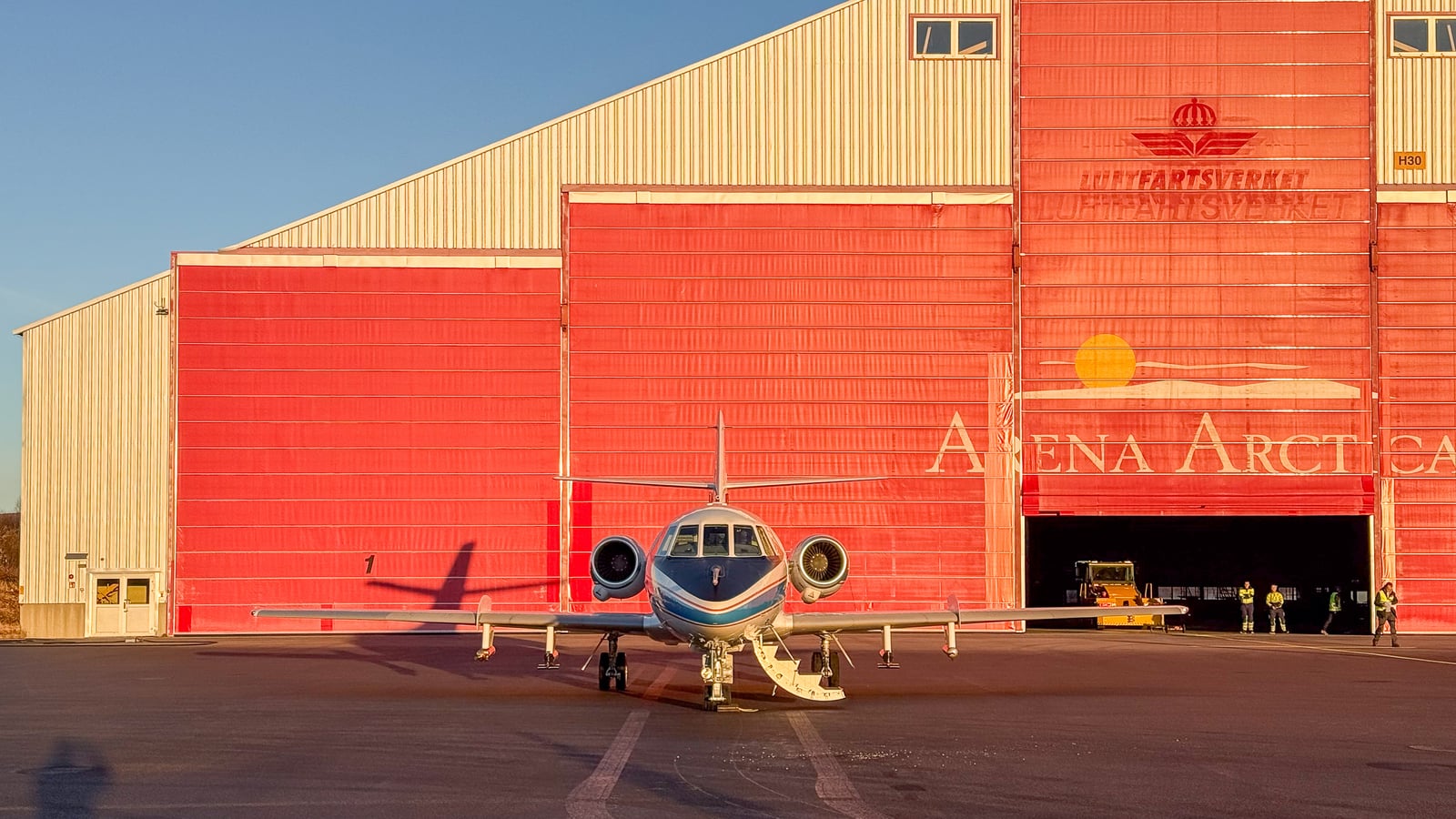
The flight accompanied DLR's MAPHEUS-17 launch from Esrange on October 1. While the rocket carried experiments towards an altitude of almost 300 kilometres, the Falcon 20E aircraft worked much lower down, circling between two and six kilometres to intercept its thinning plume.[2]
Finding the plume before it disappears
The operational problem was timing. Air traffic control had to reopen the relevant airspace after launch before the Falcon could enter. DLR says the aircraft then circled for about an hour, with pilots coordinating closely with the rocket team, the spaceport and air traffic control. Meanwhile, the exhaust was spreading and becoming more dilute.[2]
ESA reports that the aircraft took off roughly 20 minutes before the rocket. Ground instruments near the launch pad provided another measurement point; NASA participated with carbon-dioxide detection equipment. The campaign therefore combined observations near the source with sampling after the plume had travelled through the air.[1]
The Falcon is an established atmospheric laboratory. DLR's description of the platform explains how external instrument pods, air inlets and equipment inside the cabin let researchers examine air composition. A nose boom supports measurements of turbulence, while special windows accommodate remote-sensing instruments. Those are platform capabilities; the description does not identify every instrument flown on this particular mission.[4]
That distinction matters when reading an announcement about successful operations. Getting an aircraft into position is a necessary step towards a usable measurement. Establishing what its sensors detected, and with what uncertainty, is another.
Three records fix the limits of the present report:
| Record | What it establishes | What remains open |
|---|---|---|
| DLR launch account, October 1 | The rocket flight and coordinated aircraft deployment took place.[2] | It does not provide a complete atmospheric-impact assessment. |
| ESA campaign account, October 6 | Ground and airborne observations were collected for evaluation.[1] | It gives no published emissions totals from the campaign. |
| Peer-reviewed study, May 14 | Earlier plume observations exposed a mismatch in an emissions inventory.[5] | Its results cannot be transferred directly to MAPHEUS-17. |
Why these measurements can change a model
Connor Barker and colleagues' study in Earth's Future compared SABRE aircraft observations of a Falcon 9 rocket plume with an emissions inventory. Near 16 kilometres altitude, the observed ratios of nitrogen oxides to water vapour were roughly five to six times the inventory estimates.[5]
The discrepancy concerned a specific chemical ratio and sampling altitude. It did not mean every pollutant was underestimated by that factor. The authors inferred that plume combustion remained more efficient with altitude than assumed, with different implications for different pollutants.[5]
MAPHEUS-17 used solid-propellant motors; the earlier comparison concerned a kerosene-fuelled Falcon 9. Engine chemistry and altitude matter, so one flight cannot supply a universal correction for the industry.[2][5]
There is also a separate return journey to investigate. In 2023, NOAA researchers reported metals associated with spacecraft reentry inside stratospheric aerosol particles. Their instruments identified a chemical signature consistent with spacecraft alloys. That finding concerns material shed as hardware returns through the atmosphere, a different process from freshly emitted launch exhaust. It demonstrates why an assessment of space activity must distinguish launches from reentries, and the presence of material from its eventual effects.[6]
The next result to look for
For atmospheric researchers and launch operators, the immediate value is a tested field operation. Its wider usefulness will depend on the quality and scope of the resulting data.
Over the next 24 hours, readers should check whether any update reports new findings or repeats the flight announcement. Over seven days, the useful development would be a methods or data-release plan. Over 30 days, look for an evaluation or an announced follow-up campaign. These are monitoring horizons, not promised delivery dates.
The base case is continued evaluation of a single campaign. An upside would be validated plume measurements, with uncertainties and sufficient documentation to inform another flight. A downside would emerge if analysis found that plume interception or instrument performance left too little usable evidence. These are conditional outcomes, not agency forecasts.
Before using Firewall to support a broader environmental claim:
- Check which gases and particles were measured, at what altitude, and against what background.
- Look for published uncertainty estimates before comparing the results with another engine or launch site.
- Revise the assessment if the data evaluation contradicts the initial operational account; withhold claims of reduced pollution until a comparison actually demonstrates a reduction.
Sources
- European Space Agency, “How to record rocket emissions,” October 6, 2026 — campaign operations, ground measurements and pending data analysis.
- German Aerospace Center, “Successful flight of DLR sounding rocket MAPHEUS®-17,” October 1, 2026 — launch, propulsion and aircraft coordination.
- European Space Agency, “DLR research aircraft ready for Firewall campaign,” October 6, 2026 — campaign photograph and DLR credit.
- German Aerospace Center, “Falcon” — research-platform description, air inlets and instrument mounting arrangements.
- Connor R. Barker and colleagues, “Radiative Forcing and Ozone Depletion of a Decade of Satellite Megaconstellation Missions,” Earth's Future, May 14, 2026 — published paper, UCL Discovery (PDF).
- NOAA Chemical Sciences Laboratory, “NOAA scientists link exotic metal particles in the upper atmosphere to rockets, satellites,” October 16, 2023 — measured signatures of spacecraft reentry in stratospheric particles.