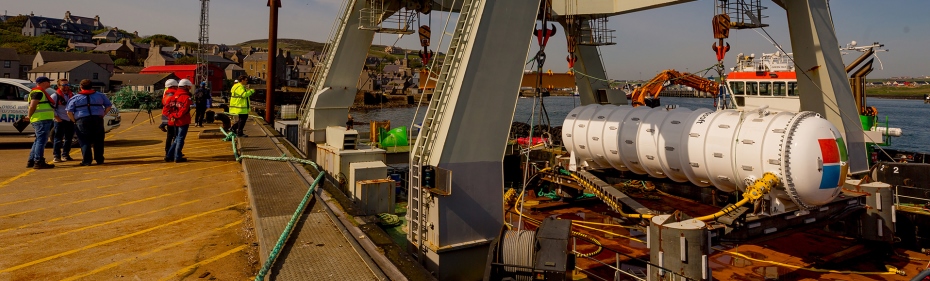
As of 2026-10-12 23:34 UTC, underwater AI data centres have joined the emerging issues identified by GESAMP, the UN marine scientific advisory group. UNESCO’s Intergovernmental Oceanographic Commission reported the development on October 7. The announcement identifies a subject for possible assessment; it supplies no finding of ecological damage.[1]
The question it raises is tangible. A sealed vessel can keep computers dry while the surrounding sea carries away their heat. That arrangement changes the cooling bill. Understanding what it changes for the water and its inhabitants requires another set of measurements.
What has actually changed?
Three records establish the news and its boundaries:
- September 7–11, reported October 7, 2026: GESAMP's London meeting identified five emerging marine issues. Their inclusion is confirmed; the notice provides no impact estimates.[1]
- June 2018 to summer 2020: the European Marine Energy Centre hosted and subsequently reported the retrieval of Microsoft’s Northern Isles experiment. This is an established demonstration history, rather than evidence of a new deployment this month.[3]
- July 2026 work-programme record: the International Telecommunication Union lists a technical report on evaluating natural-surface-water cooling as under study, with June 2028 as its target timing. That is a work plan, not a completed standard.[7]
GESAMP’s normal assessment machinery helps explain the distinction. Its working groups undertake defined studies requested by sponsoring organisations, and their reports normally pass through peer review and GESAMP approval before publication.[2] Identifying an issue is an early step in assembling that evidence.
How does the sea cool a computer?
The server remains inside a pressure vessel. In the Northern Isles design, Naval Group adapted submarine cooling technology: seawater passed through radiators behind the server racks and returned to the ocean. The water collected heat without bathing the electronics. Microsoft’s deployment account describes a container about 40 feet long, holding 12 racks and 864 servers.[5]
The attraction is access to a cool environment and a way to remove heat without relying on freshwater cooling supplies. Microsoft's later account also reported improved equipment reliability: the underwater servers failed at one-eighth the rate of the land comparison. Researchers proposed the dry nitrogen atmosphere and absence of human disturbance as explanations. EMEC republished those company findings in September 2020.[4]
Those are useful results with specific boundaries. The reliability comparison concerns hardware inside the vessel. The ecological question concerns conditions outside it. A successful answer to the first does not provide the measurements needed for the second.
What did the Orkney trial establish?
EMEC places the installation at Billia Croo, its wave-energy test site west of the Orkney mainland. Naval Group led the installation and local contractor Green Marine carried it out. The experiment stayed for a second year beyond the initially anticipated year of testing.[3]
That history gives the proposal more substance than a drawing of servers beneath blue water. Deployment, remote operation and retrieval happened at an identified site. It also makes the limits easier to see: this was one installation in particular marine conditions. Its results are a starting point for questions about another site's currents, operating load and surrounding habitat.
The source relationship matters, too. EMEC participated in the project, and its results announcement reproduces Microsoft's account.[3][4] These are valuable firsthand records of the experiment; they do not supply an independent ecological assessment of every future underwater facility.
Would fish around the vessel prove it is harmless?
Microsoft tried to make the outside observable. An August 2018 technical account describes two cameras at fixed positions outside Northern Isles and a machine-learning system for counting marine life. The demonstrated detector focused on fish and arrow worms, using 200 labelled images. The authors presented this monitoring as a first step toward understanding environmental effects.[6]
A camera can establish that an animal appeared in its field of view. The inference remains narrower than a finding that the ecosystem is healthy. Counts alone cannot explain whether animals have gathered around a new structure, whether species outside the detector's categories have changed, or what happened beyond the cameras.
That distinction suggests a better question for a project developer: what conditions existed before deployment, what changed during operation, and what comparable observations were collected elsewhere? This is an evidentiary test, not a claim that the Orkney experiment caused harm.
What would a fuller assessment measure?
The ITU work item offers a useful checklist of categories: heat in discharged water, water quality, aquatic organisms and the sustainability of water abstraction. It also identifies biofouling, corrosion, sediment and ecological disturbance as issues to address.[7]
Its scope is broader than underwater servers. A data centre can use a natural water body for cooling while remaining on land. The proposed framework therefore helps identify questions; it cannot be presented as an adopted subsea-specific rule. Its “under study” status is especially relevant when an announcement invokes international standards.[7]
The practical implication is to ask for environmental observations alongside cooling performance. An efficient heat exchanger tells a buyer how well heat leaves the equipment. A site assessment must follow that heat into the receiving water and examine conditions for living things there.
What should readers watch next?
The following are conditional interpretations, not announced outcomes. The base case is further scrutiny, confirmed by a defined assessment scope or published monitoring requirements. The upside would be repeatable site evidence showing that cooling benefits coexist with acceptable ecological effects under stated conditions. The downside would be persistent adverse changes associated with operation, or monitoring too limited to distinguish project effects from background variation. Either would weaken broad claims of environmental suitability.
For coastal communities, infrastructure buyers and reporters assessing a proposal:
- Within 24 hours: separate a deployment announcement, a company test result and an independent assessment. Describe the GESAMP news at its actual stage.
- Within seven days: request the project's baseline observations, monitoring area, operating conditions and plans for responding to adverse findings. Treat the environmental claim as unresolved if those records are absent.
- Over 30 days: watch for assessment terms, published data or changes to the ITU work item's status. Revise this account if a completed assessment or adopted instrument replaces the preliminary record.[1][2][7]
The decisive evidence will connect the computer's performance to the particular stretch of sea receiving its heat.
Sources
- UNESCO Intergovernmental Oceanographic Commission, “From space debris to underwater data centres: GESAMP 53 maps emerging threats to the ocean,” October 7, 2026 — September meeting and issues identified for possible assessment.
- GESAMP, “Working Groups” — assessment mandates, expert participation, peer review and approval.
- European Marine Energy Centre, “Naval Group | Project Natick” — installation site, project participants, testing history and archival photograph credited to Microsoft.
- European Marine Energy Centre, “Microsoft share findings following data centre trials at EMEC,” September 15, 2020 — republication of Microsoft's retrieval, reliability and freshwater-cooling findings.
- John Roach, Microsoft, “Under the sea, Microsoft tests a datacenter that’s quick to deploy, could provide internet connectivity for years,” 2018 deployment account — vessel dimensions, server racks and seawater heat exchange.
- Xiaoyong Zhu and colleagues, Microsoft Azure, “Monitoring environmental conditions near underwater datacenters using Deep Learning,” August 27, 2018 — camera positions, detection categories and training-data limits.
- International Telecommunication Union, work item LSTR-DC-WaterEnv, “Water Environment Sustainability Evaluation Framework for Data Centers Utilizing Natural Surface Water Cooling,” updated July 13, 2026 — proposed scope, under-study status and June 2028 target.