As of 2026-05-06 21:02 UTC, NASA's newest NEO Surveyor update is easy to underrate because it reads, at first glance, like ordinary mission-progress copy.[1] The more important point is that the agency's asteroid-hunting telescope has now crossed into integration and testing after clearing critical design review in February.[1][2] That does not mean the planetary-defense gap is solved. It means the question has changed. For years, NEO Surveyor was a congressional mandate, an architecture choice, and an oversight problem. It is now a piece of hardware on a clock.
That distinction matters because NASA still has an unfinished survey job. The Planetary Defense Coordination Office says NEO Surveyor is being built to complement ground-based observatories and sharply accelerate discovery of the remaining undiscovered near-Earth-object population.[3] NASA's Office of Inspector General said last year that the agency remained about 45% shy of the congressional goal to identify 90 percent of near-Earth objects 140 meters wide or larger, the size class associated with major regional damage.[4] The mission therefore matters less as one more telescope announcement than as the agency's most direct answer to a deadline it already missed.
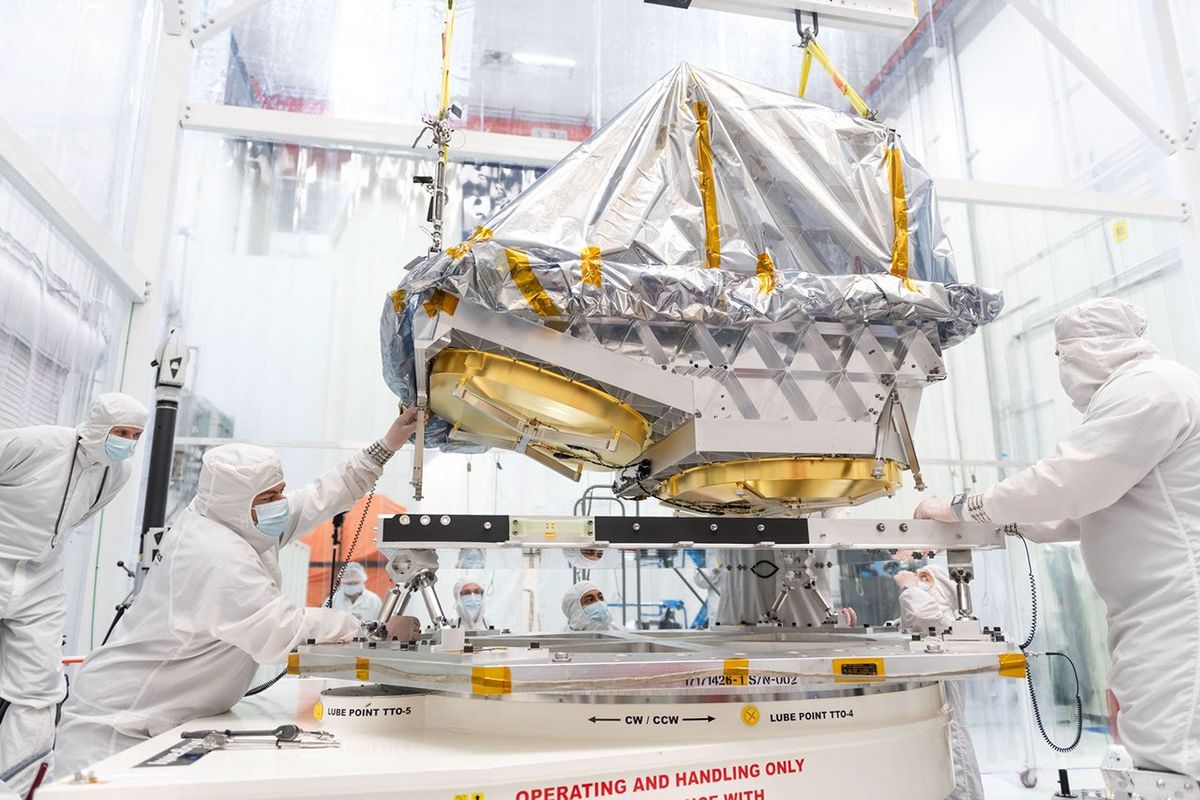
Image context: the cover uses a real NASA integration photograph showing engineers attaching the NEO Surveyor telescope to its flight base frame in Utah. That is the right visual here because the live story is no longer a concept rendering or a funding placeholder. It is whether the assembled observatory can now make it through the remaining test, software, and launch sequence.[1]
Fact file
| Item | What is live now | Confidence note |
|---|---|---|
| Current milestone | NASA said on May 5, 2026 that NEO Surveyor is undergoing integration and testing.[1] | Direct from NASA's current mission update. |
| Prior gate | NASA said the mission passed critical design review on Feb. 6, 2025 and could proceed to full-scale fabrication, construction, assembly, and testing.[2] | Direct from NASA's February 2025 status update. |
| Launch target | NASA says launch is scheduled no earlier than September 2027.[1][2][5] | Repeated across current mission materials and the launch-services release. |
| Mission type | NASA describes NEO Surveyor as its first infrared space telescope purposely designed to discover potentially hazardous asteroids and comets.[1][3] | Strong; consistent across multiple NASA pages. |
| Survey objective | NASA says the mission's five-year baseline survey is intended to find at least two-thirds of the unknown NEOs larger than 140 meters.[5] | Strong; from the launch-services contract release. |
| Why it matters | NASA's PDCO says NEO Surveyor, working with ground-based systems, should drastically accelerate discovery of the remaining undiscovered NEO population.[3] | Strong; direct from planetary-defense overview. |
| Oversight context | NASA OIG said in June 2025 that the agency was still about 45% shy of the congressional 90% discovery goal for 140-meter-class NEOs.[4] | Strong for the oversight snapshot, but it predates the May 2026 integration update. |
What changed this week
The May 5 update did not announce a launch, a new budget line, or a fresh asteroid scare.[1] What it did announce was subtler and more operational: NEO Surveyor is now deep enough into buildout that NASA is talking about component integration, detector software, and how the observatory will process the flood of survey data it expects to collect.[1] That is a different phase of risk from concept approval. Once a mission enters integration and testing, the challenge is less about whether the idea is justified and more about whether every subsystem arrives, mates, survives test, and stays on schedule.
The February 2025 critical design review is what made this phase possible. NASA said a standing review board found that the mission met all technical performance measures and requirements, which allowed the project to proceed into full-scale fabrication, construction, assembly, and testing.[2] In other words, the mission is no longer being judged mainly as a paper design. It is being judged as a spacecraft program.
That shift sounds procedural, but for planetary defense it is strategic. A mission like NEO Surveyor only changes risk if it actually flies. Hardware integration is the point where optimistic architecture diagrams begin to collide with schedule, supply chain, thermal control, software, and test discipline. The clean-room photos matter because they mark entry into that unforgiving part of the process.[1]
Why NEO Surveyor is not just another NASA observatory
NASA already has ground-based surveys, orbit-analysis pipelines, and coordination channels for warning about possible impactors.[3][6] The reason NEO Surveyor still matters is that some of the most consequential objects are also some of the hardest to find with visible-light systems alone. NASA's current materials keep making the same technical argument: dark asteroids and comets do not reflect much sunlight, but they glow in infrared after being warmed by the Sun.[1][2] A dedicated infrared telescope in space sees a part of the threat picture that the existing network sees less well.
That is why the mission sits at the center of the congressional mandate story. The 2005 George E. Brown Jr. Near-Earth Object Survey Act told NASA to identify and track 90 percent of the 140-meter-and-larger population.[4] The OIG's June 2025 review said the agency had improved substantially since 2014, but still had not closed the gap and still faced staffing and resource constraints inside the Planetary Defense Coordination Office.[4] NASA's open-science explainer this spring put the mission's role even more bluntly: NEO Surveyor is the first spacecraft specifically designed to look for asteroids and comets that pose a hazard to Earth, and the data it collects will be made widely available.[6]
So the new milestone is not merely about scientific curiosity. It is about whether NASA can convert an acknowledged detection shortfall into a functioning survey machine before another decade slips by.
What is still unresolved
The mission is further along, but the easy part is over. NASA still says no earlier than September 2027, which is close enough to be concrete and far enough away for delays to matter.[1][2][5] Integration and testing are exactly where space projects discover uncomfortable facts about interfaces, vibration tolerance, contamination control, thermal performance, and the software chain that has to turn raw detections into usable survey products.
There is also a broader policy limit. The OIG noted that NASA did not have additional NEO discovery or mitigation missions planned after NEO Surveyor.[4] That does not weaken the case for the telescope. It sharpens it. If the United States is leaning heavily on this mission to accelerate the unfinished survey task, then schedule credibility and post-launch operations matter more than celebratory milestone language.
What to watch next
In the next 30 days, watch for additional NASA updates on subsystem integration and test progress rather than headline science claims. The real near-term question is whether the mission continues hitting build milestones cleanly.[1]
In the next 12 months, watch whether NASA keeps the launch language at no earlier than September 2027 or starts widening the window.[1][2][5] That is the simplest external signal of schedule health.
By launch readiness, the real measure is not how compelling the mission pitch sounds. It is whether NEO Surveyor can reach space with a stable operations and data pipeline strong enough to start shrinking the survey gap that Congress identified two decades ago.[3][4][6]
The bottom line is narrower than an asteroid-movie frame and more important than a routine project update. NEO Surveyor's May 5 milestone means NASA's main next-generation detection mission has moved from justification to execution. The live story now is not whether planetary defense needs the telescope. It is whether NASA can carry this hardware across the remaining schedule without losing the chance to turn an old mandate into a real warning advantage.[1][2][3][4][5][6]
Sources
- NASA Science, "NASA's Next-Gen Near-Earth Asteroid Space Telescope Takes Shape" (May 5, 2026).
- NASA Science, "NASA's NEO Surveyor Successfully Completes Critical Design Review" (February 11, 2025).
- NASA Science, "Planetary Defense Overview" (accessed May 6, 2026).
- NASA Office of Inspector General, "Assessing NASA's Strategy to Protect Earth from Hazardous Asteroids and Comets" (June 30, 2025).
- NASA, "NASA Awards Planetary Defense Space Telescope Launch Services Contract" (February 21, 2025).
- NASA Science, "How NASA Science Data Defends Earth from Asteroids" (April 10, 2025).