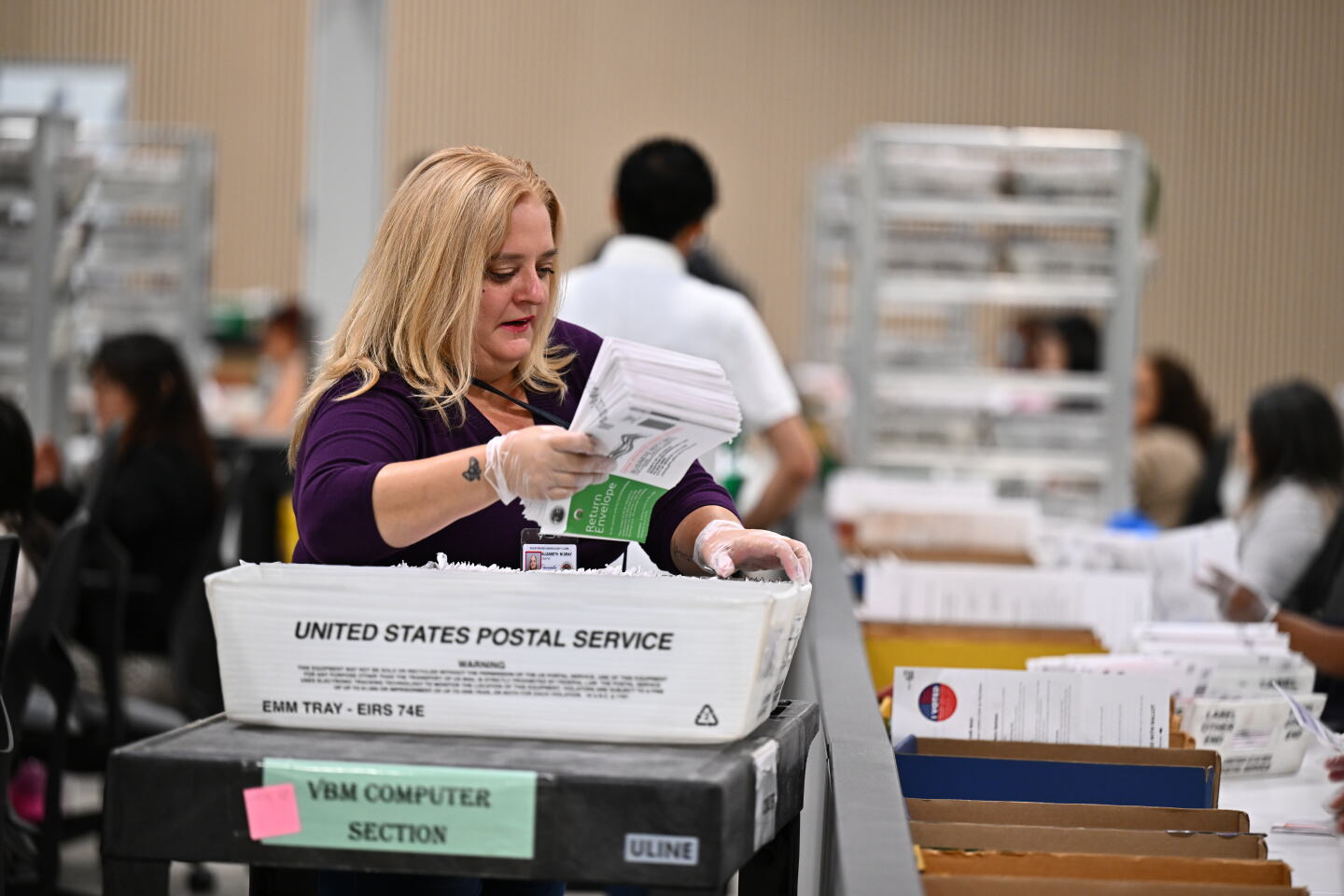
As of 2026-06-30 07:35 UTC, the Supreme Court has left postmark-based mail-ballot grace periods standing. In Watson v. Republican National Committee, a 5-4 Court reversed the Fifth Circuit and held that federal election-day statutes do not force states to receive all absentee or mail ballots by Election Day itself.[1][2]
The immediate effect is practical: states that already count mailed ballots postmarked by Election Day and received later do not have to rewrite those rules in a rush before the 2026 midterms. The longer-running issue is not settled politics. It is administration: voters need state-specific deadlines, election offices need clean canvass reporting, and campaigns need to stop treating "postmarked by Election Day" as if it meant the same thing everywhere.[3][4]
Fact File
| Signal | What is known now | Confidence note |
|---|---|---|
| Supreme Court result | Justice Amy Coney Barrett wrote the majority opinion, joined by Chief Justice John Roberts and Justices Sonia Sotomayor, Elena Kagan, and Ketanji Brown Jackson. Justice Samuel Alito dissented, joined by Justices Clarence Thomas and Neil Gorsuch, with Justice Brett Kavanaugh joining most of the dissent.[1][2] | High for the vote split and authorship; the opinion remains subject to normal formal revision before bound publication. |
| Legal holding | The Court said the federal statutes setting the day for federal elections regulate when ballots must be cast, not a single national receipt deadline. Mississippi's rule survived because it requires ballots to be postmarked by Election Day and received within five business days afterward.[1] | High for the holding; narrower than a general endorsement of every possible state mail-ballot rule. |
| What the Court did not decide | The majority stressed that the question was narrow and did not decide the legality of absentee voting generally, early voting, vote counting after Election Day, certification timing, or the full scope of Congress's election power.[1] | High; this is a boundary condition for reading the case. |
| State deadline map | Movement Advancement Project's current map shows 5 states with mail-ballot receipt deadlines before Election Day, 31 states with receipt deadlines on Election Day, and 14 states plus Washington, D.C., with deadlines after Election Day.[4] | High for the current category map; state laws can still change. |
| Military and overseas voters | UOCAVA protects absentee-voting access for uniformed and overseas citizens, and the Court treated UOCAVA's references to state receipt deadlines as evidence that receipt timing remains a state-law matter.[1][5] | High for the statutory framework; state implementation details vary. |
| Live California example | California tells voters for 2026 elections that mailed ballots must be postmarked on or before Election Day and received no later than seven days after Election Day: June 9 for the June 2 primary, and November 10 for the November 3 general election.[6] | High for California; not transferable to states with Election Day receipt deadlines. |
What Actually Changed
The ruling changed the legal baseline, not the calendar on every refrigerator. Before Monday's decision, election officials in grace-period states faced the possibility that a federal court ruling would force emergency deadline changes months before the midterms. The Supreme Court removed that particular federal preemption threat. If a state already has a lawful postmark-plus-receipt window, Monday's opinion lets that state keep using it unless its own legislature or courts change course.[1][3][4]
That is why the case matters beyond Mississippi. The Mississippi statute at issue is narrow: certain absentee ballots must be postmarked on or before Election Day and received within five business days. But the logic of the ruling applies to the broader class of state systems that separate the voter-facing act of casting a ballot from the administrative act of receiving it. California's seven-day window, Illinois' 14-day window, New York's seven-day window, and other variants still depend on state law, not on one federal receipt rule.[4][6]
The opinion also clarifies a vocabulary problem that causes bad public reporting. A ballot received after Election Day is not necessarily a ballot cast after Election Day. The Court's core distinction is that federal law sets the voting day; states may decide how much later a ballot cast on time can arrive. That distinction will matter most in close races, where "late-arriving ballots" can sound like "late voting" unless election offices and newsrooms keep the language precise.[1][4]
Why The Fight Is Not Over
The dissent treated post-election receipt as a threat to a uniform national Election Day and warned about fraud risk and public confidence. The majority responded that election-integrity policy belongs primarily to legislatures when the statutory text does not create the rule challengers want.[1] That means the legal defeat for the RNC is not the same as a political settlement.
State legislatures can still shorten or lengthen receipt windows within the boundaries of state constitutions, federal statutes, and voting-rights protections. MAP's current categories show how much variation remains: some states require receipt before Election Day, most require receipt on Election Day, and a smaller group allows postmarked ballots to arrive afterward.[4] Monday's decision removes one federal preemption trigger, but it does not freeze state law.
The operational fight will therefore move to a quieter place: instructions, envelopes, postmarks, tracking tools, and canvass updates. California's public guidance is a useful model because it tells voters not only the legal rule but also the mailing behavior that reduces risk: mail early, and if mailing on Election Day, get a hand-stamped postmark from a postal employee.[6] The same kind of concrete instruction matters in every grace-period state. A legal right to be counted is weaker when voters misunderstand the postmark requirement or when an envelope enters the mail stream too late to get usable evidence.
Decision Impact
Next 24 hours: state and county election offices in grace-period states can stop preparing emergency messaging that would have told voters a postmark window had vanished. The more important task is to audit public pages so they do not blur three different deadlines: hand delivery by close of polls, mail postmark by Election Day, and receipt several days later where state law allows it.[3][4][6]
Next 7 days: campaigns, parties, civic groups, and local media should update their voter-facing scripts. The safest short version is not "mail ballots can arrive after Election Day." It is "check your state rule; in some states a mailed ballot must be postmarked by Election Day and received within a fixed window, while in most states it must arrive by Election Day."[4][6]
Next 30 days: the best administration signal will be transparent reporting of unprocessed ballots. California's state results site separates vote-by-mail ballots received on or before Election Day from vote-by-mail ballots received after Election Day through E+7, plus provisional and other categories. That kind of category-level reporting reduces confusion when totals change during the canvass.[6]
Scenarios
Base case: existing grace periods remain in place through the 2026 general election, with states focusing on voter education and canvass transparency. Results in mail-heavy states may still take days to finish, but the delay is explained as a statutory counting process rather than a surprise legal crisis.[3][4]
Upside case: election offices use the ruling as a prompt to make mail-ballot accounting more visible. If public dashboards show how many ballots were received before Election Day, after Election Day, in signature-cure status, provisional, or damaged and remade, fewer voters have to infer process from shifting totals.[6]
Downside case: legislatures compress deadlines close to the election, courts are asked to referee new state-law fights, and public instructions fracture across counties. The warning sign would be a voter hearing one message from a party mailer, another from a county page, and a third from a national news story. That is how a deadline ruling turns into voter error rather than legal clarity.[4][6]
Action Checklist
- Voters: do not generalize from the Supreme Court headline. Check your state or county deadline, because most states still require mailed ballots to be received by Election Day.[4]
- Election offices: put hand-delivery, postmark, receipt, cure, and canvass dates in one visible deadline table rather than scattering them across FAQ pages.[4][6]
- Campaigns and civic groups: say "postmarked by Election Day" only where state law actually uses that rule, and pair it with the final receipt date.[4]
- Journalists: distinguish ballots cast on time but received later from ballots cast late. The former is the issue in Watson; the latter is not what the ruling authorizes.[1]
- State legislators: if changing receipt windows, do it with enough lead time for envelope printing, voter education, ballot-tracking updates, and county training.[4][6]
The invalidation condition is concrete: if Congress amends the federal election-day statutes to set a national receipt deadline, or if a state changes its own law before the November 3, 2026 general election, this report's state-by-state operating assumptions need to be refreshed. Until then, the defensible read is narrow but important: Election Day remains the voting deadline, while ballot receipt remains a state-designed clock.[1][4]
Sources
- Supreme Court of the United States, Watson v. Republican National Committee, slip opinion, No. 24-1260 (decided June 29, 2026) - holding, scope limits, Mississippi statute, majority and dissent.
- Mark Sherman, Associated Press, "Supreme Court allows states to count mailed ballots received after Election Day" (June 29, 2026) - current report on the decision, vote split, litigation background, and immediate political response.
- Julie Carr Smyth, Associated Press, "Supreme Court ruling gives a reprieve to states with grace periods for receiving mail ballots" (June 29, 2026) - state-reaction reporting, affected states, deadline examples, and AP ballot-processing photograph used as the cover image.
- Movement Advancement Project, "Mail Ballot Receipt Deadlines" (accessed June 30, 2026) - current map categorizing states by whether mail ballots must be received before, on, or after Election Day.
- U.S. Department of Justice Civil Rights Division, "The Uniformed and Overseas Citizens Absentee Voting Act" - statutory background on absentee voting protections for uniformed service members and overseas citizens.
- California Secretary of State, "Election Dates and Resources" - 2026 California primary and general election deadlines for hand-delivered and mailed vote-by-mail ballots.