As of 2026-10-17 16:35 UTC, the International Space Station has received the final pair of solar arrays intended to complete its power upgrade. A SpaceX Dragon docked on October 15 with the hardware aboard, moving a programme that began installing new arrays in 2021 into its last installation phase.[1][3]
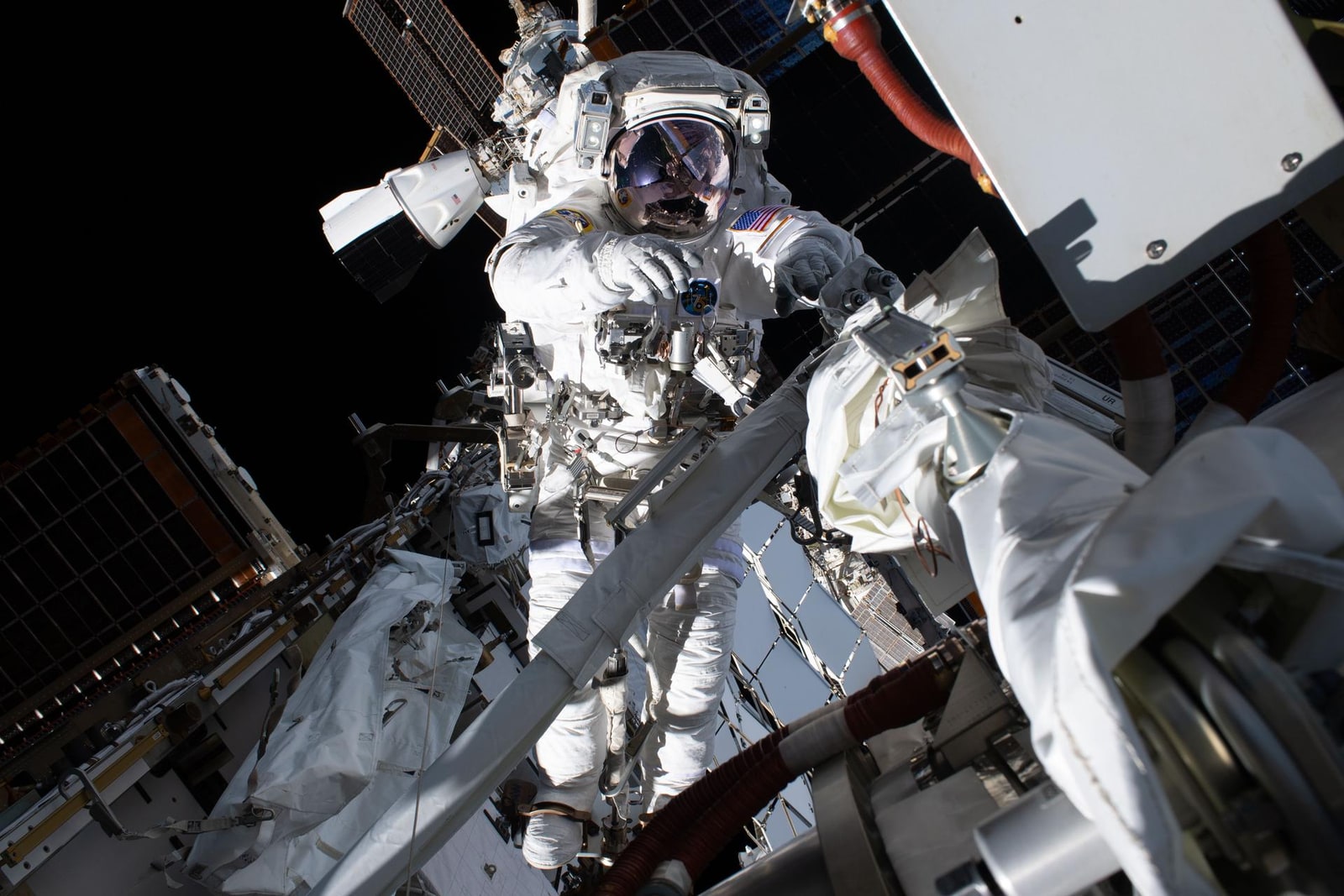
NASA has scheduled two spacewalks for October 29 and November 5. Astronauts Anil Menon and Joshua Kutryk are assigned to install the seventh and eighth International Space Station Roll-Out Solar Arrays, known as IROSAs. The equipment has reached the station; its deployment and contribution to the electrical system remain ahead.[2]
Delivery follows months of preparation
Dragon reached the space-facing port of the Harmony module at 10:27 a.m. EDT on October 15, NASA reported. The spacecraft carried more than 6,300 pounds of food, supplies and equipment on SpaceX’s 35th commercial resupply mission for the agency. The solar hardware shared the delivery with research materials, including equipment for artificial-retina manufacturing and heart-tissue studies.[1]
The arrival closes one part of a sequence documented in three records:
- August 6 — installation site prepared: NASA reported that Jessica Meir and Menon completed their main spacewalk objectives, including preparation of the 3B power channel. This confirms enabling work, rather than installation of the new array.[6]
- October 12 — final pair identified: Redwire, the array supplier, described the shipment as the fourth and final pair. Its announcement establishes the manufacturer’s account of the hardware and programme scope.[3]
- October 15 — delivery confirmed: NASA’s docking report placed the cargo at the station. It did not report that the arrays were operating.[1]
That separation is consequential. A successful cargo arrival removes the transport step from the remaining work, but leaves the physical installation and electrical performance to be demonstrated. For readers following the upgrade, “delivered,” “deployed” and “generating power” describe different achievements.
The original wings keep working
The new equipment extends an existing electrical system. NASA’s account of a June 2021 installation describes roll-out arrays roughly 60 feet long and 20 feet wide, positioned in front of the older wings. Each shades a little more than half of the original array; the exposed portion of the older hardware continues contributing power.[4]
This arrangement addresses ageing without requiring wholesale removal of the legacy wings. In that 2021 report, NASA said the original arrays were still functioning but showing expected degradation after exceeding their designed 15-year service life. The first pair had been deployed in December 2000.[4]
The deployment mechanism also has a flight record. During the June 25, 2021 installation, an array unfurled using stored kinetic energy over about ten minutes, after which mission control confirmed power generation. That earlier operation illustrates the distinction between getting a wing into position and verifying that it produces electricity. Its duration is historical context, not a promised timetable for either upcoming spacewalk.[4]
The programme initially covered six new arrays. On June 28, 2023, Redwire announced a Boeing follow-on contract for two more, following deployment of the sixth. The company identified Boeing’s Spectrolab as a partner in developing the original six, delivered under Boeing’s station contract with NASA.[5]
The final pair therefore completes an expanded programme. It also shows the long interval between ordering orbital infrastructure and putting it to use: contract, manufacture, delivery and installation appear in separate records, across several years.[1][5]
More power, with completion still to prove
Redwire says each roll-out wing can provide more than 20 kilowatts for over ten years after deployment. Those are the supplier’s performance claims, not measurements of the two newly delivered units. Its October announcement says six wings were already deployed before this shipment.[3]
NASA’s plan assigns the seventh array to electrical channel 2A and the eighth to 3B. The agency links the additional power to critical station operations, including support for its eventual safe, controlled deorbit.[2]
The practical implication is broader than adding capacity for experiments. Maintaining an ageing station requires power through its remaining operating life and final operations. This delivery concerns equipment for that work; it does not, by itself, establish a revised retirement date or a successful future deorbit.
The next checks are in orbit
NASA plans a briefing at 18:00 UTC on October 20 to preview the work.[2] Over the next 24 hours, the useful distinction for researchers and observers is the status of the hardware. Within seven days, the briefing should provide the next opportunity to examine the installation plan. Within 30 days, both scheduled spacewalks will have fallen due, making their actual outcomes the stronger evidence.
The following scenarios are interpretation, with observable triggers:
- Base case: both outings proceed on the announced dates. Completion still depends on reports confirming installation, deployment and electrical operation.
- Upside: those reports also establish that both new arrays perform as intended, supporting a firmer assessment of the completed upgrade.
- Downside: a postponement, incomplete deployment or electrical issue leaves part of the work outstanding. Any such report would invalidate the assumption that the published schedule delivers a finished upgrade.
For the next round of coverage:
- Check the October 20 briefing for revisions to dates and tasks.
- After each outing, distinguish completed installation from confirmed power generation.
- Revise any completion claim if NASA reports unfinished work or further checks.
Sources
- NASA, “SpaceX Dragon Docks with Science, Supplies, and Roll-Out Solar Arrays” (October 15, 2026) — docking, cargo and arrival status.
- NASA, “NASA to Host News Conference Previewing US Spacewalks 100, 101” (October 14, 2026) — planned dates, crew, channels, operational purpose and archival photograph.
- Redwire, “Final Pair of Redwire ROSA Wings Launch to the ISS, Completing Historic Power Modernization Effort” (October 12, 2026) — supplier’s pre-launch announcement and performance claims.
- NASA, “Second of the New Solar Arrays Successfully Deployed” (June 25, 2021) — historical deployment, dimensions and relationship to the original arrays.
- Redwire, “Redwire Announces Follow-On Contract to Develop Additional Roll-Out Solar Arrays for the International Space Station” (June 28, 2023) — expansion from six arrays to eight and contractor roles.
- NASA, “Astronauts Complete Spacewalk for Solar Array Modifications” (August 6, 2026) — preparatory work on the 3B power channel.