As of 2026-10-23 09:35 UTC.
Researchers in Japan have accelerated the breakdown of compostable plastic films by incorporating enzymes into the material. Their study, published in Nature on October 21, tested samples in coastal water and on the deep seafloor.[1]
The University of Tokyo, JAMSTEC and Gunma University announced the results on October 22. Their next steps include testing long-term durability and safety, reducing costs and scaling up production: work still needed to turn the experimental material into useful products.[2]
Taking the test beyond the compost heap
The research addresses a gap between a familiar label and an unfamiliar destination. NOAA’s Marine Debris Program explains that plastics suitable for industrial composting are not necessarily designed to break down quickly in the ocean. It also distinguishes fragmentation from disappearance: ordinary plastic debris can become smaller pieces that are extremely difficult to remove.[4]
UNEP raised a related concern in a 2015 assessment. Some polymers need sustained heat and other conditions found in industrial composters, conditions rarely available at sea. The agency also warned that a biodegradable label can encourage people to treat a material as an easy technological answer to litter. That assessment predates the new experiment; it explains the problem the researchers are trying to address, rather than evaluating their formulation.[5]
Earlier fieldwork had already established that the deep ocean was not uniformly hostile to biodegradation. In a 2024 study, Taku Omura and colleagues documented microbial decomposition of several biodegradable materials at sites extending beyond 5,500 metres. Rates generally slowed with depth, and polylactic acid did not degrade at the shore or deep-sea sites tested. That finding made the identity of the polymer and its surroundings central to any claim about breakdown.[3]
The new work asks whether supplying the enzymes inside the plastic can reduce its dependence on finding the right conditions outside it.[2]
A strong result with a depth attached
At 757 metres, three polyesters containing an embedded cutinase enzyme approached complete film mass loss in five months. Biodegradation was more modest at 5,503 metres. The shallower result cannot be assigned to the deepest deployment.[1]
The recipes differed, too. Coastal trials included enzyme concentrations of 0.1% by weight, while deep-sea samples used 3%. The low loading had little effect on mechanical properties; the higher loading reduced tensile strength and stretch before breaking.[1]
JAMSTEC describes the approach as a water-activated process. Enzymes incorporated into the plastic remain inactive without water. Once water reaches them, including through abrasion or physical damage, they can begin breaking down the material. That offers a possible way to reconcile dry use with later degradation, while leaving performance under real storage and use conditions to be established.[2]
Disappearing film is one part of the evidence
Chemical analysis and laboratory oxygen-demand tests using coastal seawater supported microbial processing of breakdown products. They did not establish complete conversion of every deep-sea sample into carbon dioxide and water.[1]
For readers assessing a product claim, the practical distinction is between several separate questions. Does the object lose its shape? Do its polymer chains break down? What becomes of the resulting material? NOAA’s account of persistent fragments shows why an answer to the first question cannot settle the others.[4]
The institutions identify safety, durability and production scale as follow-up work.[2] The resulting judgment is necessarily provisional: this is evidence for a material design worth developing, with its commercial and environmental performance still to be demonstrated.
What would move the story forward
For packaging developers and organisations buying disposable products, three conditional paths matter:
- Base case: further work establishes where the formulation is useful, triggered by published durability, safety and manufacturing results.
- Upside: independent trials reproduce the advantage in finished products while confirming acceptable performance during use.
- Downside: realistic storage, thickness or cost requirements erode the benefit, limiting the material to narrower applications.
Over the next 24 hours, check claims against the paper’s actual test conditions. Over seven days, look for substantive independent assessment. Over 30 days, review any announced follow-up trials or production partnerships. These are suggested review intervals, not deadlines promised by the researchers.
- Ask suppliers to identify the tested material, environment and endpoint behind a biodegradability claim.
- Keep collection and disposal practices in place; the experiment does not demonstrate removal of existing ocean litter.
- Reassess this account if corrections change the reported results, or if independent finished-product trials establish performance beyond these experimental samples.
Sources
- QiuYuan Huang and colleagues, “Enzyme-embedded polyesters for accelerated biodegradation in the deep sea.” Nature, October 21, 2026 — field results, enzyme loading, mechanical properties and degradation measurements.
- JAMSTEC, University of Tokyo and Gunma University, “Development of enzyme-embedded biodegradable plastics with accelerated degradation even in the deep sea” (translated title), October 22, 2026 — institutional announcement, water activation and planned development work; in Japanese.
- Taku Omura and colleagues, “Microbial decomposition of biodegradable plastics on the deep-sea floor.” Nature Communications 15, 568, January 26, 2024 — earlier field study.
- NOAA Marine Debris Program, “Plastic” — industrial composting, marine persistence and fragmentation.
- UNEP, “Biodegradable Plastics Are Not the Answer to Reducing Marine Litter, Says UN,” November 17, 2015 — historical assessment of composting conditions and labelling concerns.
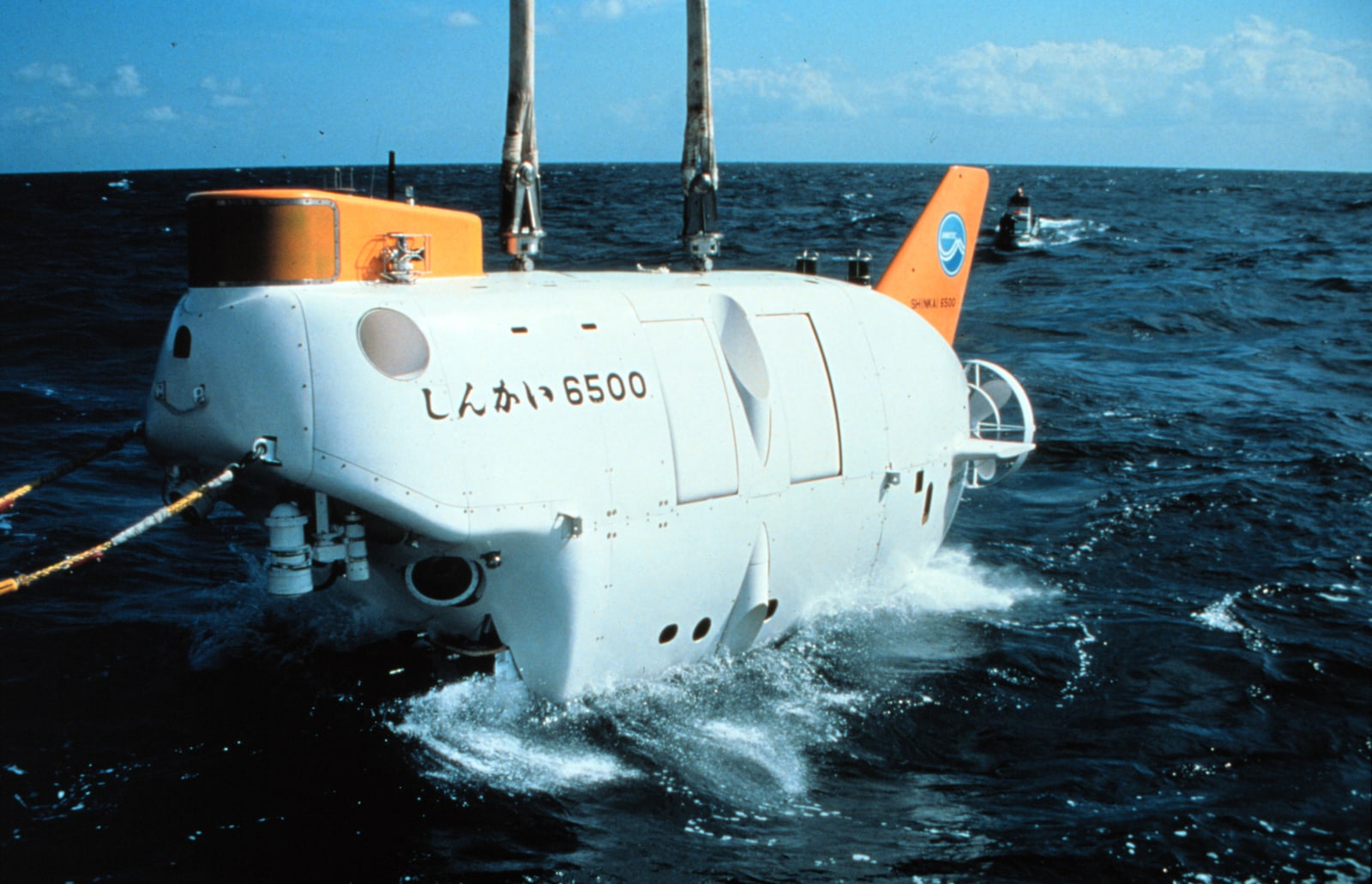
- NOAA photographic collection, “JAMSTEC’s Shinkai 6500,” via Wikimedia Commons — archival photograph and provenance; date unknown.