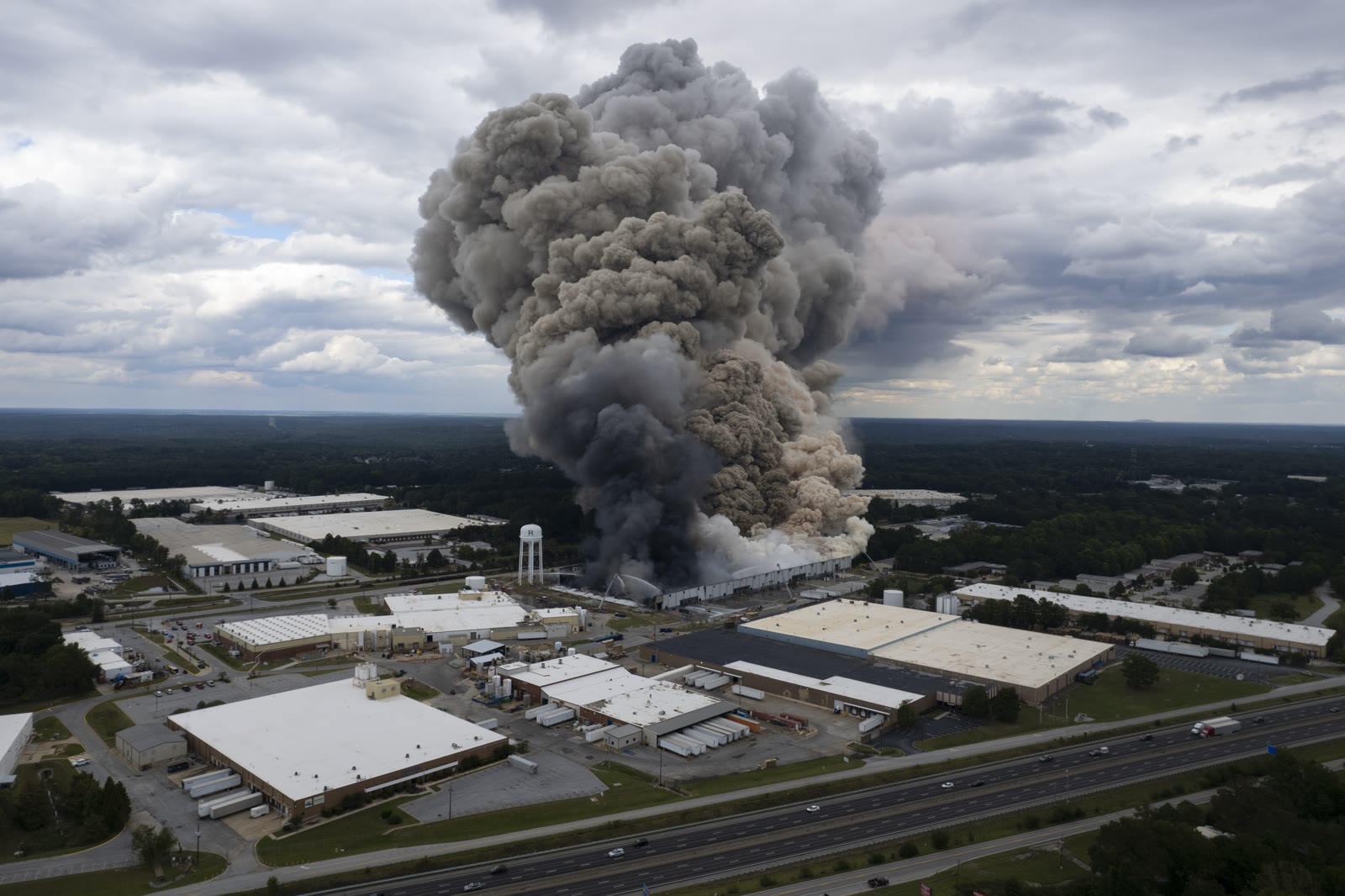
As of 2026-07-22 20:36 UTC, federal investigators have supplied a precise trigger for the fire that destroyed BioLab's Plant 12 warehouse in Conyers, Georgia: a corroded sprinkler-system component failed at about 5 a.m. on September 29, 2024, putting water onto reactive pool chemicals. The resulting decomposition produced heat, toxic gases and two fires. A plume spread across metropolitan Atlanta; about 17,000 people were reportedly evacuated and 90,000 were advised to shelter in place.[1]
The trigger is not the central discovery. The U.S. Chemical Safety and Hazard Investigation Board's 148-page final report, released July 21, reconstructs a warning chain that began soon after the warehouse opened in 2019. Corrosion was photographed, counted, repaired and allowed to recur. Chemical inventory grew beyond the quantity described before construction. Internal safety procedures existed but were not fully used. And the chemicals remained outside two federal major-accident programs even though a bad reaction could release gases those programs explicitly regulate.[1]
This was not a hidden defect that revealed itself without notice. It was a system repeatedly describing its own failure mode.
What the Record Establishes
| Time and source | Verified finding | Confidence boundary |
|---|---|---|
| July 21, 2026 — Chemical Safety Board | The board identifies sprinkler-system failure as the most likely initiating-water scenario and lists five safety issues: maintenance, hazard identification, corporate oversight, fire-code guidance and federal regulatory coverage.[1] | High confidence in the board's final investigative record. The CSB is independent but nonregulatory; it does not issue fines or adjudicate civil liability. |
| 2019 to December 2023 — inspection and inventory records reviewed by the CSB | Corrosion appeared shortly after chemical storage began. The December 2023 inspection recorded 1,124 corroded sprinkler heads outside the warehouse's protected “bunker” area.[1] | High confidence in the records as summarized by investigators. The CSB identifies sprinkler-system failure as the most likely initiating-water scenario based on contemporaneous employee reports, the corrosion-related failure history and water flow observed before firefighting began. |
| September 2024 — CSB reconstruction | The warehouse held nearly 14 million pounds of chlorinated isocyanurates and other reactive chemicals, versus an anticipated average inventory of about 6.2 million pounds submitted to local authorities before construction.[1] | High confidence in the inventory comparison. “Anticipated average” is not the same thing as a legal maximum. The CSB finds the warehouse's 2019 design noncompliant with applicable NFPA standards; destruction prevented a complete measurement of the incident-day pile configuration. |
| September 29–October 17, 2024 — local reports and EPA response | Authorities used evacuation and shelter orders while EPA monitored chlorine and related compounds; the emergency response lasted 17 days, with nearly two weeks of school closures reported.[1][4][7] | High confidence in the protective actions and monitoring record. These sources do not establish an individual long-term health outcome for every person who encountered odor or haze. |
| OSHA enforcement record — current as of July 22, 2026 | OSHA's inspection database lists the case as closed, with four serious and one other current violation and a $61,473 current penalty.[3] | High confidence in the live agency summary. The database totals citation items differently from OSHA's April 2025 announcement, which described four serious and two other-than-serious violations. |
| July 22, 2026 — company response reported by AP | BioLab says it cooperated with the investigation, is reviewing the report and will consider its recommendations; the company completed cleanup and stopped manufacturing at Conyers.[5] | Confirmed company position, not an acceptance of every CSB conclusion. The public response does not yet include a recommendation-by-recommendation implementation schedule. |
The Sprinkler System Was Both Safeguard and Ignition Route
Plant 12 stored chlorinated isocyanurates: useful sanitizers that become dangerous when heat or moisture starts decomposition. The warehouse was not air-conditioned, and the CSB found its ventilation insufficient for the humidity and chemical volume inside. Fumes from the bulk product combined with ambient moisture and condensed as hydrochloric acid droplets on metal, attacking the very sprinkler components intended to control a fire.[1]
The corrosion pattern was not subtle. Inspection reports in 2021 and 2022 found hundreds of affected heads in the “bunker,” where most of the chemicals were then kept. BioLab replaced those heads with corrosion-resistant, wax-coated models in late 2022 and upgraded other bunker components in 2023. That intervention worked as a diagnosis: the December 2023 inspection found no deficiencies in the upgraded bunker heads.[1]
But inventory had expanded beyond the bunker into areas that largely retained brass-finish heads. The same December inspection found 1,124 corroded heads there. Instead of converting the rest of the system, the facility generally replaced vulnerable components after they corroded or leaked—a practice the report calls “run to failure.” Emergency repairs patched a hole in fire-protection piping in July 2024. More corroded heads were replaced on September 13 and September 17–20, only days before the disaster.[1]
The alarm history made the condition measurable. From January 1, 2023, through the morning of the fire, the warehouse fire-protection system registered an abnormal status on at least 60 of 637 days, or 9.6% of the period. After KIK Consumer Products issued a corporate fire-impairment procedure in March 2024, the CSB identified 13 days when Plant 12's system was impaired for more than four hours. The site could not produce the notifications that the procedure required for those events.[1]
In the CSB's reconstruction, a corroded component leaked at about 5 a.m. on September 29. Water reached the product; decomposition created heat; heat activated more sprinklers; more chemicals got wet. A protection system degraded by the storage environment became the mechanism that spread the reaction.[1]
KIK had proposed a different initiating source: rain from Hurricane Helene entering through known roof leaks. The CSB found those documented leaks were away from the first reacting material, noted that no additional rain fell in the 36 hours before the event and placed the initial wet product beneath the corroded sprinkler system. The CSB therefore describes sprinkler-system failure as the most likely initiating-water scenario—an evidence-weighted finding, not an uncontested certainty.[1]
More Product, Less Room to Intervene
The inventory change amplified that mechanism. Documents submitted before Plant 12 was built described about 6.2 million pounds of anticipated average raw-material inventory. By the day of the fire, the building held nearly 14 million pounds of chlorinated isocyanurates and other reactive chemicals—roughly 5,000 large “super sacks,” most weighing more than a ton apiece.[1]
Quantity mattered twice. It put reactive material beneath sprinkler heads outside the corrosion-resistant bunker, and it changed the geometry of the emergency response. Sacks were double-stacked in multiple rows against a wall. When the first material began off-gassing, a KIK responder moved four sacks but could not reach the reacting ones behind them before the vapor thickened and visibility collapsed. Firefighters later faced the same access problem.[1]
The first visible roof fire was extinguished around 8:10 a.m., but decomposition continued under the roof. Around noon, a second, larger fire broke through the building's center. Walls and roof sections began collapsing shortly afterward. The report estimates $50.5 million in property damage and says no injuries were reported during the incident or emergency response.[1]
That last fact needs a boundary. “No injuries reported” is not a finding that the community experienced no health effects. Contemporary AP reporting documented one resident describing a headache, coughing and throat and chest irritation while chlorine was detected near the site.[7] EPA compared its readings with an emergency action level of 0.5 parts per million for chlorine, averaged over a sampling period, and used the results to inform local protective measures until federal monitoring ended October 17.[4] Neither record, on its own, is a longitudinal health study.
The Control System Existed Mostly on Paper
The CSB's corporate findings go beyond maintenance. KIK had approved a “PSM Lite” procedure in February 2024 that called for hazard analysis when equipment or processes changed. Yet no formal risk assessment was completed for Plant 12 because the Conyers operation was not actively following the procedure. Management told investigators that the site had other priorities and was not ready to apply it.[1]
The company also had an incident-tracking system. Two off-gassing events from November 2023—one of which ignited a wooden pallet—were still open without completed corrective action when the September 2024 fire occurred. A safety employee described the local response to small releases as “react, take care of it, get back to work.” Current local coverage of the final report likewise centers the preventable choice to keep replacing vulnerable components after corrosion or leakage instead of eliminating the recurring condition.[1][6]
The fair counterpoint is that Conyers was not operating in a total absence of rules. Fire codes and NFPA standards applied; inspections occurred; the bunker heads were upgraded; OSHA later brought workplace citations; and KIK had written internal procedures. The investigative finding is narrower and more consequential: those layers did not force a complete hazard review, did not convert the full sprinkler system, did not control the actual inventory configuration and did not close known impairment records before the trigger arrived.
The Federal Blind Spot Is Real—but It Is Not an Alibi
OSHA's Process Safety Management standard is designed to prevent catastrophic releases at covered workplaces. EPA's Risk Management Program focuses on off-site public and environmental consequences. Coverage turns largely on listed substances and threshold quantities. Chlorine, hydrogen chloride and bromine are listed. The stored chlorinated isocyanurates and BCDMH that can generate those gases during decomposition are not.[1]
That distinction left nearly 14 million pounds of reactive material outside both programs. The CSB says coverage would have required elements such as process-hazard analysis, mechanical-integrity controls, incident investigation and off-site consequence planning that might have prevented the event or reduced its severity. It does not claim a regulation guarantees perfect implementation.[1]
The age of the recommendation is the accountability problem. The board has asked for broader federal coverage of reactive hazards since its 2002 study and again in later investigations. Its new report reiterates recommendations to OSHA and EPA rather than announcing a new rule.[1] The current BioLab investigation page lists new recommendations to KIK and the National Fire Protection Association as open and awaiting a substantive response, staff evaluation or board action.[2]
Closing Plant 12 and ending chemical manufacturing at Conyers also do not close the exposure pathway. The report says former Conyers operations moved to BioLab's Ontario, California, facility and to third-party manufacturers and warehouses. That is why the board asks KIK to create storage standards across its Pool Division, assess third-party sites, audit its PSM Lite program and audit implementation. The next safety record will be written at the receiving facilities, not inside the destroyed Plant 12 warehouse.[1][2]
What Changes Now: 24 Hours, 7 Days, 30 Days
Next 24 hours: KIK should publish a recommendation ledger naming the facilities and third parties in scope, without disclosing security-sensitive layouts. For each, the useful minimum is current inventory range, fire-system material, most recent corrosion findings, storage-access standard and date of the last formal hazard analysis. OSHA's database now shows a closed case; the next useful disclosure is the remedy and abatement record behind that summary, not another repetition of the initial citation totals.[2][3]
Next 7 days: OSHA and EPA should say whether the reiterated reactive-hazard recommendations are under active rulemaking review, and if not, what existing authority they believe covers this failure mode. NFPA should identify the code cycle and technical committee that can address the report's finding that pool chemicals were classified mainly as oxidizers without enough direction on water reactivity and metal corrosion.[1][2]
Next 30 days: KIK's first substantive response should contain owners, deadlines and independent audit terms. Local fire and building authorities hosting bulk pool-chemical storage should reconcile permitted assumptions with current inventory and physically test responder access—not merely confirm that a spreadsheet has an aisle. EPA and local agencies should preserve the Conyers monitoring record in a form residents and health researchers can download.[2][4]
Three Ways the Report Can Travel
Base case — the company audits, but federal coverage does not move. KIK extends internal standards to company and third-party sites while OSHA and EPA do not advance broader reactive-hazard coverage. Trigger: public company responses gain dates and audit scopes, but no federal docket, request for information or rulemaking milestone appears.
Upside case — the warning chain becomes a transferable control standard. Independent audits verify corrosion-resistant systems, inventory controls, accessible storage and completed hazard analyses across every receiving facility; NFPA clarifies the multiple hazards; OSHA and EPA set a dated path for coverage. Trigger: closed CSB recommendations are supported by published evidence rather than policy promises.[2]
Downside case — risk migrates out of view. Conyers remains closed, but production and storage shift to third parties whose inventory, fire protection and emergency plans are less visible. Trigger: KIK declines to identify the audit universe, CSB recommendations remain open without substantive responses, or a receiving site reports recurring leaks or off-gassing without a completed investigation.
The Checklist the Fire Left Behind
- Warehouse operators: treat repeated leaks as precursor incidents, not maintenance volume. Revalidate hazard analysis whenever inventory leaves its designed storage zone.
- KIK and its contractors: show that corrosion-resistant protection, humidity control, storage configuration and emergency access work together; passing one inspection cannot compensate for a failed system boundary.
- Local authorities: compare current inventories with permit assumptions and applicable maximum quantities, then walk the responder route to material stored behind the first row.
- Federal agencies: answer the coverage question directly—what process-safety duties apply when an unlisted reactive solid can generate listed toxic gases at catastrophic scale?
- Journalists and residents: distinguish CSB recommendations from enforceable orders, proposed OSHA penalties from final dispositions, and emergency air readings from long-term health conclusions.
- Invalidation condition: revise the causal account if the CSB withdraws or materially changes its finding that a failed corroded sprinkler component supplied the initiating water. Revise the forward-risk assessment if KIK publishes independently verified evidence that every company and third-party receiving site has completed the recommended inventory, storage, corrosion and hazard-analysis controls.
The narrow version of the BioLab story is that water touched a chemical that had to stay dry. The documented version is harder to dismiss: for five years, the warehouse produced evidence that its atmosphere was eating its fire-protection system. The fire began when the last warning became a leak.
Sources
- U.S. Chemical Safety and Hazard Investigation Board, Chemical Decomposition, Fires, and Toxic Gas Release at KIK Consumer Products / Bio-Lab Conyers Facility (final investigation report, July 2026) — primary 148-page cause, chronology, inspection, inventory, corporate-control, regulatory and recommendation record.
- U.S. Chemical Safety and Hazard Investigation Board, “Bio-Lab Inc. Conyers Fire and Chemical Release” — live investigation page and current status of recommendations to KIK Consumer Products and NFPA.
- U.S. Occupational Safety and Health Administration, “Inspection 1778326.015 — Bio-Lab, Inc.” — live official enforcement record showing closed-case status, current violation classification and current penalty.
- U.S. Environmental Protection Agency, “Conyers, GA: BioLab Fire” — primary emergency-response account, chlorine action level, monitoring method and downloadable air-monitoring record through October 17, 2024.
- Jeff Martin, Associated Press, “Improper chemical storage, sprinkler damage blamed for Georgia plant fire” (July 22, 2026) — independent current report and BioLab's response to the final findings.
- Sydney Stallworth and Atlanta News First staff, “Not replacing corroded sprinklers to blame for massive 2024 BioLab fire, final report finds” (July 21, 2026) — current local reporting on the report's preventability finding and maintenance record.
- Jeff Martin, Associated Press, “Shelter-in-place order for 90,000 Georgia residents lifted after chemical fire” (September 30, 2024) — contemporary reporting on protective orders, one resident's reported symptoms, confirmed chlorine detection, the site's earlier incident history and the source page for the archival cover photograph.