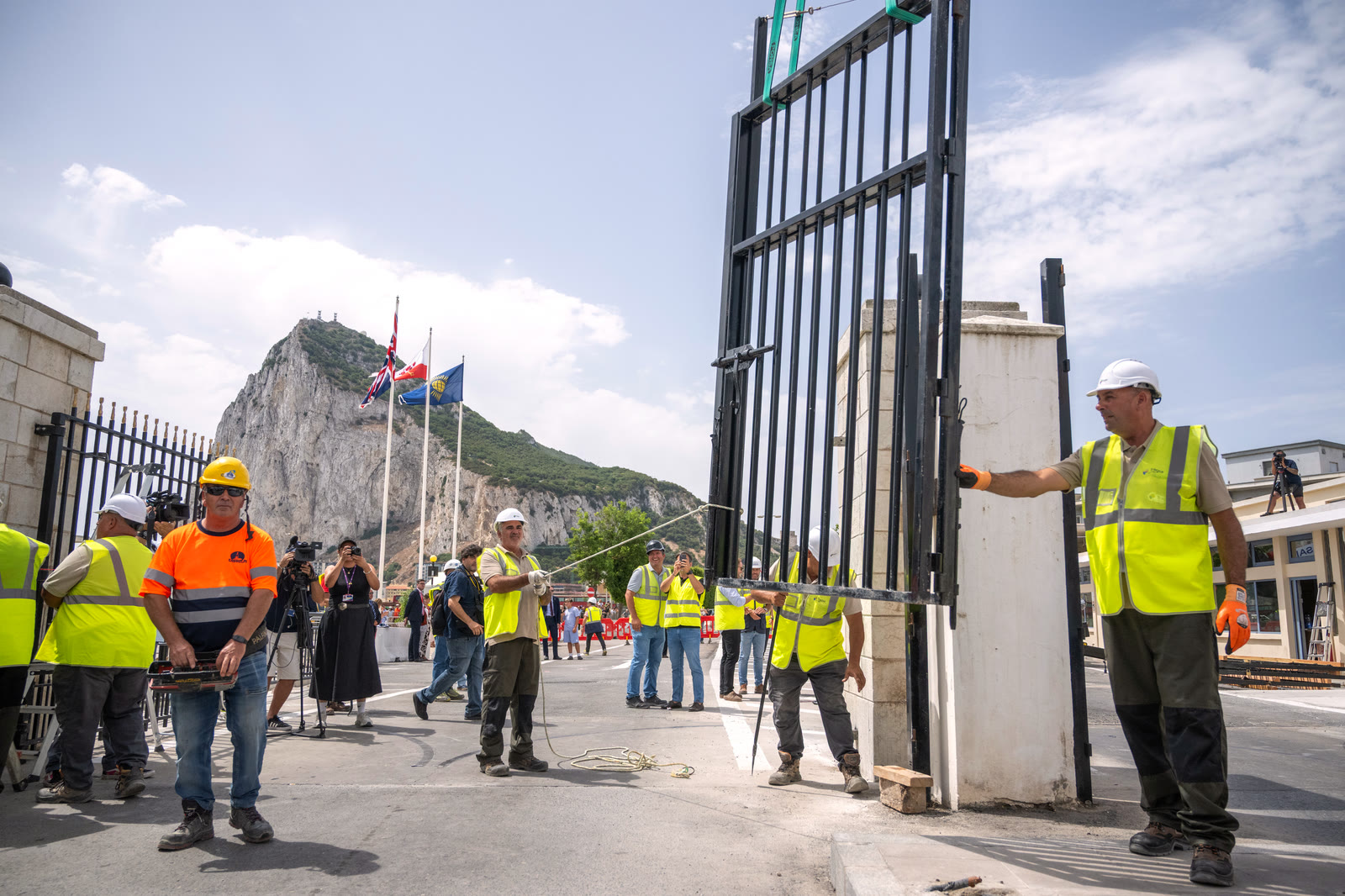
As of 2026-07-16 00:34 UTC, people can walk or drive between Gibraltar and Spain without stopping at the old land checkpoint. The treaty signed on 14 July did not settle or erase the disputed de facto frontier. It redistributed border control: away from the road and pedestrian crossing, and toward Gibraltar's airport, port, customs system and joint UK/Gibraltar-Spanish enforcement arrangements.[1][2]
That distinction matters immediately to approximately 15,500 frontier workers, about half of Gibraltar's workforce, and to anyone arriving by air from the United Kingdom or another place outside the Schengen area.[4] The first group should encounter less daily friction. The second should expect more formal entry processing than the phrase “the fence is gone” suggests.
This reported Q&A synthesizes the signed treaty, its operational arrangement, current travel guidance, institutional analysis and reporting from the first day. Where the documents establish a rule, the answer says so. Where implementation has only just begun, the answer stays conditional.
Image context: the cover is an AP photograph made by Marcos Moreno as workers removed the actual fence on 15 July. It records the physical event discussed here; it is not a symbolic border graphic.[6]
The Verified Position
| Record | What it establishes | Confidence boundary |
|---|---|---|
| Treaty signed 14 July; provisional application from 15 July | Physical barriers connected to the circulation of people at the land frontier are removed. Gibraltar's port and airport become the relevant external border-crossing points.[1] | High on the legal design. Provisional application is not the same as completion of every ratification step. |
| Border-check arrangement signed by the UK, in respect of Gibraltar, and Spain | Spain performs Schengen checks at the airport and, when required, the port; e-gates, staffed booths and a shared second-line area divide the work.[2] | High on assigned responsibilities. One day of operation cannot establish normal queue times or system resilience. |
| UK travel guidance effective 15 July | Short-stay entry conditions align with Schengen rules; applicable visitors clear both Gibraltar and Spanish checks and may then cross the land frontier freely.[3] | High for the common British-visitor case. Nationality, residence, visa and travel-document status can change the result. |
| Government of Gibraltar account | Roughly 15,500 frontier workers cross daily, and the treaty expressly preserves the parties' positions on sovereignty.[4] | High as the Gibraltar government's stated figure and legal position. It is not an independent measure of future economic gains. |
| European Parliament briefing | The agreement is provisionally operating while parliamentary consent remains ahead; the briefing lists 14 December 2026 as an indicative plenary date.[5] | High on the institutional timetable when published. “Indicative” means the date can move. |
| First-day reporting | The fence was removed and people crossed without the old checkpoint; officials also described added cameras and enforcement resources.[6] | High that the opening occurred. Operational performance, privacy practice and public acceptance are still early evidence. |
1. Did Gibraltar's Border Disappear?
No. The line remains; routine controls at that line disappeared.
The de facto frontier remains, while the UK and Spain have not reconciled their competing positions on sovereignty and jurisdiction. The agreement explicitly says that neither the treaty nor measures taken under it alter those legal positions.[1][2] What changed is the location at which a traveler arriving from outside the common circulation area is checked.
The mechanism resembles a house whose front hallway has moved. A person already admitted into the Schengen side—someone arriving in Málaga, for example—can continue overland into Gibraltar without a second passport stop. A person flying directly from London reaches the external edge at Gibraltar airport and must clear the controls there. The open road therefore depends on a harder perimeter at air and sea arrival points, plus cooperation away from the former booth.
This is why “passport-free land frontier” is accurate while “borderless Gibraltar” is not. The agreement removes the routine checkpoint, not immigration law, customs law, police jurisdiction or the territorial dispute.
2. What Happens If You Walk Or Drive In From Spain?
In the ordinary case, you continue across without a passport or customs check at the former frontier.
That is the daily-life dividend of the arrangement. A commuter who lives in La Línea de la Concepción and works in Gibraltar no longer has to build an unpredictable border queue into each trip. Families, shoppers and visitors can make the same short crossing without treating it as a fresh entry into or exit from the Schengen travel area.[4][6]
Freedom from a fixed checkpoint is not freedom from all enforcement. The administrative arrangement gives Spain responsibility under Schengen law for preventing unauthorized external-border crossings and provides for coordinated surveillance, joint maritime patrols, direct communications and a bilateral working group.[2] AP also reported that Gibraltar had expanded cameras, police, customs and coastguard capacity as the fence came down.[6]
The practical uncertainty is not whether the booth was removed—it was—but how proportionately the replacement surveillance is used and how authorities handle exceptional security or migration pressures. A future temporary control would be a material change, not proof that no border exists today.
3. What Happens If You Fly From The UK?
You should expect two sequential decisions at Joshua Hassan Gibraltar International Airport.
On entry, Gibraltar authorities conduct their immigration check first. Spanish authorities then conduct the Schengen check. On exit, the order reverses: the Spanish Schengen exit check comes before Gibraltar's. The treaty makes the two sets of entry conditions cumulative, so passing one does not compel the other authority to admit you.[1][2]
The operating arrangement divides first-line processing between Schengen e-gates and staffed booths, with a shared area for second-line checks.[2] For a visa-exempt UK visitor, the UK travel page says the familiar short-stay ceiling is 90 days in any 180-day period, and time in Gibraltar counts together with time elsewhere in the Schengen area. It also says a passport must have been issued within the previous ten years and remain valid for at least three months after the planned departure from Gibraltar or Schengen.[3]
Where the EU Entry/Exit System applies, the Spanish check includes EES registration. The EU says visa-exempt short-stay travelers can have four fingerprints and a facial image stored with their entry and exit record; repeat crossings generally verify the existing record rather than create it again.[7] A first arrival can therefore take longer than a repeat visit even if both systems are working normally.
Once both authorities admit the traveler, there is no additional routine passport stop on the road into Spain. That is the bargain in its clearest form: two controls once at the external arrival point, no repeated control at the land crossing.
4. Does Everyone Follow The Same Route?
No. Residence and travel status matter more than the color of the passport cover alone.
Gibraltar residents receive treaty-specific facilitation and are exempt from EES and, when it begins, ETIAS at the Gibraltar frontier under the arrangements described by the Gibraltar government.[8] EU citizens and other people with free-movement rights have their own legal route and can use automated systems where eligible. Short-stay visitors from the UK and other non-EU countries generally enter through the Schengen-aligned visitor rules, including EES where applicable.[1][2][3]
That means two British citizens on the same flight may not have identical processing if one is a documented Gibraltar resident and the other is a tourist. Likewise, a traveler who needs a Schengen visa is not put on the visa-free route merely because Gibraltar is a British territory.
The safe operational rule is to check status, not slogans. Airlines and travelers should verify the current Gibraltar guidance before departure, particularly for children, nonstandard travel documents, residence-card holders and mixed-nationality families. The published framework is detailed, but the first weeks will reveal which edge cases generate the most confusion at check-in and at the shared control area.
5. If People Cross Freely, What Happened To Customs?
Customs control also moved; it did not cease.
The agreement creates a bespoke customs relationship intended to remove routine goods checks at the land frontier. Current UK guidance warns air passengers that certain goods must instead be declared to customs on arrival at Gibraltar airport.[3] The treaty and its supporting arrangements also coordinate standards, duties, transit and enforcement so that an open road does not become an unexamined route into the EU customs territory.[1]
For an ordinary pedestrian with personal belongings, the visible experience should be much simpler than the old checkpoint. For freight forwarders, retailers, tobacco and alcohol businesses, couriers and travelers carrying restricted or declarable goods, the change is a new workflow rather than deregulation. Businesses should use commodity- and route-specific official guidance; a general news article cannot safely collapse the treaty's hundreds of customs pages into one allowance.
The clearest early warning signal will be goods moving smoothly at the land crossing while declarations, transit records and enforcement work at the new points of control. If paperwork is unclear or systems do not reconcile, friction may reappear in warehouses and delivery schedules even while cars continue over the road.
6. Is Gibraltar Now Part Of Schengen, And Did Spain Gain Sovereignty?
The operational answer is “Schengen rules now reach Gibraltar's external arrivals”; the constitutional answer is “the sovereignty dispute is unchanged.”
Official travel guidance says Gibraltar's short-stay entry conditions now formally align with Schengen requirements. Spanish officials perform the Schengen decision because Spain is the neighboring Schengen state, while Gibraltar officials separately decide entry into Gibraltar.[2][3] This produces free circulation over the land frontier without making Gibraltar an ordinary Spanish border post or resolving who owns the territory.
Calling Gibraltar simply “a new Schengen member” hides the hybrid structure. Calling the Spanish officers evidence of transferred sovereignty ignores the treaty's express reservation of both sides' legal positions. The more precise description is a common circulation arrangement with juxtaposed controls: two authorities, two bodies of law and one external-arrival sequence.
That precision is politically important. The design works because it separates a practical question—how to prevent a hard border for workers and families—from the sovereignty question that negotiations could not settle. If either side later treats daily administration as a concession on sovereignty, the arrangement will face political strain even if the e-gates perform perfectly.
7. What Should We Watch After The Ceremony?
Queues, edge cases and legal follow-through—not speeches—will show whether the new border geography works.
In the next 24 hours, watch first-time EES registration and dual-check processing at the airport, any carrier confusion before boarding, and whether road traffic stays genuinely fluid after ceremonial controls end. One opening-night crossing is encouraging but does not represent a summer arrival bank.
Over the next seven days, watch whether residents and short-stay visitors are consistently routed to the correct lane; whether customs guidance answers real freight and passenger questions; and whether authorities publish interruption notices with enough specificity for travelers to act. Repeated manual overrides, inconsistent treatment of the same documented status or failures in the handoff between the two controls would identify a coordination problem. Different admission decisions can also be lawful because the two authorities apply cumulative entry conditions.[1][2]
Over the next 30 days, compare airport processing times, missed connections, land-crossing flow and freight complaints with the promises of the treaty. Also watch institutional follow-through: provisional application delivers current effects, but the European Parliament briefing still places consent later in the year.[5]
Three paths are plausible:
- Working transition: first-time biometric and customs friction is visible but declines as repeat travelers are recognized and staff learn the shared workflow. The trigger is falling processing time without a return of routine land checks.
- Better-than-expected integration: dependable controls support new travel patterns and cross-border work while businesses absorb the customs model. The trigger is sustained land fluidity alongside reliable airport, port and freight operations—not a single quiet day.
- Displaced congestion: the old queue vanishes from the road but reappears at airport booths, airline desks or goods-processing systems. The trigger is persistent delay, inconsistent status decisions or emergency measures that recreate frequent checks at the land frontier.
Action Checklist
- Travelers arriving by air or sea: count Gibraltar time inside the Schengen short-stay allowance where applicable; confirm passport, visa and residence-document rules before boarding.[3]
- Gibraltar residents: carry the residence documentation that unlocks resident treatment; do not assume nationality alone communicates status to a carrier or e-gate.[2][8]
- Airlines and travel agents: describe the two checks separately and build first-time EES enrollment into connection advice.[2][3][7]
- Cross-border employers: remove obsolete routine-queue assumptions from shifts, but keep a disruption channel for exceptional controls or system outages.
- Traders and couriers: replace old frontier habits with the current declaration and transit workflow; confirm goods-specific rules rather than extrapolating from passport-free movement.[1][3]
- Public authorities: publish processing and interruption evidence early enough to distinguish a one-off opening problem from a structural bottleneck.
This Q&A should be revised if official guidance changes the 90/180-day treatment, resident exemptions or order of the dual checks; if routine land controls are restored; if provisional application is suspended; or if the consent process materially changes the treaty. Until then, the simplest accurate answer is also the most useful: the de facto frontier did not disappear. The system was redesigned so that external arrivals face two sequential controls, without a repeated routine control at the land crossing.
Sources
- UK Foreign, Commonwealth & Development Office, UK/EU and EAEC: Agreement in respect of Gibraltar (signed 14 July 2026) — final treaty volumes, circulation framework, border-crossing points, customs model and sovereignty reservation.
- UK and Spain, Administrative Arrangement on Border Checks and Border Surveillance (signed 25 June 2026; published 14 July) — airport and port workflow, e-gates, staffed booths, second-line checks and joint surveillance.
- UK Foreign Travel Advice, “Gibraltar: Entry requirements” (current from 15 July 2026) — dual checks, passport validity, 90/180-day treatment, EES and passenger customs guidance.
- HM Government of Gibraltar, “UK and EU Sign Historic Treaty on Gibraltar's Future Relationship with the EU” (14 July 2026) — provisional-application timing, frontier-worker estimate and Gibraltar's account of sovereignty protection.
- European Parliamentary Research Service, EU–UK agreement on Gibraltar (July 2026) — institutional design, provisional application and the remaining consent timetable.
- Suman Naishadham, Associated Press, “Gibraltar ushers in a new era as British territory's border fence with Spain is removed” (15 July 2026) — first-day reporting, commuter context, surveillance response and source page for Marcos Moreno's photograph.
- European Union Entry/Exit System, “FAQs about EES” — scope, 90/180-day calculation and biometric records for short-stay non-EU travelers.
- HM Government of Gibraltar, “Gibraltar and Europe: Past, Present and Future” (17 March 2026) — resident EES and ETIAS exemptions, land-frontier treatment and the dual-control model.