As of 2026-07-15 17:34 UTC, New Zealand has confirmed its first detection of the globally circulating H5N1 avian-influenza strain: one brown skua found on Petone Beach, across the harbour from central Wellington. The test identifies H5N1 clade 2.3.4.4b in the ocean-going seabird. It does not establish a wildlife outbreak, a poultry infection, or a human-health emergency.[1][7][8]
That narrow description is the news. For years, New Zealand’s operating question was when H5N1 might arrive. It is now whether surveillance finds the virus anywhere beyond this bird. Officials report no mass mortality, no evidence yet of transmission among wild birds, no poultry detection, and no further illness found during checks of Petone Beach and nearby areas.[1] Those negatives are reassuring, but they are a first snapshot rather than proof of containment.
The useful response is therefore neither panic nor complacency. The next evidence has to come from field reports, targeted sampling, laboratory characterization, poultry biosecurity, and observation of vulnerable wildlife. Until those layers accumulate, one infected skua is a confirmed incursion with an unknown footprint.
Confirmed, Not Yet Confirmed
| Timestamp / record | What it establishes | Confidence boundary |
|---|---|---|
| New Zealand government release, July 15 | One brown skua found at Petone Beach tested positive for H5N1 clade 2.3.4.4b—the country’s first detection of this strain.[1] | High for the tested bird. The release does not identify when or where it became infected. |
| Petone field check, reported July 15 | Officials found no other issues on the beach or nearby and reported no mass mortality or evidence of wild-bird transmission.[1] | A reassuring initial search, not a national prevalence estimate. |
| Poultry status, reported July 15 | No H5N1 has been detected in poultry; eggs and poultry meat remain safe to eat.[1] | High for the official status at publication. It can change with new testing. |
| Wildlife protection programme, begun in July | About 300 core breeding birds from five highly threatened native species are being vaccinated with a two-dose course.[1][2] | Targeted insurance for small, intensively managed populations—not population-wide protection for New Zealand’s wild birds. |
| Australian notification, June 20 | Australia’s first H5N1 detection was also in a migratory brown skua, prompting enhanced surveillance and an epidemiological investigation.[4] | A strong regional warning. No published genomic or epidemiological evidence yet links the Australian and New Zealand birds directly. |
| Global assessment, updated May 20 | FAO, WHO, and WOAH call for rapid notification, virus characterization, and coordinated animal, wildlife, and public-health surveillance.[5] | Global operating guidance; New Zealand’s local spread remains an open question. |
One Bird Changes the Phase, Not the Risk Label
The phrase “first case” can make several different risks sound interchangeable. They are not. The immediate conservation question is whether infected migratory birds have exposed colonies or species with small populations. The production question is whether wild birds or contaminated environments reach commercial or backyard poultry. The human-health question is narrower still: whether people have direct, close, prolonged exposure to infected animals or contaminated material.[1][5]
New Zealand’s government continues to describe the risk to the public as low. It says human infection is rare without substantial exposure, and that normal eggs and poultry remain safe to eat.[1] Low risk does not mean wildlife workers, veterinarians, poultry staff, hunters, bird carers, or members of the public should handle a sick bird. It means the evidence does not support treating one wild-bird detection as community human transmission.
For wildlife, the global record is more sobering. WOAH says highly pathogenic H5 viruses have caused mortality and ecological disruption across bird and mammal species since 2021, including losses in seabirds and marine mammals.[6] New Zealand cannot infer that outcome from one skua. But it has a reason to search hard before breeding colonies and spring movements make a quiet signal harder to interpret.
The brown skua also supplies a geographic clue without solving the route. Australia notified WOAH on June 20 that its first H5N1-in-wildlife detection was in the same migratory species and the same globally dominant clade.[4] New Zealand officials explicitly point to recent Australian coastal detections as a possible pattern to watch.[1] Species, timing, and region make migration a plausible explanation. Only sequencing and field epidemiology can show whether the detections belong to the same transmission chain, separate introductions, or a wider circulation that sampling has only begun to reveal.
Preparation Arrived Before the Virus
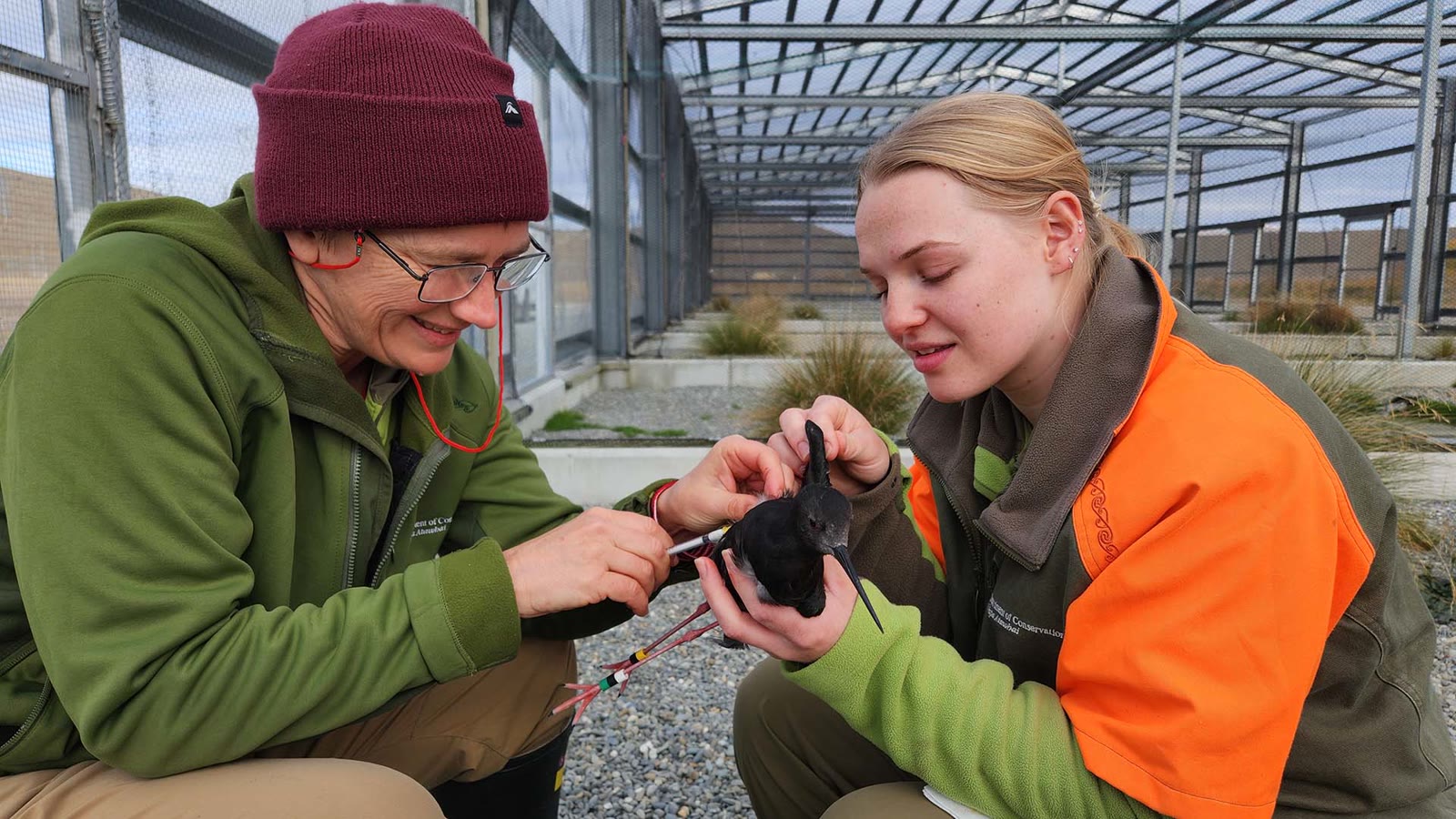
The detection did not catch every part of the system at a standing start. On July 2—thirteen days before the confirmation—the Department of Conservation announced vaccination of roughly 300 core breeding birds: kākāpō, takahē, tchūriwat’/tūturuatu/shore plover, kakī/black stilt, and kākāriki karaka/orange-fronted parakeet.[2] The birds are in captivity or, for kākāpō and takahē, on offshore islands. DOC says it is using a two-dose course and starting before the breeding season so protection has time to develop.[2]
That programme is deliberately selective. It is feasible because the chosen populations are small, intensively managed, and accessible enough to receive both doses. It cannot vaccinate every threatened species, every seabird colony, or every bird that crosses a farm boundary. Its value is to protect irreplaceable breeding cores while surveillance and biosecurity carry the wider load.
Poultry planning has also been moving toward long-term management. MPI consulted on six proposed regulatory measures, including farm biosecurity programmes, record keeping, audits, and standards that could extend beyond commercial operators. Its policy premise is blunt: if H5N1 becomes widespread in wild birds, eradication is unlikely.[3] The consultation page says final decisions are still pending, so it should not be mistaken for rules already in force. The Petone detection now makes the gap between proposed architecture and operational readiness more consequential.
The cover photograph belongs to this preparation phase. It shows a real kakī/black stilt being vaccinated by conservation staff, not the infected skua. That distinction matters: no verified public photograph of the tested Petone bird is being presented here. The image documents a concrete protective action whose purpose was established before the positive test.[2]
The Next 24 Hours, 7 Days, and 30 Days
Next 24 hours: MPI’s highest-value task is to preserve and publish the detection boundary: specimen history, collection date, diagnostic confirmation path, beach-search coverage, and any initial sequence information that can be released. Councils, wildlife carers, veterinarians, and the public need one consistent reporting instruction. The threshold announced by the government is three or more sick or dead wild birds in a group; people should record the location and details but not handle or move the animals.[1]
Next 7 days: surveillance should expand according to risk, not publicity. Petone and connected coastal sites matter, but so do seabird roosts and colonies, wildlife-rehabilitation admissions, poultry holdings with wild-bird contact, and places receiving migratory species. Results should be reported with denominators—how many birds, which species, which places, and which dates—because “no further detections” means little without the search effort behind it. Genomic comparison with Australian and international sequences could materially sharpen the route assessment.[4][5]
Next 30 days: officials should publish an integrated wildlife–poultry–human dashboard or regular situation report, even if every result remains negative. It should separate confirmed positives, suspect mortality events, tested specimens, poultry investigations, exposed people under monitoring, and vaccination progress. MPI should also state which parts of the proposed poultry framework can operate now and which still depend on final regulation.[3][5]
Three Paths From a Single Detection
Base path — isolated coastal detections. Additional infected migratory seabirds appear sporadically, but surveillance finds no sustained transmission in local wildlife and no poultry infection. Trigger: a small number of positives separated in place and time, with negative testing around colonies and farms.
Upside path — a true sentinel event. Intensive follow-up finds no additional virus, sequencing supports an isolated introduction, and the endangered-bird vaccination course is completed before spring. Trigger: broad, well-described negative surveillance over several weeks—not merely the absence of public reports.
Downside path — the first visible point of wider circulation. More species or locations test positive, clusters of illness or mortality appear, or poultry is infected. Trigger: related sequences across multiple detections, rising wildlife mortality, farm exposure, or transmission within a managed flock. That branch would raise conservation and production stakes immediately; the human-risk assessment would still depend on exposure and any evidence of mammalian or human infection.[1][5][6]
What To Do—and What Would Change This Report
- Do not touch, collect, or move sick or dead birds.[1][2]
- Report a group of three or more sick or dead wild birds or other wildlife to MPI’s exotic pest and disease hotline, with an exact location, species if known, counts, and photographs taken from a safe distance.[1]
- Poultry owners should tighten on-farm biosecurity and call a veterinarian about unusual illness or sudden deaths; detailed farm standards remain part of the policy work.[1][3]
- Officials should publish the size and shape of the surveillance effort alongside results, so a negative finding can be interpreted.
- News reports should keep “one infected wild bird,” “wildlife transmission,” “poultry outbreak,” and “human infection” as separate statuses.
This report’s base assessment would be invalidated by any confirmed H5N1 infection in New Zealand poultry, a cluster of linked wild-bird detections, evidence of local bird-to-bird transmission, unusual mammal illness associated with the virus, or a human infection. It would become more reassuring only after transparent, geographically broad surveillance stays negative long enough to cover meaningful bird movement—not simply because the first day found nothing else.
One brown skua has ended New Zealand’s claim of having no H5N1 detection. It has not established what comes next. The quality of the next month will be measured by how quickly the country turns a single positive specimen into a credible map of presence—or absence.
Sources
- New Zealand Government, “H5 bird flu confirmed in New Zealand” (15 July 2026) — primary announcement, detection boundary, current poultry and public-health status, surveillance, reporting instructions, and vaccination count.
- Department of Conservation Te Papa Atawhai, “DOC to vaccinate ‘at risk’ birds against bird flu” (2 July 2026) — species selection, two-dose programme, timing, limitations, field guidance, and source page for the cover photograph.
- New Zealand Ministry for Primary Industries, “Proposed regulations for managing high pathogenicity avian influenza H5N1 in poultry” (updated 15 April 2026) — long-term-management premise and six proposed regulatory measures.
- World Organisation for Animal Health, “Australia notifies first case of High Pathogenicity Avian Influenza H5N1 in a wild bird” (30 June 2026) — brown-skua detection, clade, surveillance response, and regional context.
- FAO, WHO, and WOAH, “Updated joint public health assessment of recent high pathogenicity avian influenza A(H5) virus events in animals and people” (20 May 2026; data through 1 March) — One Health surveillance, characterization, and exposure-risk framework.
- World Organisation for Animal Health, “Statement on the impact of HPAI on wildlife worldwide” (18 December 2025) — documented global wildlife impacts and surveillance priorities.
- 1News, “Case of H5 bird flu confirmed in New Zealand” (15 July 2026) — independent New Zealand report on the Petone detection and initial response.
- Reuters via KELO-AM, “New Zealand reports first H5N1 bird flu case in migratory seabird” (15 July 2026) — independent international confirmation of the announcement.