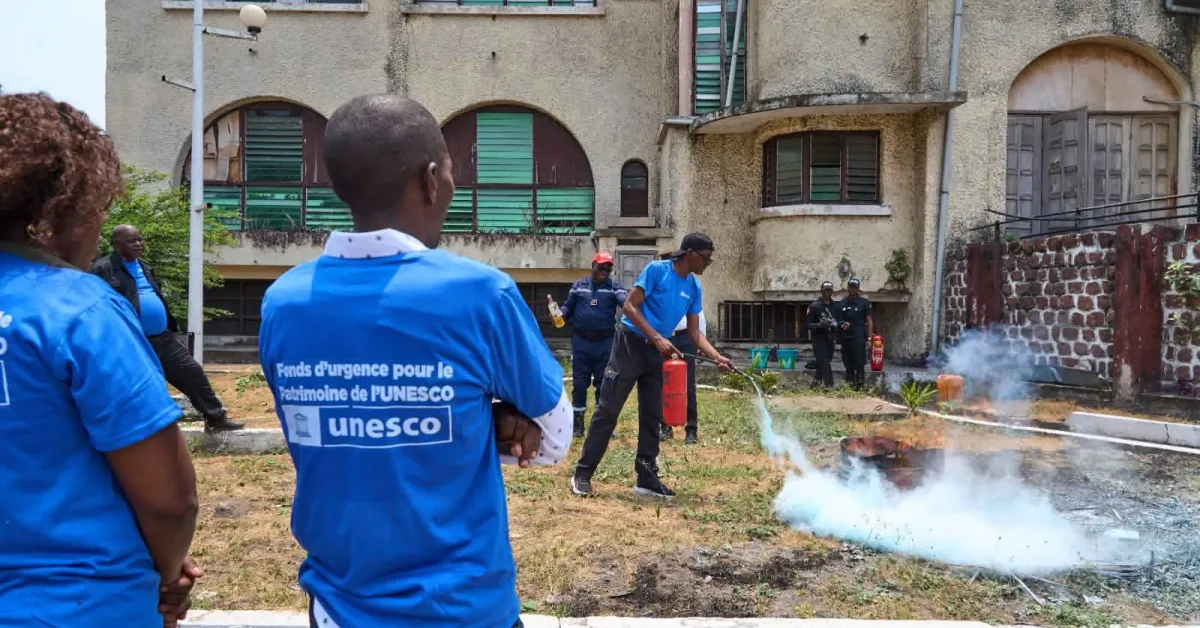
As of 2026-10-12 16:32 UTC. A fire safety exercise at Brazzaville's Marien Ngouabi Museum gives a concrete shape to a broad ambition: protecting heritage before disaster strikes. In an account published on October 9, UNESCO described a September workshop organized with the Republic of the Congo's culture ministry, including practical instruction by two civil protection colonels.[1]
The exercise matters because heritage protection requires people with different expertise to act together. A museum custodian understands a collection; an emergency responder understands an incident. Training can bring those responsibilities into contact. The harder test is whether the connection remains usable after participants return to their institutions.
What the announcement establishes
Three facts anchor the report:
- September 14–16: the workshop took place in Brazzaville, with Heritage Emergency Fund support.
- About 30 participants: heritage officials, civil protection personnel, site managers, community representatives and experts attended.
- A museum exercise: participants practised using firefighting equipment at a heritage site.[1]
These are the organizer's reported activities. The short announcement supplies no institution-by-institution readiness assessment, follow-up budget or measured reduction in losses. It also describes training, not a response to a museum fire.[1]
That evidence boundary sets the question for this analysis: what would turn a documented exercise into a durable capacity?
The connection between the museum and the responder
ICCROM, the intergovernmental conservation organization, identifies a recurring difficulty in its 2018 First Aid to Cultural Heritage in Times of Crisis handbook. Communities often act first to protect their heritage, while emergency responders may lack information about its cultural significance or the skills needed to handle it. The publication therefore treats heritage first aid as a coordinated activity involving communities, custodians, responders and humanitarian workers.[2]
The implication for Brazzaville is that the mix of participants may be as consequential as the equipment demonstration. Knowing whom to contact, who understands a particular collection and who coordinates an emergency can make specialist knowledge available when it is needed. This is an inference from the guidance, not a finding that the workshop has already created those arrangements.[2]
It also changes what counts as a useful follow-up question. Asking how many people attended measures the reach of a training session. Asking whether their institutions can now work together tests the relationship the session was intended to build.
A collection needs a destination and a record
Firefighting is one part of a longer problem. If endangered objects must be moved, their journey needs planning too. ICCROM and UNESCO's 2016 Endangered Heritage guide covers emergency documentation, safe transport and temporary storage. It is designed to help institutions prioritize realistic action with limited resources.[3]
Those elements are connected. A proposed evacuation is incomplete if it identifies objects to move but leaves their destination unresolved. Transport arrangements are harder to use if nobody has decided what takes priority. Documentation keeps the movement of a collection intelligible to the people who will care for it afterward. These are practical implications of the guide's workflow; the Brazzaville announcement does not establish that participants rehearsed collection evacuation.[3]
There is an equally ordinary administrative layer. The Canadian Conservation Institute's emergency planning resource, updated in August 2026, provides a manual, a customizable plan and ten worksheets. Its subjects include forming an incident management team, assessing emergency risks and setting salvage priorities. The manual also addresses training a response team and assembling resources.[4]
That offers a useful standard for assessing progress: an institution should be able to show how training changed its plan. A named responsibility, an agreed priority or an identified resource makes preparedness more concrete than a general promise to improve resilience. The Canadian material is a reference for that assessment, not evidence about conditions at any Congolese museum.[4]
Emergency support needs a lasting home
UNESCO describes the Heritage Emergency Fund as a flexible pool of contributions supporting preparedness and response. Its mandate includes short-term interventions and first aid during the gap before larger recovery projects can begin. Initial assessments can also provide the basis for further funding.[5]
That design gives small interventions a clear purpose. They can establish what needs attention and bring the right people together quickly. It leaves a separate question for the institutions receiving support: how will the work become part of their continuing responsibilities? The fund's description is not a commitment to finance every subsequent need.[5]
For museum managers and funders, the next 24 hours are a useful horizon for checking what the published account actually claims. Over seven days, a follow-up inquiry could seek responsibility assignments and the intended next exercise. Over 30 days, revised plans or documented resource commitments would provide stronger evidence of continuity. These are suggested reporting horizons, not deadlines announced by UNESCO.
The base case is a completed training activity whose lasting effects remain unmeasured. An upside would be participating institutions adopting plans and testing them together; the trigger would be documented changes followed by another exercise. A downside would be an identified task remaining undone because responsibility or resources were unresolved. Silence in a press release alone would not establish that failure.
To assess the next update:
- Look for assigned responsibilities and practical changes at participating institutions.
- Check whether an exercise tested the plan and recorded what needs correction.
- Revise this cautious assessment if follow-up records demonstrate sustained readiness—or identify specific gaps that training has not resolved.
Sources
- UNESCO, “Protecting Heritage from Disasters: UNESCO and Congo Strengthen National Capacities,” October 9, 2026 — workshop dates, participants, museum exercise and photographs.
- Aparna Tandon, First Aid to Cultural Heritage in Times of Crisis — Handbook, ICCROM and Prince Claus Fund, 2018 — coordinated response involving communities, custodians and emergency personnel.
- Aparna Tandon, Endangered Heritage: Emergency Evacuation of Heritage Collections, UNESCO and ICCROM, 2016 — documentation, transport, temporary storage and realistic prioritization.
- Canadian Conservation Institute, “Response ready: Emergency response planning for heritage institutions,” updated August 17, 2026 — planning manual, worksheets, team responsibilities and salvage priorities.
- UNESCO, “What we do: The Heritage Emergency Fund” — preparedness, short-term assistance and the transition toward longer recovery projects.