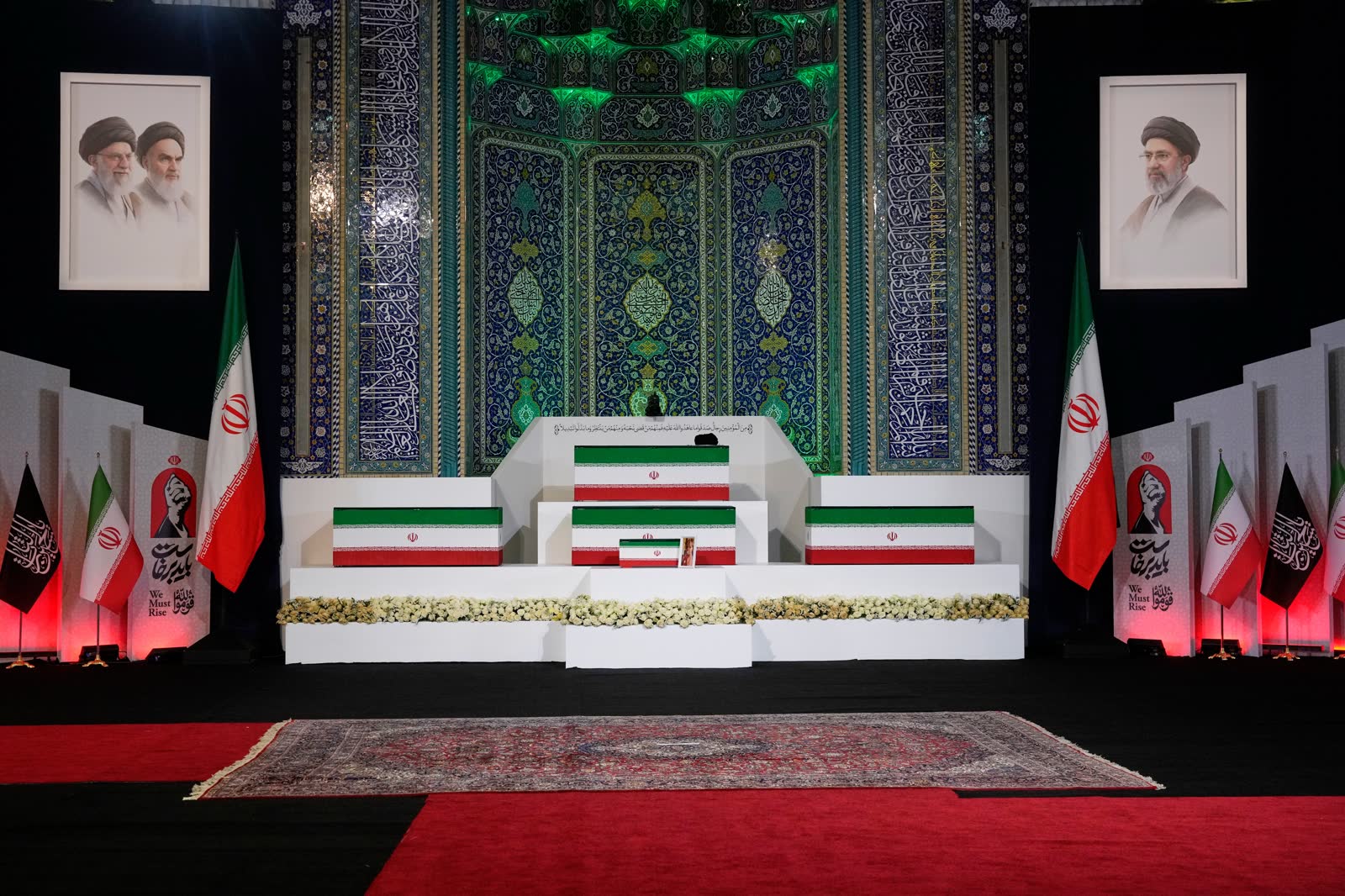
As of 2026-07-03 12:35 UTC, Iran's funeral week for Ali Khamenei has become a short diplomatic clock, not just a mourning ritual. The caskets of Khamenei and several family members were displayed Friday at Tehran's Imam Khomeini Grand Mosalla, with public ceremonies set to run across Iran and Iraq before burial in Mashhad.[1][2]
The practical news is that three files are now moving together: a mass state funeral designed to project continuity, a fragile U.S.-Iran negotiation process paused until after the ceremony, and a Strait of Hormuz route dispute that can still disturb shipping and energy markets even while officials talk about progress.[3][4][5]
The uncertainty boundary is important. Crowd estimates, security expectations, and Iranian political messaging are partly official or state-aligned claims. The funeral schedule is visible and well reported; the deeper questions around succession, ceasefire durability, and maritime enforcement remain conditional.
Fact Line
| Timestamp / source | What changed | Confidence note |
|---|---|---|
| AP, July 3 | Iran began public funeral preparations at the Grand Mosalla, where Khamenei's coffin was displayed with coffins of relatives killed in the same wartime strike.[1] | High for the visible ceremony and AP photo/reporting; lower for claims about internal elite decision-making. |
| Al Jazeera, July 3 | Funeral rites are scheduled from July 3-9, with stops in Tehran, Qom, Najaf, Karbala, and final burial at Imam Reza Shrine in Mashhad.[2] | High for the published itinerary; crowd size and security outcomes remain forward-looking. |
| The Guardian, July 3 | Tehran officials planned large closures, road restrictions, a major Monday procession, and airspace restrictions around the funeral week.[3] | Medium-high; operational details may shift if security conditions change. |
| AP, July 1 | U.S. and Iranian negotiators met separately with Qatari and Pakistani mediators, reported "positive progress," and expected the next meeting after the funeral.[4] | High for the mediator-reported process; not proof of a final deal. |
| Al Jazeera, July 3 | Iran warned ships against unapproved Strait of Hormuz routes, while reported transits remained below prewar levels despite some recovery.[5] | Medium-high; traffic numbers are useful but can move quickly and depend on tracking coverage. |
| Anadolu, July 1 | CENTCOM said a Bahrain dialogue with officials from 12 countries focused on regional security and free flow of commerce through Hormuz.[6] | High for the public military-diplomatic signal; it does not guarantee enforcement outcomes. |
Why The Funeral Matters Beyond Mourning
State funerals are political infrastructure. They organize grief, put hierarchy on camera, and turn a leadership break into a sequence of repeated images: coffin, clerics, guards, flags, crowds, slogans, foreign delegations, and the chosen burial site. In this case the sequence matters more than usual because Khamenei led Iran from 1989, shaped the security state over decades, and died during a war that also hit members of his family.[1][2]
The funeral route is built to widen the frame. Tehran shows state control. Qom ties the event to Iran's clerical establishment. Najaf and Karbala extend the message into the Iraqi Shia religious geography. Mashhad, Khamenei's birthplace and the site of Imam Reza Shrine, gives the burial a personal and religious endpoint.[2][3]
That route is also a security problem. The Guardian reports that officials expected offices to close in Tehran, road traffic to be redirected, airspace to close on Monday, and large crowds to move through the capital.[3] Those measures are not decorative. They reveal the main operational fear: a funeral meant to prove unity can become a pressure point if crowd control, protest risk, foreign attack risk, or factional signaling breaks the script.
Mojtaba Khamenei's role sharpens that pressure. Reporting describes him as successor and notes that he has remained out of public view after being injured in the same February strike that killed his father and relatives.[2][3] If he remains unseen through the funeral week, the state can still project continuity through written statements, officials, and institutions. But the absence makes the ceremony carry extra weight. The funeral has to perform some of the legitimacy work that a visible new leader would normally perform.
The Diplomacy Window
The negotiation file is paused, but not dormant. AP reported that U.S. and Iranian negotiators met separately in Qatar on Wednesday with Qatari and Pakistani mediators, agreed to continue discussions, and expected the next meeting after the funeral.[4] That makes the funeral week a buffer: a period when both sides can claim respect for the ceremony while measuring whether the ceasefire environment holds.
The hard issues did not disappear. AP identified the Strait of Hormuz and Lebanon as major sticking points, and reported that an interim arrangement had opened a path toward shipping passage and ceasefire extension while leaving disputes over route control and fees unresolved.[4] Al Jazeera's July 3 report then showed why the shipping question remains live: Iran's military command threatened a forceful response to ships using unapproved routes, while tracked crossings were still far below the roughly prewar normal reported by the outlet.[5]
The U.S. and regional response is also being staged in public. Anadolu reported that CENTCOM led a Bahrain security dialogue with senior officials from 12 countries, emphasizing regional defense coordination and the free flow of commerce through the Strait of Hormuz.[6] That is not a guarantee that shipping risk is solved. It is a signal that the waterway is now both a negotiation item and a coalition-management item.
For markets and governments, the most useful read is therefore conditional. If the funeral week passes without major maritime incidents, without a public succession rupture, and with the next Qatar round scheduled quickly, the ceasefire track becomes more credible. If Tehran's route warnings turn into interceptions, if Israel-related threats escalate, or if the new Iranian leadership sends conflicting signals, the pause becomes a risk gap rather than a de-escalation window.[3][4][5]
Decision Impact
Next 24 hours: watch the Friday foreign-delegation ceremony and the start of public mourning for signs of message discipline. The key indicators are not only crowd size; they are whether senior Iranian officials keep the focus on unity and negotiation permission, or shift toward threats that narrow the room for the next Qatar round.[1][3][4]
Next 7 days: the main operational test is whether Tehran can move massive crowds through the planned ceremonies while maintaining airspace, road, and internal security controls. A smooth week strengthens the state's claim that succession is organized. A disorderly week, or a visible gap around Mojtaba Khamenei, raises questions about who can speak authoritatively for Tehran in talks.[2][3]
Next 30 days: the Hormuz file becomes the measurable test. More ship transits, fewer route confrontations, and a scheduled follow-up negotiation would support the base case. Renewed attacks on commercial vessels, unilateral toll demands, or a stalled Qatar process would undermine it.[4][5][6]
Scenarios
Base case: the funeral week proceeds under heavy security, Mojtaba Khamenei remains mostly offstage, and negotiators reconvene after the burial. Hormuz traffic stays constrained but improves enough to keep talks alive. The trigger is a confirmed next meeting after July 9 plus no major maritime incident during the funeral window.[2][4][5]
Upside case: the ceremony gives Iran's leadership enough domestic cover to accept a narrower interim maritime arrangement. In this branch, route warnings soften, shipping insurers and operators see a more predictable passage regime, and the U.S.-regional Bahrain dialogue becomes a support structure rather than a parallel pressure campaign.[5][6]
Downside case: the funeral becomes a platform for harder retaliation language, or an incident in the Strait forces negotiators back into crisis management. Warning signs include a public split over the ceasefire, attacks or seizures involving commercial ships, Israeli or U.S. military alerts around the ceremony, or a failure to set the next Qatar meeting after burial.[3][4][5]
Action Checklist
- For energy and shipping desks: track actual Hormuz transits and route enforcement, not only official statements about progress.[5]
- For diplomats: separate funeral-week rhetoric from post-burial negotiating behavior; the real test starts when the next Qatar meeting is scheduled or delayed.[4]
- For regional security analysts: watch whether Mojtaba Khamenei's absence remains manageable through institutions or becomes the story itself.[2][3]
- For readers: treat crowd-size claims as political signals, not settled measurements. The better evidence is whether the ceremony changes decisions on talks, shipping, and security posture.[3][4][5]
- Invalidation condition: this explainer's base case fails if a major Hormuz incident, attack threat, or visible succession rupture prevents a prompt post-funeral negotiating round.[4][5][6]
The bottom line is that the funeral is doing double work. It is a public farewell for a leader who shaped Iran for nearly four decades, and it is a controlled pause in a still-dangerous negotiation. If the week closes with orderly ceremonies and a dated diplomatic follow-up, Tehran will have used mourning as a bridge. If it closes with maritime escalation or succession ambiguity, the ceremony will have revealed how fragile that bridge still is.[1][2][4][5]
Sources
- Jon Gambrell, Associated Press, "Iran prepares for dayslong funeral for late Supreme Leader Ayatollah Ali Khamenei, killed in war" (July 3, 2026) - ceremony scene, family coffins, state messaging, and AP image used as the cover photograph.
- Marium Ali, Al Jazeera, "Mapping Iran's Ali Khamenei funeral: Where mourners will gather each day" (July 3, 2026) - funeral itinerary, city sequence, burial site, and leadership context.
- Patrick Wintour, The Guardian, "Ali Khamenei's six-day funeral expected to draw millions in Iran" (July 3, 2026) - Tehran closures, procession expectations, security context, and Mojtaba Khamenei visibility questions.
- Jon Gambrell, Associated Press, "US and Iran hold separate meetings in Qatar and agree to continue discussions" (July 1, 2026) - mediator process, post-funeral timing, Strait of Hormuz dispute, and ceasefire context.
- John Power, Al Jazeera, "Iran warns ships against using unapproved routes in Strait of Hormuz" (July 3, 2026) - Iranian route warning, traffic figures, oil-price context, and Hormuz risk framing.
- Ahmet Salih Alacaci, Anadolu Agency, "US-led Bahrain talks focus on Hormuz shipping, Mideast defense: CENTCOM" (July 1, 2026) - regional security dialogue, 12-country participation, and free-flow-of-commerce statement.