As of 2026-10-08 01:35 UTC. The 2026 Nobel Prize in Chemistry, awarded to Henri B. Kagan and Kenso Soai, brings an unexpectedly simple question into view: how can a chemical reaction turn a small preference into an overwhelming one? The French Chemical Society's October 7 announcement places molecular chirality and the amplification of asymmetry at the center of the award.[1]
Imagine a reaction making molecules that come in left- and right-handed versions. A slight initial advantage for one version need not remain slight. Under particular conditions, the chemistry can magnify it. Understanding that possibility changes both how chemists think about selective synthesis and how they investigate the emergence of molecular handedness in living systems.[2][3]
What does molecular handedness mean?
Your hands are mirror images, but rotating your left hand will never turn it into your right. Some molecules have the same relationship: their atoms are connected in the same order, yet their three-dimensional arrangements cannot be superimposed. The two versions are called enantiomers. A mixture containing equal amounts has no overall preference for either hand.
Life often shows a pronounced preference. The Japan Academy's account of Soai's research points to the L-amino acids used in proteins and the D-sugars in nucleic acids. These examples pose a historical puzzle: how did such consistent choices emerge from chemistry that could produce both alternatives?[3]
Chemists distinguish the size of an imbalance from the share of the majority version. In an illustrative batch containing 51 left-handed molecules and 49 right-handed ones, the majority share is 51 percent, while the enantiomeric excess is just 2 percent: the difference between the two shares. A nearly even mixture can therefore contain a small, measurable starting advantage.
Three dated findings establish the story's sequence:
- 1986: Kagan and collaborators published reactions whose selectivity departed from the expected proportional relationship with the handedness of the chiral auxiliary.[2]
- 1995: Soai's group reported asymmetric autocatalysis with amplification of that imbalance.[3]
- 2020: structural and mechanistic studies investigated how the catalytic assemblies make such amplification possible.[4][5]
These are documented research milestones. Their implications for the origin of life require a further argument.
What did Kagan change?
A reasonable starting expectation is proportionality: reduce the handedness bias of a catalyst's chiral component and the bias in its product should decline correspondingly. In his personal account, Kagan describes experiments that broke this expectation in both directions. Some products showed less selectivity than the proportional prediction; another showed more.[2]
The positive departure is the important opening for amplification. Molecules in a catalyst mixture can associate into assemblies with different activities. In one model Kagan discusses, assemblies containing opposite-handed components are inactive, leaving the catalytically active population more strongly biased than the mixture initially added. The mixture's overall composition therefore does not tell the whole story of which species are doing the work.[2]
This is a conditional mechanism. A nonlinear effect can improve selectivity or erode it, depending on the system. Kagan's contribution made the departure from proportionality something chemists could investigate and model.[2]
How does Soai's reaction build on a small lead?
Autocatalysis means that a reaction's product helps catalyze the formation of more product. In the Soai system, the product's zinc alkoxide form performs this role selectively: it favors the production of molecules with matching handedness. The reaction combines that self-promoting behavior with interactions that suppress the competing pathway, allowing an initial excess to grow.[4]
The early result was modest enough to make the logic visible. A later research paper recounts how the 1995 work began with an autocatalyst ratio of 51:49 and produced newly formed material at 55:45. Feeding product into subsequent reaction cycles increased the enrichment further.[4]
The molecular machinery matters. In their 2020 mechanistic study, Soumitra Athavale and colleagues investigated four-unit catalyst assemblies. Their experiments and calculations linked the assembly's geometry to how it binds a starting molecule and favors one product. Assemblies containing opposite-handed units behaved differently. That work supplies a physical explanation for why the two pathways need not remain evenly competitive.[5]
Calling this merely “a molecule making copies of itself” loses the essential point. The process changes the relative abundance of the two versions. More product alone would not explain why the initial minority becomes progressively less represented.
Does that explain why life chose one hand?
It demonstrates a mechanism by which a small imbalance can become large. Establishing that this mechanism produced life's particular molecular preferences would require evidence connecting it to the relevant molecules and conditions on early Earth. The Japan Academy's 2025 assessment explicitly treats how and when biological homochirality emerged as unresolved.[3]
The experimental boundaries are substantial. The Soai chemistry uses specialized starting materials and a zinc reagent sensitive to moisture; structural changes can alter or eliminate the desired behavior. The 2020 research examines those constraints rather than presenting a universal reaction available to every molecule.[4][5]
The useful distinction for this week's coverage is between demonstrating amplification and reconstructing its historical role. The Nobel announcement recognizes established chemical achievements. It does not itself supply that missing historical evidence.
What to watch in the follow-up coverage
For science editors and teachers, the next 24 hours are a chance to distinguish the two discoveries clearly. Over seven days, accompanying explanations can be checked against the research. Over 30 days, any claims of fresh applications deserve their own evidence; these are reading priorities, not promised research deadlines.
The base case is renewed explanation of established experiments. An upside would be a new study demonstrating amplification in a broader or plausibly prebiotic setting; its trigger would be published methods and results. A downside would be coverage presenting the award itself as proof that life's origin has been solved, without supplying that connection.
Before repeating a claim:
- Identify whether it concerns catalyst selectivity, autocatalytic amplification, or a proposed origin-of-life pathway.
- Check which starting materials and conditions the result actually covers.
- Revise the account if new evidence changes those boundaries; treat a claim that the historical puzzle is settled as unsupported until the missing connection is demonstrated.
Sources
- Société Chimique de France, “Henri B. Kagan, prix Nobel de Chimie 2026” (October 7, 2026) — award announcement and research context; French.
- Henri B. Kagan, “Nonlinear Effects in Asymmetric Catalysis: A Personal Account,” Synlett (2001), pp. 888–899, especially sections 1–3 — author account preserved by the German National Library; PDF.
- The Japan Academy, “The Discovery of Asymmetric Autocatalysis and Insights into the Origins of Homochirality” (2025), pp. 15–19 — Soai award assessment and research chronology; PDF.
- Soumitra V. Athavale, Adam Simon, Kendall N. Houk and Scott E. Denmark, “Structural Contributions to Autocatalysis and Asymmetric Amplification in the Soai Reaction,” Journal of the American Chemical Society (2020) — early results, reaction components and structural constraints.
- Soumitra V. Athavale, Adam Simon, Kendall N. Houk and Scott E. Denmark, “Demystifying the asymmetry-amplifying, autocatalytic behavior of the Soai reaction through structural, mechanistic, and computational studies,” Nature Chemistry (2020) — catalyst assemblies and the proposed mechanism.
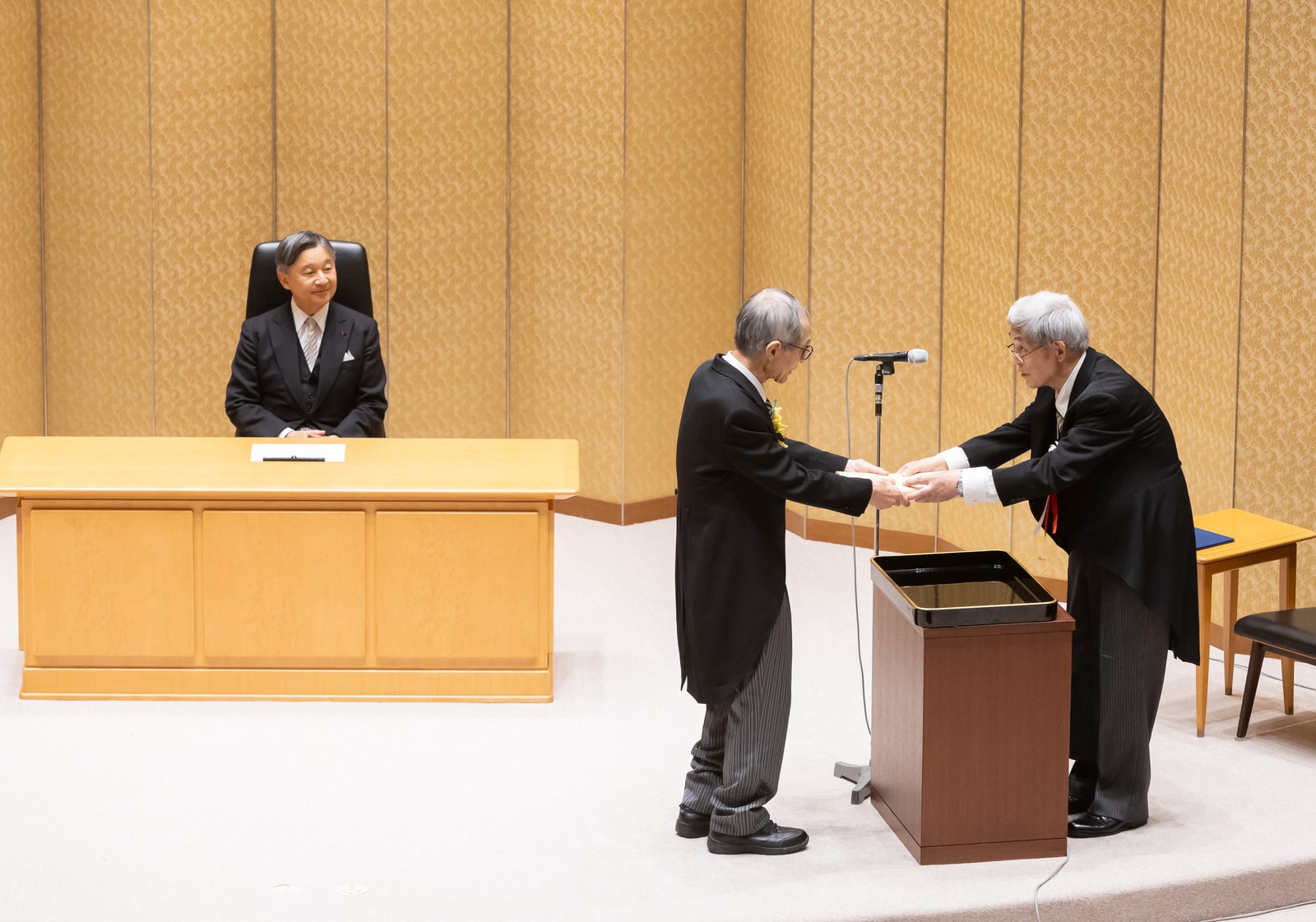
- Soai Research Group, Tokyo University of Science, laboratory homepage — Japan Academy photograph and caption documenting the June 10, 2025 award ceremony; Japanese.