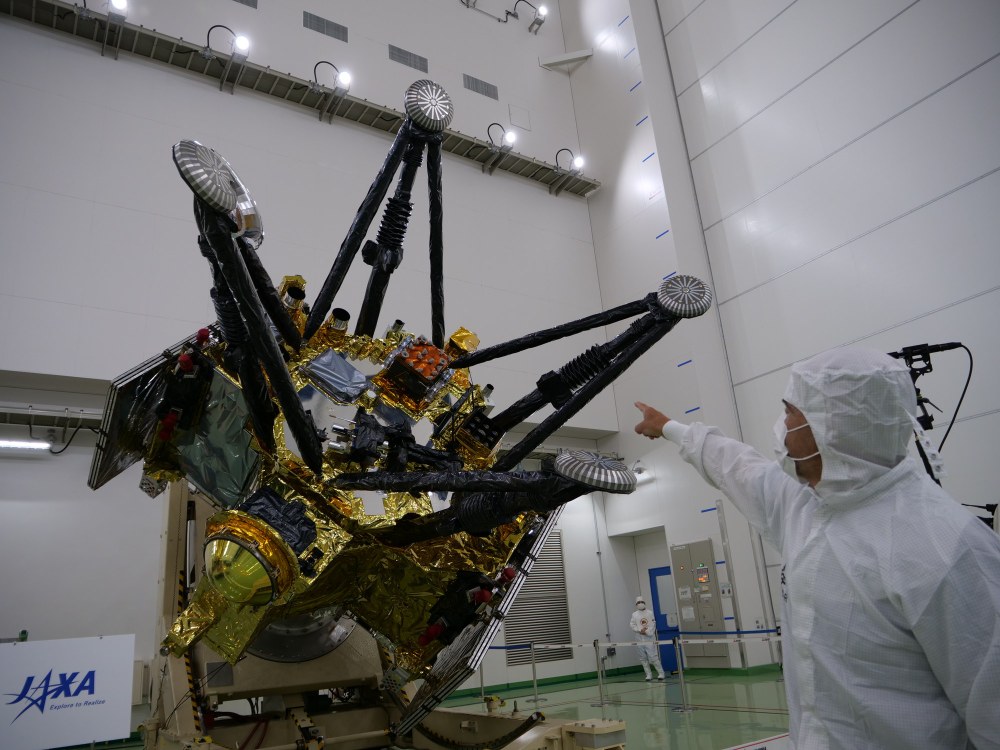
As of 2026-10-15 05:33 UTC, Japan’s Martian Moons eXploration mission, or MMX, is scheduled to leave Tanegashima on an H3 rocket at 19:41 UTC on October 19—04:41 the following morning in Japan. JAXA announced that appointment in August; ESA reaffirmed it in an October 13 mission preview. The launch remains ahead of us.[1][2]
The destination is Phobos, the larger of Mars’s two small moons. The cargo coming home is meant to be at least ten grams of its surface material. That modest quantity carries an unusually large question: did this moon arrive from elsewhere, or take shape from the wreckage of a collision with Mars?[3]
Getting closer will help. Bringing something back opens a different kind of investigation.
Why photographs have left the origin unsettled
Phobos and its companion Deimos present an awkward combination of clues. Their dark surfaces resemble carbon-rich asteroids, while their nearly circular paths close to Mars’s equatorial plane fit more comfortably with formation from a disk of debris. An explanation must account for both the material and the motion.[4][5]
The familiar alternatives are capture and impact: Mars acquired passing asteroids, or a large collision threw material into orbit that later assembled into moons. But the choice has become more interesting than that shorthand suggests. A NASA-led simulation study published in 2024 explored an asteroid torn apart during a close encounter with Mars. Some fragments remained in orbit, collided and could have supplied a moon-forming disk. The study demonstrated a possible route; it did not establish what actually happened.[5]
A returned sample gives those competing histories something physical to answer to. Its composition can help distinguish material originating in an asteroid from a mixture involving Mars and an impactor.[5] The value lies in confronting formation models with evidence they must explain together.
Why the sample still needs a map
MMX will first spend time learning where it is safe and useful to land. JAXA describes a path around Mars that keeps the spacecraft close to Phobos, called a quasi-satellite orbit. From there, observations of terrain and composition help narrow the landing candidates. A bag of grains becomes more informative when scientists know the landscape it came from.[3]
Different instruments supply different parts of that context. MEGANE measures gamma rays and neutrons to investigate the surface’s chemical elements. MIRS examines infrared light to investigate minerals. Neither instrument is simply another camera: together with imaging, their measurements help connect the eventual sampling site to the wider moon.[4]
Then Idefix, the small rover built by DLR and France’s CNES, is meant to inspect the surface before the main spacecraft lands. DLR’s current account envisages releasing it from about 40 metres up around the turn of 2028–29. It must settle onto Phobos, right itself and work in gravity less than a thousandth of Earth’s. Its observations should improve preparations for the larger spacecraft’s touchdown.[6]
That sequence explains the rover’s practical importance. Surface exploration contributes to choosing and understanding the place from which the sample will be taken. The scientific investigation and the landing preparation depend on much of the same evidence.
What Earth’s laboratories add
Returning material makes room for instruments too large, sensitive or complicated to fly. It also preserves an opportunity: future researchers can examine stored grains with techniques that do not yet exist. ESA expects the recovered material to be catalogued in Japan and shared with mission partners. The planned return to Earth is in 2031.[2]
There may be a second history mixed into the sample. JAXA expects Phobos to have accumulated material thrown off Mars by impacts. Such grains could preserve information about the planet’s changing environment.[4] Finding Martian material among the grains would therefore require careful interpretation: it could be a later arrival on the moon’s surface, rather than a simple verdict on how the entire moon formed. That is an inference from the possible mixing, and another reason the surrounding geological context matters.
The operational calendar deserves the same care. NASA’s October 8 briefing notice describes sample collection as no earlier than December 2028; ESA’s October 13 account places the main spacecraft’s sampling landing in 2030. An earliest possible date and a stated mission sequence are different kinds of information. These public summaries do not justify presenting a single sampling appointment as settled.[7][2]
The next milestones—and what would change the picture
For educators planning coverage and readers following the mission, three dated facts anchor the immediate outlook:
| Milestone | Source and status | What it establishes |
|---|---|---|
| October 15, 20:00 UTC | NASA briefing announced October 8; still upcoming at this article’s timestamp | An opportunity for updated explanations of instruments and sampling plans.[7] |
| October 19, 19:41 UTC | JAXA launch schedule, reaffirmed by ESA | The intended departure time; success requires a subsequent operational report.[1][2] |
| October 21–November 7, Japan dates | JAXA’s reserved launch period | Published provision for another attempt, with timing subject to change.[1] |
The base case is a launch within the published opportunity followed by the outward journey. The trigger for moving from anticipation to that account is confirmation of departure and spacecraft communications. An upside case would be successful departure on the first scheduled attempt followed by a healthy spacecraft checkout. The downside case is a delay beyond the reserved period or an operational fault; either would require a fresh mission schedule. These are conditional ways to read the next announcements, not probability estimates.
A short checklist keeps the coming month in perspective:
- Next 24 hours: check NASA’s briefing for clarification of the sampling sequence. Revise any intermediate date if JAXA publishes an updated plan.
- Next seven days: check JAXA’s launch notices before arranging viewing or classroom coverage. A postponement invalidates the advertised appointment.
- Next 30 days: follow reports of spacecraft health and cruise operations. Change the near-term account if those reports identify a fault or revised trajectory.
The question to carry into launch week is how each stage helps turn a handful of grains into reliable evidence about a moon’s history. The rocket begins that investigation; much of its most revealing work is intended to happen back on Earth.
Sources
- JAXA, “Launch schedule of the Martian Moons eXploration (MMX) spacecraft aboard H3 Launch Vehicle flight No.10,” August 20, 2026 — launch time, site and reserved period.
- ESA, “Mars moon lander set to launch on 19 October,” October 13, 2026 — current launch preview, mission sequence and laboratory analysis.
- JAXA, “Mission Overview/Mission Flow” — sample objective, quasi-satellite observations and landing sequence; accessed October 15, 2026.
- JAXA, “Science” — Phobos’s properties, possible Martian material and the roles of MEGANE and MIRS; accessed October 15, 2026.
- NASA, “Making Mars’ Moons: Supercomputers Offer ‘Disruptive’ New Explanation,” November 20, 2024 — competing formation mechanisms and the limits of the disruption simulations.
- DLR, “Off to the moons of Mars – MMX mission and Idefix rover ready for launch,” September 1, 2026 — rover deployment, low-gravity operations and preparation for sampling.
- NASA, “NASA Briefing to Highlight Contributions to Martian Moons Mission,” October 8, 2026 — October 15 briefing, sampling date boundary and US contributions.
- DLR, “The spacecraft’s exploration and landing module with the Idefix rover and return module” — photograph, identification and credit; accessed October 15, 2026.