As of 2026-11-02 09:36 UTC.
A faint companion has emerged beside the dot Hera was flying toward. In an October 27 update, the European Space Agency announced that its spacecraft had resolved Didymos and its smaller companion, Dimorphos, separately for the first time. Dimorphos occupied only about one pixel in the image. Even so, Hera could finally distinguish the target whose orbit NASA’s DART spacecraft changed in 2022.[1]
The next step is to connect that measured change in motion to the physical asteroid that received the blow. ESA’s planned close-up investigation asks whether DART excavated a recognisable crater or transformed much of Dimorphos, and how its mass and structure affected the outcome.[1] Those questions determine how useful this successful experiment becomes when scientists consider a different asteroid.
The impact has already passed its first test
DART deliberately struck Dimorphos on September 26, 2022. Observations subsequently showed that the smaller asteroid completed its circuit around Didymos about 33 minutes sooner. That was measurable evidence that a spacecraft collision could change an asteroid’s motion.[3]
The experiment also had a second, subtler consequence. Research published this March detected a change in the pair’s orbit around the Sun: its roughly 770-day period shifted by about 0.15 seconds. The two bodies are bound by gravity, so a blow to the smaller one can affect the motion of the system as a whole.[3]
These were measurements of a deliberately chosen test system. NASA says Didymos was never on an Earth-impact trajectory and DART could not put it on one. Their practical relevance lies in how a small change, applied sufficiently far in advance, can grow into a useful separation from a future collision course.[3]
Why a successful shove still needs explaining
Imagine trying to judge a shove by watching how much a loaded trolley changes speed. The response depends on what it carries. For Dimorphos, the relevant momentum transfer depends on the asteroid’s mass as well as its change in velocity. Measuring the orbital change therefore leaves a physical question about how much momentum was transferred.[4]
There is a further complication. DART threw material off the asteroid. That departing debris carried momentum away, giving the surviving body an additional recoil. The spacecraft’s incoming momentum alone consequently cannot account for the full response. The original momentum-transfer study made this dependence explicit: its estimate of the enhancement varied with the assumed mass of Dimorphos.[4]
Researchers have since narrowed that uncertainty from afar. The March 2026 study used stellar occultations and radar measurements to estimate the system’s change in motion around the Sun. It reported a bulk density of 1,540 ± 220 kilograms per cubic metre for Dimorphos, compared with 2,600 ± 140 for Didymos. It also estimated a heliocentric momentum-enhancement factor of 2.0 ± 0.3.[5]
That last quantity describes the response of the system in its solar orbit. Keeping the measured orbit and the assumptions attached to a number matters when comparing different accounts of DART. Hera will arrive with existing estimates to test and refine; the asteroid’s physical properties are already constrained, though incompletely.[4][5][6]
How Hera can weigh an asteroid without touching it
ESA describes one mass-measurement method through the motion of the larger body. Both asteroids move around their common centre of mass. By following identifiable landmarks on Didymos, Hera can measure its small wobble and infer the influence of its companion. Close-range observations turn familiar-looking rocks on a surface into reference points for gravitational measurements.[6]
Surface mapping supplies another part of the explanation. It can reveal where material moved and how extensively the impact changed Dimorphos. Reading those observations together with mass and orbital motion should help researchers connect the visible aftermath to the collision physics.[6]
The two small spacecraft travelling with Hera add complementary views. Milani is designed to examine surface composition through reflected light and study surrounding dust. Juventas carries radar to probe the interior, as well as instruments and radio links for investigating gravity. These are planned measurements; a successful approach does not establish that each later experiment has succeeded.[7]
Their value is the possibility of comparing the outside with the inside. A surface image can show boulders. A combined investigation can test how that material is arranged and how the whole body responds to a disturbance.[6][7] This is the bridge from observing a spectacular impact to explaining its effectiveness.
What the next pictures can settle
ESA’s October 27 announcement says detailed images of Dimorphos will be unveiled on November 25.[1] That is a stated release plan. It does not promise a completed mass determination or an immediate verdict on every impact model.
Three conditional outcomes offer a useful way to read the coming coverage. In the base case, successful approach observations produce increasingly detailed images while the physical interpretation develops over time. An upside would be observations that clearly distinguish competing explanations of the surface changes, followed by consistent gravity and interior measurements. The downside would be an operations problem or missing measurements that leave several explanations viable. These are assessment scenarios, not probabilities supplied by the mission.
For readers, teachers and editors following the story, a short checklist can keep each new claim proportional to its evidence:
- Over the next 24 hours: check the latest ESA operations update before describing approach milestones as complete.
- Over the next seven days: distinguish an image that resolves the pair from measurements that establish surface change, mass or internal structure.
- Over the next 30 days: watch for the planned November 25 release, then identify which interpretations the published observations actually support.
A revised ESA schedule would invalidate the release-date expectation. Conflicting measurements would require revisiting the physical explanation. Neither would erase DART’s observed orbital change. Hera’s scientific contribution will be to make that established success more intelligible—and more useful when the next target is different.
Sources
- European Space Agency, “First light: Hera resolves two asteroids instead of one,” October 27, 2026—resolved pair, remaining impact questions and planned November 25 image release.
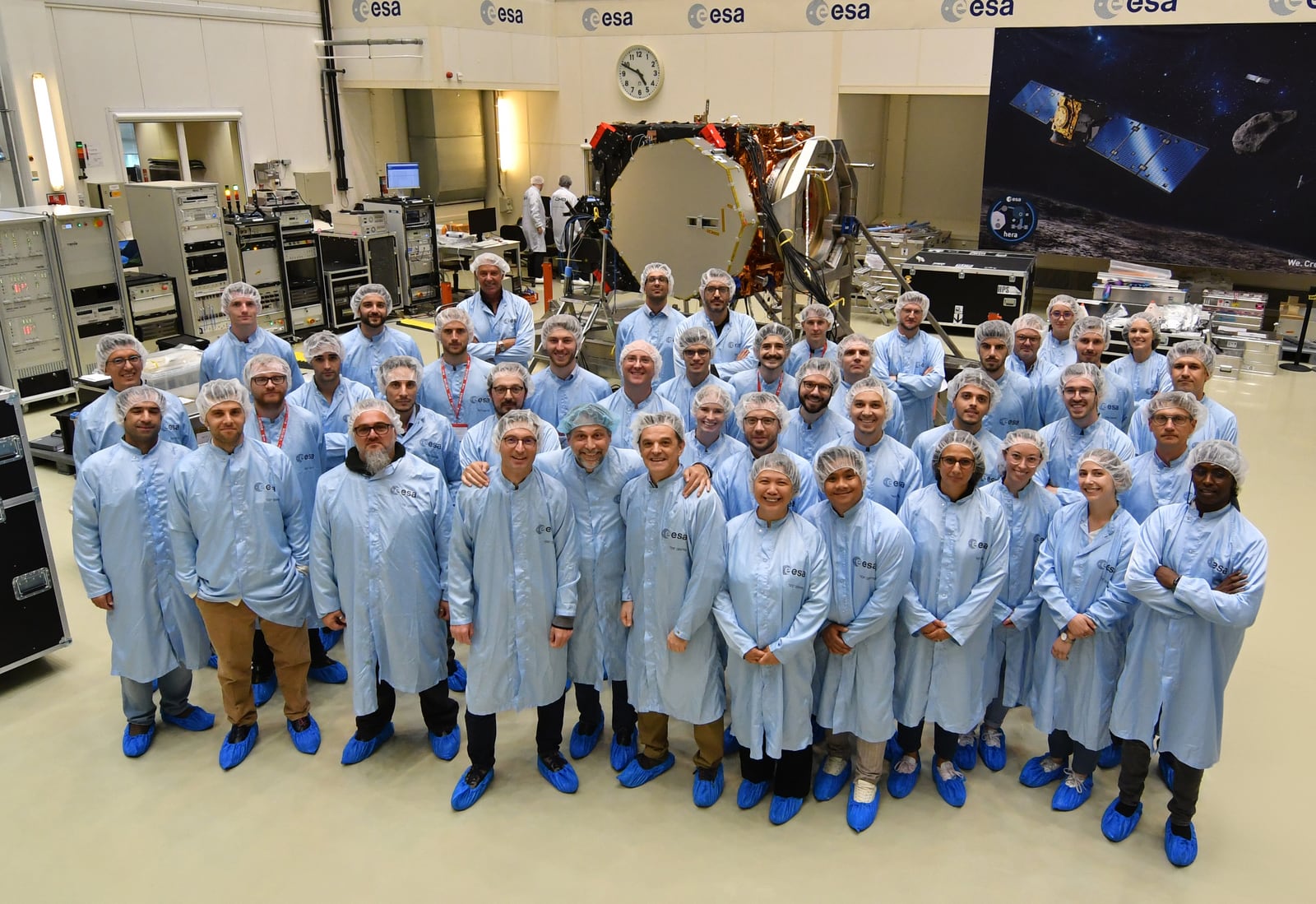
- European Space Agency, “Hera’s control team visits the spacecraft inside its cleanroom,” June 27, 2024—archival photograph, ESTEC location and ESA–A. Conigli credit.
- NASA/Jet Propulsion Laboratory, “NASA’s DART Mission Changed Orbit of Asteroid Didymos Around Sun,” March 6, 2026—binary and heliocentric orbital changes, test-system safety and advance warning.
- Andrew F. Cheng and colleagues, “Momentum transfer from the DART mission kinetic impact on asteroid Dimorphos,” Nature, 2023; author manuscript on arXiv—momentum, ejecta recoil and dependence on assumed asteroid mass.
- Rahil Makadia and colleagues, “Direct detection of an asteroid’s heliocentric deflection: The Didymos system after DART,” Science Advances, March 6, 2026; PubMed abstract—density estimates and heliocentric momentum enhancement.
- European Space Agency, “Hera’s Science”—planned mass determination from Didymos’s wobble and close-up study of the impact’s consequences; accessed November 2, 2026.
- European Space Agency, “Hera’s CubeSats”—Milani and Juventas instrument roles, radio science and interior radar; accessed November 2, 2026.