As of 2026-11-01 07:34 UTC, WHO has recognised Barbados for eliminating mother-to-child transmission of HIV as a public-health problem, following an independent assessment. The October 30 announcement reports no new infections through this route among infants born in Barbados during 2022–2024. The recognition concerns that specific transmission pathway, not the disappearance of HIV from the country.[1]
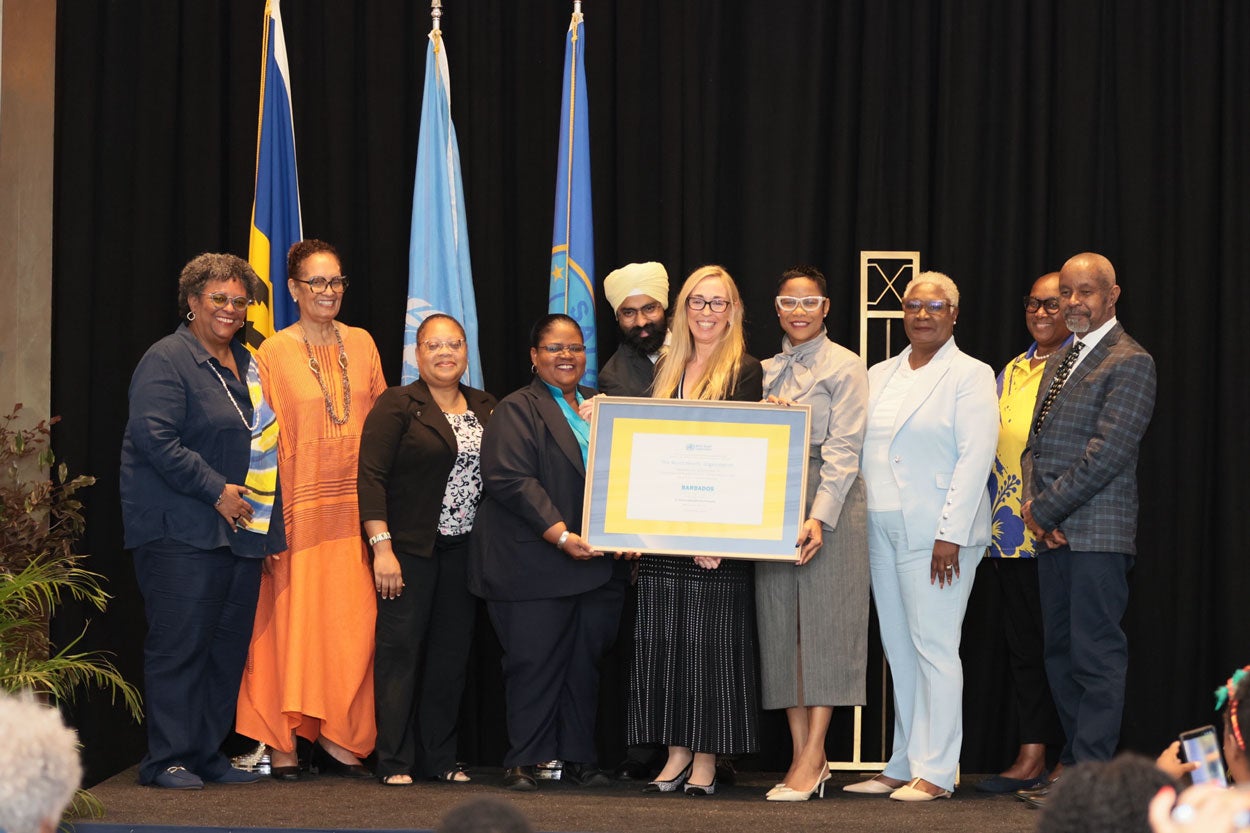
At Friday's ceremony in Maxwell, Christ Church, officials described a programme built over decades. Reporting for Barbados Today, Lourianne Graham traced its beginnings to 1995, when Barbados introduced preventive treatment for pregnant women living with HIV. The certificate recognises the cumulative result of that work.[2]
What the assessment establishes
The evidence has a defined period and scope:
| Finding | Period and source | Boundary |
|---|---|---|
| No reported infant infections from mother-to-child HIV transmission | 2022–2024; WHO/PAHO announcement.[1] | A retrospective observation, not a guarantee about future births. |
| 98% coverage for antenatal care, HIV testing and antiretroviral treatment | 2022–2024 assessment.[1] | Treatment coverage concerns pregnant women living with HIV; the other measures concern pregnant women generally. |
| 6,352 live births | 2022–2024; local ceremony reporting.[2] | All live births, not the number of babies exposed to HIV. |
WHO's validation guidance treats certification as an assessment against common criteria. Its supporting tools examine data, laboratories and programme delivery, alongside human rights, gender equality and community engagement.[3] That combination matters: a favourable infection count and a service capable of sustaining it answer different questions. Certification evaluates the broader system behind the result.
Why the services still matter
Antiretroviral treatment suppresses HIV replication and helps prevent transmission during pregnancy and through breast milk. It also protects the health of the person taking it. HIV treatment does not cure the infection, so the public-health milestone cannot be read as a reason to withdraw ongoing care.[4]
WHO's wider elimination framework connects antenatal testing with treatment, safe delivery, infant follow-up and continuing maternal care. A diagnosis has to lead to effective services; a birth has to lead to follow-up. This explains why the achievement depends on a sequence of contacts with the health system, rather than a single successful intervention.[5]
Access is part of the result. The announcement says testing and treatment are free for pregnant women regardless of nationality, and testing is voluntary and confidential.[1] WHO's validation framework explicitly includes rights and community involvement.[3] These are substantive parts of the assessment, alongside laboratory and clinical performance.
The same service network also offers a route toward WHO's broader ambition of addressing HIV, syphilis and hepatitis B together. Shared antenatal contacts can support testing and prevention across the three infections. Barbados's announcement certifies the HIV achievement; it does not announce triple elimination.[1][5]
What to watch after the ceremony
For public-health managers and readers following the programme, the next question is whether access and follow-up remain dependable. The following are conditional scenarios, not reported forecasts:
- Base case: sustained testing, treatment and infant follow-up allow the programme to preserve its gains; subsequent assessment data would support that reading.
- Upside: documented improvements in integrated antenatal services extend benefits across the three infections covered by WHO's framework.[5]
- Downside: interruptions in care or gaps in surveillance weaken confidence that the earlier results persist. Either would challenge an assumption of uninterrupted progress, without by itself establishing a formal loss of certification.
In the next 24 hours, the useful task is accurate communication of what was certified. Over the next week, programme observers can look for published follow-up commitments; over the next month, for evidence of implementation. These are monitoring horizons, not official deadlines.
- Keep the 2022–2024 evidence window attached to the zero-infection finding.
- Track service continuity and infant follow-up alongside future infection counts.
- Reassess the outlook if new data show reduced access, incomplete surveillance or a revised WHO assessment.
Sources
- PAHO/WHO, “Barbados eliminates mother-to-child transmission of HIV,” October 30, 2026 — assessment findings, access to services and photograph.
- Lourianne Graham, “Barbados meets global HIV targets,” Barbados Today, October 30, 2026 — ceremony reporting, programme history and live-birth denominator.
- WHO, “Global guidance on criteria and processes for validation: elimination of mother-to-child transmission of HIV, syphilis and hepatitis B virus,” publication page dated August 4, 2022 — validation framework and assessment tools.
- WHO, “HIV and AIDS,” July 27, 2026 — treatment, prevention and the distinction between suppression and cure.
- WHO, “Triple Elimination Initiative” — integrated antenatal services, infant follow-up and continuing care; accessed November 1, 2026.