As of 2026-10-20 22:33 UTC.
A navigation satellite needs an exceptionally steady clock. It also needs electronics that turn that clock’s timing into something a receiver can use. On October 20, ESA reported that Airbus’s first Galileo Second Generation signal generation module had passed tests in Toulouse and returned to Friedrichshafen for the next stage of assembly.[1]
The significance is what those electronics are designed to permit later: changes to navigation signals after launch. Airbus has described reconfigurable digital payloads as a central feature of its next-generation spacecraft.[2] To understand the value, follow a position fix backwards—from a receiver on Earth to the equipment being assembled in Germany.
How does a clock become a position?
A satellite broadcasts timing information and information about its orbit. A receiver uses the signal’s travel time, together with the known speed of light, to estimate distance. Measurements from several satellites allow it to establish its position. Tiny timing errors matter because radio signals cover substantial distances in extremely short intervals.[3]
An atomic clock supplies the stable reference, but it is one part of the chain. Satellite clocks also need regular synchronisation with reference clocks on the ground; stability over a few hours does not eliminate longer-term drift.[3] Precision depends on maintaining that relationship.
The transmitted signal also needs an identifiable pattern. Galileo uses codes that let receivers distinguish satellites sharing a frequency and measure how long a signal has travelled. The receiver compares an arriving code with a locally generated copy. Navigation data then supply information including satellite position and clock corrections.[4]
The signal generator sits where precise time becomes a structured broadcast. ESA describes the new module as taking timing information from onboard atomic clocks and producing navigation signals for transmission to Earth.[1]
Why change the signal after launch?
Signal design involves compromises. ESA’s technical backgrounder explains that longer codes can help distinguish signals and track faint ones, while acquiring them can require a larger search. Shorter codes can be acquired faster but are easier to confuse. Different signal designs therefore serve different needs.[4]
That is why programmability matters. Airbus’s production announcement described fully digital payloads that could be reconfigured in orbit to support new signals and services. The same announcement gave the spacecraft a planned operating life of 15 years.[2] A design expected to remain useful for that long benefits from some room to respond to needs that emerge after manufacture.
ESA says the new generator can produce different signals in real time and be reprogrammed in orbit. It identifies better resistance to interference, faster acquisition and greater positioning accuracy as potential benefits.[1] These are capabilities to develop and demonstrate; the announcement does not quantify a performance gain for a particular receiver.
The useful distinction is between changing the broadcast and achieving a better result at the user’s end. A more adaptable transmitter creates engineering options. Demonstrating their value requires the rest of the system.
What still stands between the module and service?
The immediate hardware sequence is concrete. The generator is due to be paired with a radio-frequency output module; ESA puts payload testing and full integration of the first Airbus flight satellite in 2027.[1]
There is also a ground-control sequence. In an August report, ESA described a July 3 test connecting the operational Galileo Control Centre in Oberpfaffenhofen to a Thales Alenia Space satellite model in Rome. The centre activated its payload and sent commands; the model executed them and returned telemetry about its condition.[5]
That result concerned the Thales model. It does not establish completion of the equivalent Airbus tests or qualification of a finished flight spacecraft. ESA’s report distinguished representative models from the flight models that would undergo subsequent tests.[5] The distinction explains why a successful component examination is meaningful without being the last examination.
Will receivers be ready?
EUSPA’s APOGEE project makes the user side visible. Its receiver test platform is being developed to evaluate new Galileo signals, including quasi-pilot signals intended to shorten the time needed to obtain a first position fix. The project combines simulation with receiver development so testing can proceed before full deployment.[6]
Its stated objectives include processing both legacy Galileo signals and new-generation components. EUSPA also describes configurable signal generation and receivers as tools for refining algorithms.[6] This is evidence of preparation, rather than a demonstration that every existing device will gain every proposed feature.
For equipment buyers, the implication is to ask about the specific signal and receiver capability behind a claim. “Supports Galileo” describes a broad relationship; a promise about a future feature needs a more precise explanation of what the device can receive and process.
What would demonstrate progress next?
The following are assessment scenarios, not announced outcomes. The base case is continued integration and testing, supported by published completion milestones. The upside would be tests connecting reconfiguration to measurable benefits in suitable receivers. The downside would be an incompatibility that requires hardware, software or schedule changes. A documented, successful test resolving that incompatibility would remove the specific concern.
For readers tracking the programme:
- Within 24 hours: treat the announcement as a component milestone. A formal service notice would change that assessment.
- Over seven days: look for test details and distinguish the manufacturer, model and subsystem involved before combining results.
- Over 30 days: check for integration updates and receiver evidence. Revise expectations if ESA changes the sequence or publishes measured results.
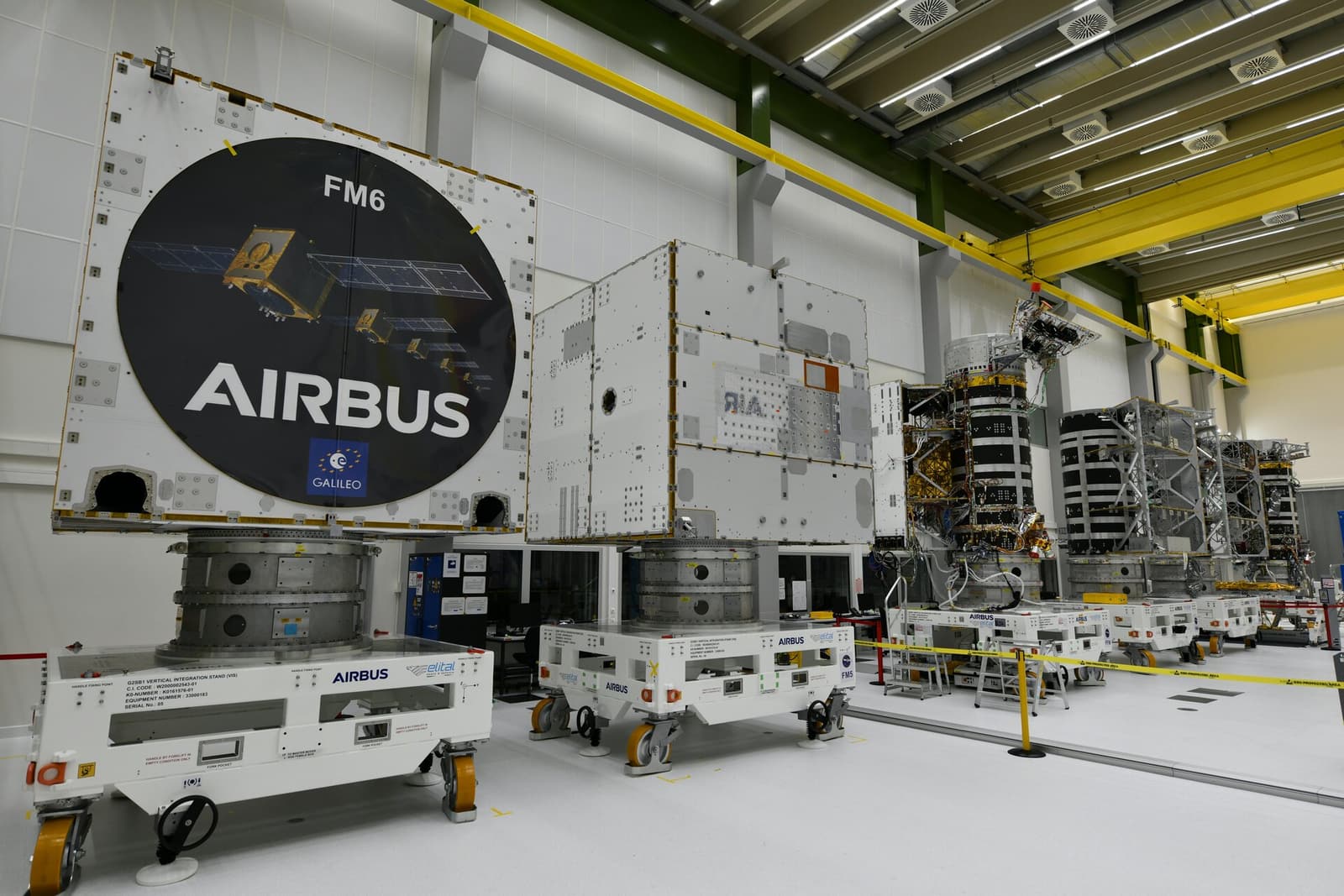
The assembly-line photograph captures the present stage well: spacecraft taking shape, with several kinds of proof still to come. The promise of an adaptable signal becomes useful when the entire journey—from clock to broadcast to receiver—works together.
Sources
- European Space Agency, “New brain for Galileo,” October 20, 2026—signal generator tests, reprogrammability and the next integration steps.
- Airbus, “Airbus starts Galileo Second Generation satellite production,” December 1, 2023—digital payload design, in-orbit reconfiguration and planned spacecraft life.
- European Space Agency, “Galileo’s clocks”—technical background on travel-time measurement, atomic clocks and ground synchronisation.
- European Space Agency, “Galileo navigation signals and frequencies”—technical background on ranging codes, acquisition tradeoffs and navigation data.
- European Space Agency, “Ground Control to Galileo Second Generation,” August 10, 2026—July compatibility test and the distinction between representative models and flight hardware.
- EU Agency for the Space Programme, “APOGEE – quAsi PilOt siGnal tEst bEd,” updated September 1, 2026—receiver simulation, acquisition objectives and preparation for new signals.
- European Space Agency, “Galileo Second Generation assembly line,” October 16, 2026—photograph and caption; image credit: Airbus Defence and Space.