As of 2026-08-02 05:35 UTC, England’s month of free bus travel for children is live. From August 1 through August 31, children aged 5 to 15 inclusive can make unlimited free journeys on participating local buses, without registering for a national pass.[1]
The promise is simple; boarding can be less so. “Free” describes the child fare, not a single nationwide set of route, identification or supervision rules. Stagecoach excludes named categories of service. Arriva sets a cross-border boundary and an accompaniment rule. Morebus uses a different accompaniment test and requires proof of age for older children.[3][4][5]
The practical question is therefore not just, “Is the scheme running?” It is, “Does this operator cover this route, in this direction, for this child under its published terms?” That distinction matters before a family plans a connection, sends a child out alone or assumes that “no registration” means “no evidence.”
Confidence is high on the dates, age band and headline funding. Confidence is lower on the first-day passenger experience: the cited public pages do not yet report an England-wide journey total, refusal rate or complaints count.
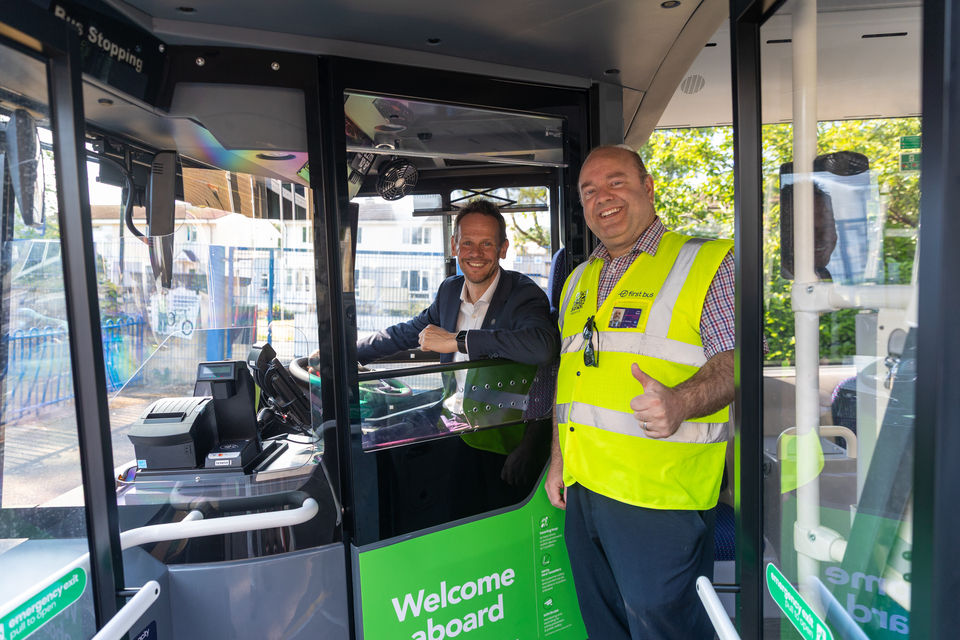
Image context: the cover shows a transport official and First Bus driver aboard a green bus. The Department for Transport published the photograph with its report of the roads minister’s July 9 launch visit in Bath, so it documents the actual rollout rather than using a generic transport image.[2]
The offer in six verified facts
| Timestamp and source | Confirmed fact | Confidence boundary |
|---|---|---|
| May 20 — HM Treasury announcement | The government committed more than £100 million to fund free fares and continue supporting bus services. It described unlimited journeys for ages 5–15, no registration and participating local buses in England.[1] | High confidence on the program envelope. The announcement does not split the quoted sum into fare reimbursement versus wider service support. |
| July 10 — Department for Transport launch detail | The travel window is August 1–31. DfT said child fares typically cost £1–£2 and again limited the offer to participating buses.[2] | High confidence on dates and eligibility. The fare range is a national illustration, not every operator’s normal price or every family’s saving. |
| Current Stagecoach terms | Most local journeys in England qualify, but certain longer-distance coach services, routes where older and disabled passengers’ concessionary travel is unavailable, and dedicated school services do not.[3] | High confidence for Stagecoach only. Its exclusions should not be projected onto another operator. |
| Current Arriva terms | Eligible journeys must start in England; school services and journeys starting in Wales are excluded. Children under 11 must travel with someone aged 16 or over, and Arriva lists accepted forms of age evidence.[4] | High confidence for the published Arriva rule. A route crossing the border can have a different result on the return leg. |
| July 24 — Morebus terms | Ages 5–11 must be with a fare-paying adult, while older children may travel independently; ages 14–15 need age evidence. Every free journey still generates a child ticket.[5] | High confidence for Morebus, with one ambiguity: its published age bands both include age 11, so an 11-year-old travelling alone should confirm the rule directly. |
| Current Medway Council list | Medway names five participating operators rather than describing every bus in the area as automatically covered.[6] | High confidence for Medway’s list at the cutoff. It is evidence of local confirmation, not a national operator directory. |
One funded offer, several boarding contracts
At the national layer, the scheme removes the eligible child fare. Treasury says there is no registration and gives an illustrative saving of £27 for a family with two children making a weekly return trip at a £1.50 child fare during August.[1] DfT describes the policy as a cost-of-living measure and points to the West of England’s earlier Kids Go Free program as its model.[1][2]
At the boarding layer, however, a passenger deals with an operator, not a press release. That operator decides whether the specific service is inside the funded offer and how the driver records the journey. Stagecoach tells a child to ask for a free ticket and retain it; Morebus likewise requires a ticket for every boarding, including for children aged 5–7 who may normally ride without one.[3][5]
This is why no registration does not mean no transaction. A family does not need to enroll in a national database or obtain a scheme-specific pass, but a driver may still need a destination, issue a zero-fare ticket or ask for evidence that an older-looking passenger is 15 or younger. Morebus explicitly accepts a clear phone photograph of a passport or birth certificate for ages 14–15, as well as a school pass; Arriva lists school, local-authority and digital travel credentials among the ways to demonstrate age.[4][5]
The adult rule is not uniform either. Arriva says a child under 11 needs a companion aged 16 or over. Morebus says children 5–11 need a fare-paying adult, while treating a concessionary-card holder as fare-paying for this purpose.[4][5] Those are differently worded tests, and Morebus’s published bands overlap at age 11. A family should not assume that meeting one operator’s companion rule automatically meets another’s.
That is not a minor footnote. The policy is partly intended to give young people more mobility, but the amount of independent mobility available depends on the operator’s conditions. Families should treat the national age band as the first eligibility test, not the final one.
The route can change the answer
“Local bus in England” is also a service test, not merely a map pin. Stagecoach publishes exclusions for categories such as dedicated school buses and some longer-distance services.[3] Arriva makes the direction of a cross-border journey decisive: a trip starting in England can qualify, while one starting in Wales does not under its scheme page.[4]
Multi-operator trips add another seam. Medway Council’s page names Arriva, ASD Coaches, Chalkwell, Nu-Venture and Kent County as participants in its area.[6] That list is useful precisely because a journey planner may show several buses that look equally local while being run under different commercial or supported-service arrangements. The first leg qualifying does not prove that the second one does.
The safest reading is narrow and operational: verify the operator printed in the timetable for each leg, then check that operator’s scheme page for the exact route. Do the same for the return journey, especially where a route crosses the England–Wales boundary or changes operator after a connection.
Decision impact: 24 hours, seven days, thirty days
Next 24 hours — plan the boarding, not just the destination. Families travelling this weekend should identify the operator for both directions, check exclusions, carry suitable age evidence for older children and confirm whether a younger child needs any adult or a fare-paying adult. Keep enough money or another route available for a service that turns out not to participate. On board, ask for the free child ticket and retain it until the journey ends.[3][4][5]
Next 7 days — close the information gaps. Operators and local authorities should put participation, excluded route numbers, age evidence and accompaniment rules on one plainly dated page. Where age bands overlap—as they currently do at age 11 on Morebus’s page—the operator should resolve the wording. DfT can reduce failed journeys by linking those local rule pages from a central directory rather than repeating only the national promise.
Next 30 days — measure access, not announcement reach. Government and operators should publish total free journeys, geographic coverage, disputed boardings and the share of participating services. Ridership alone will not show whether the scheme worked evenly: a useful evaluation would separate age groups, urban and rural networks, accompanied and independent travel, and routes that were excluded. Parliament’s only published answer about continuation says the measure is time-limited to August 1–31; it does not promise an extension or state a renewal test.[7]
Three ways the month could unfold
Base path — high take-up with manageable local friction. Most children ride free, while a minority of journeys require an operator-page check, age evidence or a paid adult companion. Triggers: stable service delivery, clear local notices and no sustained rise in complaints about refused boarding.
Upside path — the rulebook becomes easier during the month. DfT, councils and operators converge on a searchable participation list and plainer age rules; the offer brings new riders without material crowding or reliability problems. Triggers: harmonized public guidance, rapidly corrected ambiguities and published journey counts showing broad geographic use.
Downside path — the headline outruns the network. Families read “every child” as “every bus,” then encounter excluded services, different adult conditions or missing proof-of-age rules at the stop. The reputational cost could be larger than the fare involved, especially for a child travelling independently. Triggers: repeated refusal reports, unresolved operator-list gaps, overloaded services or conflicting instructions from councils and carriers.
These are conditional paths, not forecasts. At the cutoff, the program terms are visible but national performance data are not.
Boarding checklist and invalidation conditions
- Confirm that the passenger is 5–15 inclusive and the journey takes place no later than August 31.[1][2]
- Find the actual operator for every outward and return leg; do not infer participation from the color of the bus stop or from another operator on the route.[3][6]
- Check route exclusions, especially dedicated school, longer-distance and cross-border services.[3][4]
- Check the operator’s supervision rule for a child travelling without a parent, particularly around age 11.[4][5]
- Carry accepted age evidence for an older child even though national registration is not required.[1][4][5]
- Ask the driver for the free child ticket, state the destination if requested and keep the ticket for the journey.[3][5]
- Carry a backup fare or route until the first trip confirms how the local service is applying the offer.
Invalidation conditions: revise this explainer if DfT publishes binding nationwide boarding terms that replace operator-specific conditions, if an operator changes its participation, age, evidence or accompaniment rules, or if Parliament extends the program beyond August 31. Revise the impact assessment when national journey, refusal and service-reliability data become available. Until then, the accurate shorthand is: England has a national free-fare offer for children, delivered through local rulebooks.
Sources
- HM Treasury, Prime Minister’s Office and Department for Transport, “Cost of living boost with free bus travel for children and targeted food tariff cuts” (May 20, 2026) — funding envelope, national eligibility, unlimited-journey and no-registration terms, savings example and West of England pilot figures.
- UK Department for Transport, “School’s out: Free bus travel for kids set to launch in summer holiday cost of living boost” (July 10, 2026) — launch dates, participating-bus boundary, indicative child fares and provenance of the Bath launch photograph used as the cover.
- Stagecoach, “Kids Go Free with Stagecoach Bus this August” (current August 2026 terms) — eligible period, local-service exclusions, boarding instructions and ticket retention.
- Arriva UK Bus, “Kids free bus travel” (current August 2026 terms) — England-origin, school-service, proof-of-age and under-11 accompaniment rules.
- Morebus, “Great British Summer Savings” (July 24, 2026) — accompaniment, ticketing and proof-of-age terms, including the published age-11 overlap.
- Medway Council, “Free bus travel for children summer 2026” (current scheme page) — local dates and named participating operators in Medway.
- UK Parliament, written question 5653, “Bus Services: Children” (answered June 9, 2026) — official statement that the measure is time-limited to August 1–31.