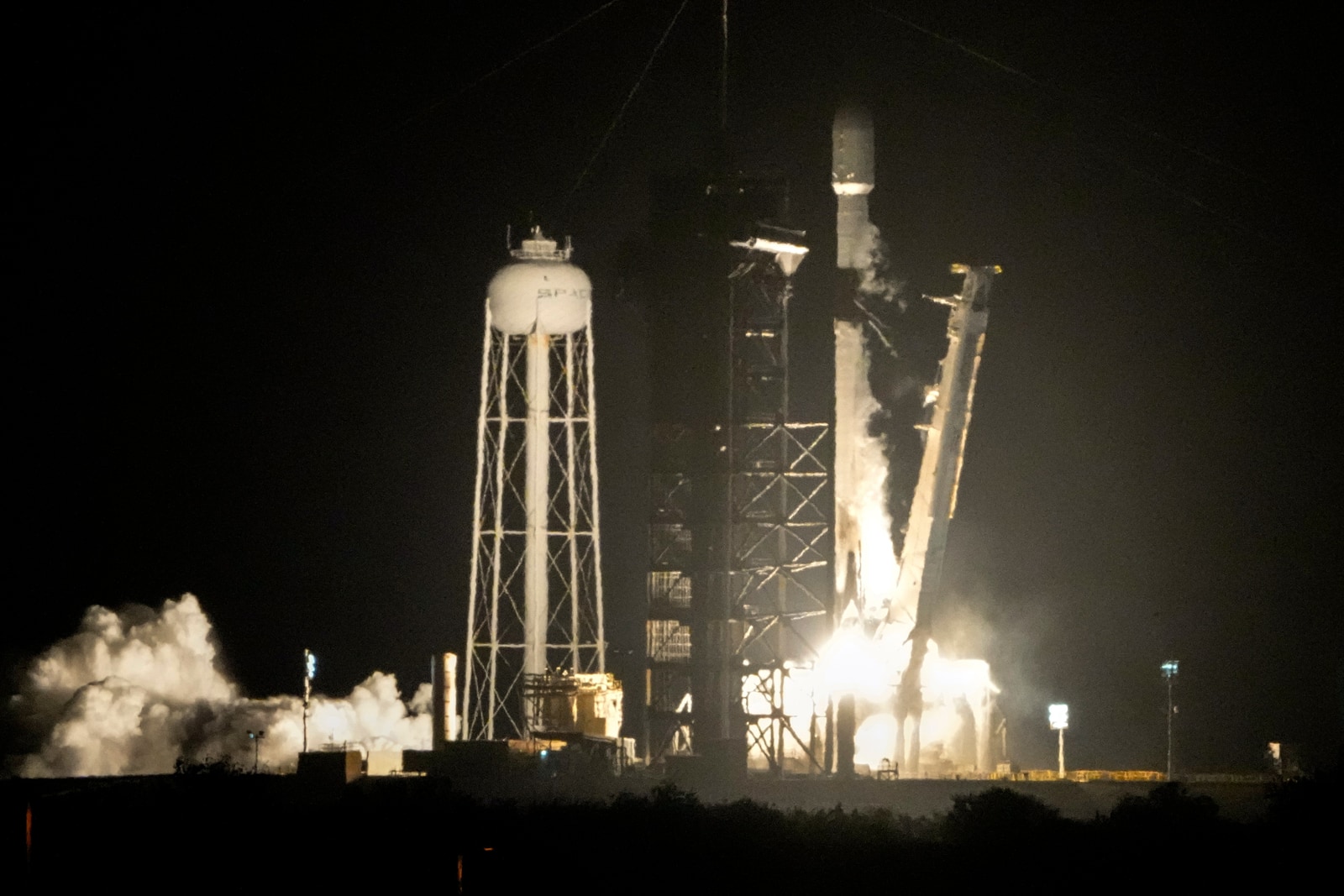
As of 2026-08-04 05:35 UTC, the spent Falcon 9 upper stage catalogued as 2025-010D was on course to strike the Moon near Einstein Crater at about 06:35 UTC on August 5. Bill Gray's August 1 tracking solution placed the collision at 06:35:37.5 UTC, with the remaining practical uncertainty measured in seconds and kilometres rather than in whether the stage will hit.[1]
The spectacle is much less certain. The roughly four-metric-ton stage should arrive at 2.43 kilometres per second on sunlit terrain near the lunar limb. A flash lasting less than a second may be lost against that bright surface; a slower curtain of ejecta may rise far enough to be seen against dark sky beyond the Moon's edge.[2][3]
That difference is why the event matters. This is not an emergency and the impact poses no danger to people on Earth. It is a rare, timed experiment in which astronomers know the impactor's origin, approximate mass, speed and arrival window before it makes a crater. A detection would calibrate models; a well-documented non-detection would constrain them too.[1][2]
Confidence is high on the collision and its timing, moderate on the final impact point, and low on naked-eye or casual-telescope visibility. Published estimates put the stage near 3,900–4,900 kilograms, and the two current plume studies are preprints built on different simplifying assumptions. Treat their brightness and plume-height figures as testable forecasts, not observations.[1][2][3]
Image context: the cover is John Raoux's file photograph of the January 15, 2025 launch that put Blue Ghost and Resilience on lunar trajectories. It shows the actual Falcon 9 mission whose upper stage is now approaching the Moon, rather than a generic rocket launch.[4][5]
The event in six verified signals
| Signal | What is established | Confidence boundary |
|---|---|---|
| Orbit solution | Gray's August 1 calculation predicts impact at 06:35:37.5 UTC, near 19.461° N, 93.293° W.[1] | The stage's irregular tumble makes solar-radiation pressure imperfectly predictable. Gray therefore trusts the result to a few seconds and a few kilometres, not the much tighter formal error. |
| Identity | 2025-010D is identified as the Falcon 9 upper stage from the January 15, 2025 launch of Firefly's Blue Ghost and ispace's Resilience landers.[1][5] | The identification is strong, but the exact remaining mass and attitude at impact are not directly measured. |
| Impact conditions | The observation-plan team uses an approximate mass of 4,000 kilograms, a speed of 2.43 km/s and an impact angle of about 34° from vertical.[2] | Gray estimates 4,900 kilograms, while a second modelling team uses about 3,900 kilograms.[1][3] Energy and crater forecasts inherit that spread. |
| Three observables | Researchers separate the event into a sub-second flash, a dust-and-rock plume evolving over minutes, and a final crater expected to be roughly 20–30 metres wide.[2] | No one has yet observed this impact. Flash brightness ranges from potentially detectable to effectively invisible depending on orientation and whether the stage meets loose regolith or exposed bedrock. |
| Ground campaign | Allocated instruments include the 3.5-metre telescope at Apache Point, the 4.3-metre Lowell Discovery Telescope and an 8.2-metre unit of the Very Large Telescope. Amateur observations are also invited.[2] | Weather, daylight, lunar glare, camera cadence and pointing can each turn a real event into a non-detection. |
| Orbital follow-up | NASA's Lunar Reconnaissance Orbiter has planned before-and-after imaging; South Korea's Danuri orbiter is expected to pass within kilometres of the stage about two minutes before impact and pursue same-day follow-up.[2][4] | A spacecraft may confirm the crater without capturing the instant of impact. Those are different results and should be reported separately. |
Watch the edge, not the headline flash
The first target is the impact flash: light produced as the stage and surface material are heated and fragmented. It should last less than a second, so a camera needs rapid, accurately timestamped exposures. The main observation-plan paper recommends at least 20 frames per second when possible. But this is a slow impact by lunar standards. Natural meteoroids commonly arrive many times faster, and the Falcon stage may not make a bright shock in competent bedrock. The lit lunar surface further reduces contrast.[2]
The second target is the plume. Here the geometry could help. The predicted site sits close to the limb, so material rising above the surface may be silhouetted against black sky rather than the bright Moon. One model resolves larger ejecta reaching about 1.5 kilometres, infers that smaller unresolved fragments will travel higher, and predicts that the longest-lived material may remain aloft for minutes. A newer, higher-resolution model predicts a curtain roughly 15–20 kilometres high and a narrow central component reaching much higher—but only for a vertical, engine-first impact. The real stage's attitude is unknown, and the expected collision is oblique.[2][3]
That caveat is the story, not an inconvenience. If observers see a lower, wider or fainter plume, the result may reveal how a hollow rocket body couples energy into regolith when it does not arrive engine-first. If they see nothing, synchronized data from multiple instruments can still place an upper bound on brightness. “Not visible” is useful only when exposure, cadence, filter, weather, pointing and time synchronization are known.
The third target arrives later: the crater. It will be far too small for an Earth-based telescope to resolve, but orbital images should expose fresh material and the crater's shape. That follow-up can settle whether a live non-detection reflected weak light, obstructed geometry or merely an observing failure.
Two precedents explain why silence still counts
NASA deliberately sent the LCROSS Centaur stage into Cabeus crater in 2009, then flew a shepherding spacecraft through the plume. The mission excavated about 350 metric tons of material, made a crater estimated near 20 metres across and helped establish the presence of water ice at the lunar south pole.[6] Yet ground campaigns did not simply receive an obvious movie of the event: the flash was hidden by local topography, initial plume searches came up empty, and later processing recovered a faint signal in existing data.[2]
In March 2022, another rocket body struck the lunar far side. Lunar Reconnaissance Orbiter images later revealed an unexpected double crater about 28 metres across at its longest dimension.[7] No telescope on Earth could watch that collision directly. The crater became the evidence.
Those cases set the correct standard for August 5. A bright plume would be an unusually legible measurement, not the threshold for declaring the impact real. The result should be assembled across three clocks: immediate high-cadence imaging, minutes-long plume searches and days-to-weeks orbital comparison.
What changes over 24 hours, seven days and thirty days
Next 24 hours — preserve the observation window. The nominal impact comes one hour after this horizon. Professional and equipped amateur observers in much of the Americas have the best combination of darkness and lunar altitude. The scientific priority is not a dramatic eyepiece view; it is continuous, time-synchronized recording around the latest predicted time, with a practice run under similar lunar illumination. Observers should keep recording after the nominal second because the plume may take time to clear the limb.[1][2]
Next 7 days — separate reports from evidence. Early social posts will be vulnerable to hot pixels, atmospheric shimmer, compression artifacts and ordinary lunar glare. A credible claim needs raw or minimally processed frames, precise UTC timing, equipment details and preferably an independent detection from another site. Danuri and LRO results should be labelled by what they actually show: conjunction, fresh surface change, crater identification or plume—not bundled into a generic “impact seen” claim.[2]
Next 30 days — turn one collision into a reusable calibration. Researchers can compare the measured or bounded brightness, plume duration, ejecta extent and crater geometry with both pre-impact models. Mission planners should also preserve the tracking history as a cislunar-debris case study. One harmless lunar strike does not establish a broad casualty risk, but it does demonstrate that an abandoned stage can spend more than a year on a Moon-crossing path before returning as an uncontrolled impactor.[1][2]
Three science-yield paths
Base path — the impact occurs on schedule, the live signal is ambiguous, and orbital images identify the crater. This would repeat the central lesson of earlier artificial impacts: the event can be real and scientifically useful without being visually obvious from Earth. Triggers: no independently confirmed flash, mixed plume reports, and a new 20–30-metre-scale surface feature in aligned before-and-after imagery.
Upside path — multiple instruments recover the same flash or plume. Time-aligned detections across sites or wavelengths would constrain brightness, duration and ejecta geometry far better than a single attractive frame. Triggers: consistent UTC onset, common sky position, reproducible image differencing and agreement with subsequent crater coordinates.
Downside path — observing conditions erase most of the live record and follow-up remains hard to interpret. Clouds, daylight, glare, timing errors or a slightly far-side impact could prevent useful ground data; complex terrain could delay confident crater identification. Triggers: no calibrated datasets, incompatible single-site claims, or post-impact images without sufficiently matched baseline coverage.
These paths rank scientific return, not physical danger. The stage is not a threat to Earth, and none of the scenarios turns this particular collision into a crisis.[1][4]
Observation checklist and invalidation conditions
- Use Gray's latest ephemeris rather than copying an older rounded time; synchronize the acquisition computer to UTC.[1]
- Record continuously before and after the predicted second. Optimize high cadence for the flash, then retain longer exposures or sequences suited to the slower plume.[2]
- Save raw frames, calibration files, exact location, telescope aperture, camera, filter, exposure, frame rate, weather and pointing details.
- Do not describe a simulation as imagery of the event. The 15–20-kilometre curtain and higher central spike are model outputs under a vertical, engine-first assumption.[3]
- Seek independent confirmation before publishing a bright pixel or blur as the impact. A non-detection should likewise state the instrument's sensitivity and observing conditions.
- Compare immediate reports with later Danuri and LRO evidence. A crater confirmation is decisive evidence of impact even if no flash or plume is recovered.[2][7]
Invalidation conditions: update this brief if the final tracking solution materially shifts the time or moves the site beyond the visible limb; if the object identification is revised; or if post-impact data show no new crater near the resolved trajectory. Replace every forecast tense after the event with observed results and their provenance. Withdraw the central claim—that visibility, not collision, is the open question—if pre-impact tracking no longer supports a lunar strike or sufficiently matched post-impact imagery finds no crater near the resolved trajectory.
Sources
- Bill Gray, Project Pluto, “Upper stage impacting the Moon on 2026 August 5” (updated August 1, 2026) — object identification, orbit history, latest impact solution, uncertainty mechanism, speed and visibility caveats.
- Benjamin Fernando et al., “Observational planning for the 2026 August 5 Falcon 9 Upper Stage lunar impact” (arXiv preprint, submitted July 16, 2026) — impact conditions, observables, simulations, ground campaign, spacecraft follow-up and data-sharing plan.
- William Jo et al., “Predicted Ejecta Dynamics and Observability of the 2026 Falcon 9 Upper Stage Lunar Impact” (arXiv preprint, submitted July 27, 2026) — high-resolution ejecta and brightness model, including its vertical engine-first assumption.
- Marcia Dunn, “A piece of SpaceX rocket will slam into the moon. How to see the aftermath,” Associated Press (July 31, 2026) — current reporting, independent expert context, orbiter plans and provenance of the John Raoux launch photograph used as the cover.
- Firefly Aerospace, “Blue Ghost Mission 1 Successfully Launches and Begins 45-Day Transit to the Moon” (January 15, 2025) — primary launch record, payload separation and mission timeline.
- NASA Science, “LCROSS” — mission chronology, impact speed, excavated mass, crater estimate and plume sampling.
- NASA, “NASA's Lunar Reconnaissance Orbiter Spots Rocket Impact Site on Moon” (June 24, 2022) — orbital identification and dimensions of the 2022 double-crater impact site.