As of 2026-10-26T19:32:28Z (UTC).
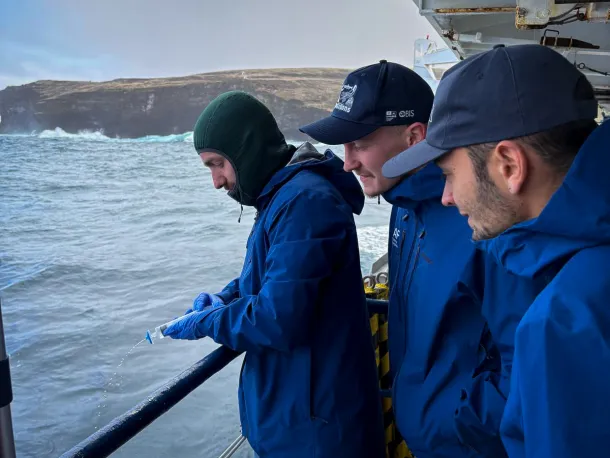
Seawater DNA sampling has begun in the Crozet Archipelago. UNESCO reported on October 23 that the French Southern and Antarctic Lands' new survey covers seven sites, including four sampled in 2022. Returning creates an opportunity to investigate ecological change.[1]
But a longer species list would not, by itself, answer that question. Environmental DNA can reveal organisms that conventional surveys miss. Establishing ecological change requires checking whether the difference lies in the sea, the sampling, or the identification process.[3][5]
What has actually been announced?
| Evidence | Reported status | What it establishes |
|---|---|---|
| 2022 survey | Four sites; 181 species and 418 taxa detected | An earlier reference point. Some identifications stop above species level. |
| 2026 survey | Seven sites, including the original four | Wider coverage plus opportunities for comparison. |
| October 23 update | Sampling under way at Crozet | Fieldwork has begun; the announcement supplies no new results. |
These figures come from UNESCO's announcement; they have not been independently audited here.[1]
Why returning is difficult—and valuable
The earlier expedition gives a sense of the work behind a bottle of water. At Kerguelen, another archipelago in the same French southern territory, researchers reached Swains Bay in December 2022 after a five-hour hike and a 315-metre climb. Another sampling location required a boat. UNESCO's contemporary account describes shoreline collection and the possibility of combining DNA results with acoustic evidence of cetaceans.[2]
That history matters because a biodiversity inventory also records where people managed to sample. Wider coverage can uncover life simply by looking somewhere new. Revisiting earlier locations offers a firmer comparison, provided researchers account for sampling and analytical differences.[5]
The practical attraction is substantial: a water sample can carry evidence of organisms without researchers having to catch each one. For a protected area with difficult access, that makes repeated observation more feasible.[2]
How a bottle becomes a species record
Marine organisms release genetic material through mucus, waste and shed tissue. Researchers collect water, extract DNA and compare sequences with reference libraries. NOAA's Northeast Fisheries Science Center describes using this approach alongside established surveys, including water sampling from fixed stations and comparisons with trawl catches and underwater sound recordings.[3]
The reference library is part of the measurement. A fragment does not arrive with a species name attached; identification depends on matching genetic evidence to known sequences. The method therefore combines field collection with laboratory work and interpretation. NOAA's comparisons with other observations help establish what each approach detects well.[3]
Water also moves. The US Geological Survey explains that currents distribute and dilute environmental DNA, while environmental conditions affect its degradation. A sampling position is consequently the place where genetic material was collected; it need not pinpoint the animal that released it.[4]
A new detection is the beginning of an explanation
A widely cited methodological review by Caren Goldberg and colleagues identifies several things that can complicate interpretation: contamination, inhibited laboratory reactions, uncertainty in positive and negative results, transported DNA, and limits on relating DNA measurements to abundance.[5]
Applied to Crozet, those cautions establish a sensible sequence. An unexpected detection should prompt scrutiny of the identification and sample handling, followed where appropriate by repeat sampling or another observation method. A missing detection should be treated as an uncertain observation before it becomes a claim of disappearance. And a list of detected species alone cannot establish how many animals live there.[5]
This is why survey design belongs in the news. The more compelling eventual finding would be a difference that survives checks on comparability and detection, rather than an impressive total released without that context.
What would turn the fieldwork into useful evidence?
The broader eDNA Expeditions 2026–2028 programme illustrates the direction of travel. Its website describes support for 25 marine sites, recurring collection every three months, results returned to local teams, and open sharing through the Ocean Biodiversity Information System.[6] Crozet's announcement does not specify its campaign's sampling cadence.[1]
For readers following the next updates, three conditional outcomes are useful:
- Base case: documented repeat samples build a stronger baseline, even if they reveal no clear ecological shift.
- Upside: a surprising detection survives quality checks and corroboration, giving managers a reason to investigate a particular species or location.
- Downside: sampling or analytical differences prevent a reliable comparison with 2022, leaving two useful inventories without a defensible trend.
These are an assessment of what the evidence could support, not project forecasts or a promised results timetable.
In the next day or week, conservation readers should distinguish fieldwork updates from released findings. Over the next month, look for methods and comparison data. No results deadline is given in the announcement.[1]
When results arrive:
- Check whether comparisons use the same locations and explain any methodological changes.
- Look for how unexpected detections were checked and uncertain identifications reported.
- Reconsider any claim of ecological change if it disappears after accounting for wider coverage or different detection methods.
Sources
- UNESCO, “Tracing marine life from a water sample: eDNA sampling begins in the Crozet Archipelago” (October 23, 2026)—current fieldwork, earlier totals, survey expansion and photograph credit.
- UNESCO World Heritage Centre, “Young scientists sample seawater in search of vulnerable marine species in the French Austral Lands and Seas” (December 15, 2022)—Kerguelen fieldwork, access constraints and complementary observations.
- NOAA Fisheries, “Environmental DNA Research in the Northeast” (updated May 14, 2025)—reference-library matching and comparisons with acoustic and trawl surveys.
- US Geological Survey, “Environmental DNA (eDNA)” (June 5, 2018)—sources, transport, dilution and degradation of genetic material in water.
- Caren S. Goldberg and colleagues, “Critical considerations for the application of environmental DNA methods to detect aquatic species,” Methods in Ecology and Evolution (2016), USGS publication record—quality control, detection uncertainty and inference limits.
- eDNA Expeditions 2026–2028, official programme website (accessed October 26, 2026)—global scope, recurring sampling and return of results to participating sites.