As of 2026-05-11T08:04:32Z (UTC), the useful way to read the Justice Department's May 7 Agri Stats settlement is to ignore the easiest headline twice over. The first easy read says Washington has found a quick lever to make meat cheaper at the grocery store. The second says this is just a technical antitrust cleanup in a niche data business. Neither is right. What the government actually filed in Minnesota is a structural remedy aimed at a very specific market design problem: for years, meat processors allegedly got granular competitor intelligence from Agri Stats while buyers such as restaurants, grocers, and food distributors were shut out of the same information channel.[1][2][3]
That distinction matters because the settlement is not built around a price cap, a merger block, or a subsidy. It is built around who can see what, how current that information is, and whether the data advantage is one-sided. Under the proposed final judgment, Agri Stats would have to stop its sales reports and non-public pricing information, stop company- and facility-level production, cost, and labor reporting, and make the vast majority of the information it still distributes available to interested domestic purchasers on reasonable and non-discriminatory terms.[1][2] That last point is the live signal. The government is not only trying to suppress an alleged competitor-information loop. It is trying to break the asymmetry between processors and buyers.[1][2]
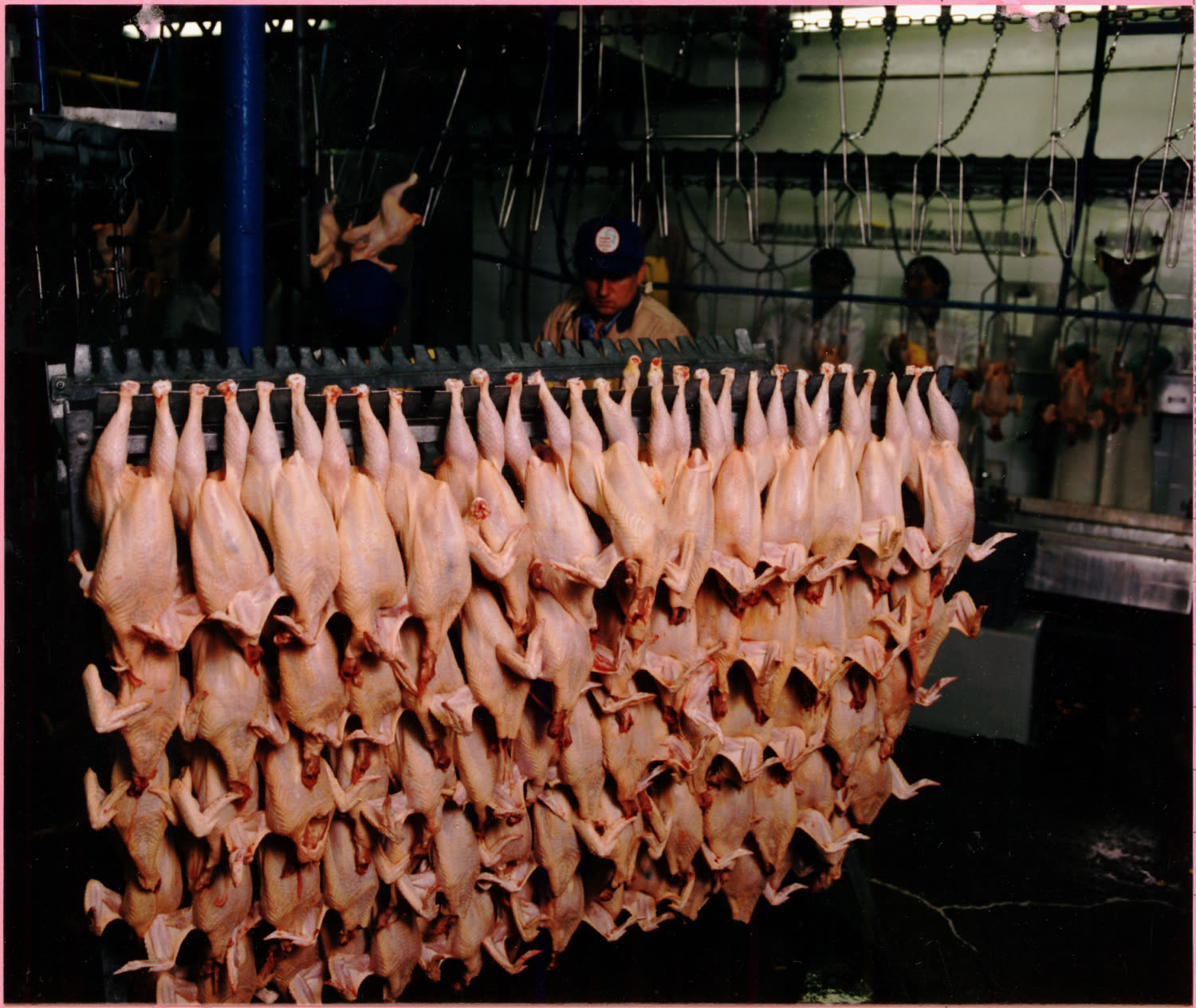
Image context: the cover uses a real archival photograph from a poultry-processing plant because the case turns on information exchange inside meat-processing markets. A courthouse image would flatten the story into litigation theater; the more accurate scene is the processing floor where chicken, pork, and turkey output is priced, tracked, and benchmarked.[6]
Fact file
- Current filing: DOJ announced the proposed settlement on May 7, 2026, in the District of Minnesota.[1][3]
- Markets at issue: the case centers on broiler chicken, pork, and turkey, not the entire meat complex.[1][4][5]
- Core remedy: Agri Stats would have to terminate sales reports, stop sharing non-public pricing information, stop company- and facility-level production, cost, and labor reporting, and open most remaining data to domestic purchasers on reasonable and non-discriminatory terms.[1][2]
- Additional controls: the proposed final judgment includes timeliness restrictions, a court-approved monitor, and an antitrust compliance program.[1][2]
- Current procedural posture: the settlement still goes through the Tunney Act process, including publication and a 60-day public comment window before final court approval.[1][3]
- Trial that now may not happen: California's attorney general said the case had been scheduled to go to trial in Minnesota on May 18, 2026.[4]
What the settlement actually changes
The most important part of the remedy is not simply that some reports go away. It is the combination of less competitor-specific visibility and more buyer-side visibility. DOJ's press release spells out both halves. Agri Stats must stop the reports processors allegedly used to identify pricing opportunities, and it must stop the company- and facility-level operating detail that gave rivals near-total visibility into one another's businesses.[1] At the same time, DOJ says most of the remaining information Agri Stats distributes must be made available to all interested domestic purchasers on reasonable and non-discriminatory terms.[1][2]
That is why the article treats this as a buyer-data symmetry file. If the allegations were right, the old system did more than let processors benchmark themselves. It allegedly let them see enough of the market, fast enough, and in a sufficiently exclusive way to weaken buyer bargaining and make coordinated price increases easier.[1][4][5] The proposed judgment tries to cut both edges of that advantage: less granular rival intelligence for processors, less exclusivity against buyers.[1][2]
DOJ's carve-out for Express Markets Inc. (EMI) helps clarify the theory.[1] The department says EMI can keep operating substantially as before because its reports are less detailed and already available to all interested parties. That implies the government's problem is not "market information" in the abstract. The problem is granular, timely, exclusionary market information that sits inside one side of the negotiation.[1]
Why this is not a one-step cure for meat prices
The settlement still matters for consumers, but the mechanism is narrower than the broadest political framing suggests. First, this is a proposed settlement, not a final judgment already in force. There is still a publication-and-comment phase before the court decides whether the remedy is in the public interest.[1][3] Second, the case is about an information-exchange system in chicken, pork, and turkey markets. It is not a master switch for every force pushing meat bills up or down.[1][4][7]
That boundary is worth keeping explicit because outside coverage is already showing the risk of over-reading the grocery-price claim. AP noted that U.S. beef prices, for example, have been shaped by additional forces such as drought, herd contraction, and border restrictions on Mexican cattle imports.[7] The Agri Stats case may still matter politically as a cost-of-living enforcement file, but its direct legal target is much narrower: the government's claim that a closed benchmarking network helped processors coordinate around price and output more effectively than competition law should allow.[1][4][5]
So the sharp reading is this: the settlement is not a magic "meat gets cheaper" button. It is a bid to change the bargaining map in three processor-heavy protein markets by making one kind of privileged competitor visibility harder to maintain.[1][2][4]
Why the background allegations still matter
The 2023 filings explain why DOJ and the plaintiff states were willing to pursue this theory in the first place. California's 2023 release described a "give to get" structure in which subscribing meat processors gave Agri Stats current business information and received standardized weekly and monthly reports in return.[5] The same release said Agri Stats refused to sell those reports to meat purchasers, farmers, workers, or consumers, preserving an advantage for the processor side of the market.[5] California's 2026 settlement release pushes the theory further, saying processors used the reports to raise prices when they learned they were below industry averages and that executives at some large processors could not recall examples of using Agri Stats information to lower prices to win share.[4]
Those allegations are still only allegations in the usual legal sense; the proposed final judgment is entered without trial and without adjudication of disputed facts.[2] But they still define the logic of the remedy. The government's theory was not merely that Agri Stats sold data. It was that the company sold a shared competitive map concentrated among firms that together accounted, at the time of the complaint, for more than 90% of broiler chicken sales, 80% of pork sales, and 90% of turkey sales in the United States.[4][5] In a market shaped that way, who gets market information, and on what terms, becomes a competition question rather than a neutral analytics question.[4][5]
What to watch next
The first checkpoint is the public-comment process. A final judgment does not exist yet; it still has to survive the Tunney Act path.[1][3] The second checkpoint is the practical definition of "vast majority" and "reasonable and non-discriminatory terms" once the remedy is operationalized.[1][2] Those phrases are where real market structure changes either become meaningful or get diluted.
The third checkpoint is broader enforcement spillover. AP noted DOJ is separately investigating possible antitrust violations in beef processing.[7] That does not mean this case automatically expands. It does mean the Agri Stats remedy may be read as a template: when dominant firms share detailed market intelligence in a closed loop, the government may try to attack not only the content of the data but also the exclusivity of its distribution.[1][7]
The narrow conclusion is the durable one. As of May 11, 2026, the Agri Stats settlement should be understood less as a retail-price breakthrough than as an attempt to rewire market visibility in chicken, pork, and turkey processing.[1][2][4] If the court approves it, the lasting change will not be a slogan about affordability. It will be that a data broker once accused of helping processors see one another more clearly would have to operate with far less exclusivity against the buyers negotiating across the table.[1][2]
Sources
- U.S. Department of Justice, "Justice Department Requires Agri Stats to End Exchange of Competitively Sensitive Information Among Nation's Largest Meat Processors that Suppressed Competition and Increased Prices for Decades" (May 7, 2026).
- United States District Court for the District of Minnesota, United States et al. v. Agri Stats, Inc. - Proposed Final Judgment (filed May 7, 2026 PDF).
- U.S. Department of Justice Antitrust Division, "U.S. v. Agri Stats, Inc." case page, updated May 7, 2026.
- California Department of Justice, "Attorney General Bonta Secures End of Unlawful Meat Price Coordination, Announces Settlement with Agri Stats" (May 7, 2026).
- California Department of Justice, "Attorney General Bonta Joins Lawsuit Against Agri Stats for Facilitating Meat Processors' Unlawful Increase of Chicken, Pork, and Turkey Prices" (November 6, 2023).
- Wikimedia Commons, "File:Meat inspectors at poultry processing plant (I0003215).jpg" - source page for the cover photograph.
- Associated Press, "Trump administration settles meatpacking antitrust case in bid to bring down grocery prices" (May 8, 2026).