As of 2026-07-09 17:34 UTC, Germany's new Tomahawk agreement is less a weapons-shopping headline than a deadline for NATO deterrence. Chancellor Friedrich Merz told parliament that Berlin has reached a deal to buy U.S.-made Tomahawk cruise missiles and station them in Germany, with the agreement reached around this week's NATO summit in Ankara.[1][2]
The important shift is operational. The 2024 U.S.-German plan spoke of U.S. long-range fires deployments in Germany from 2026, including SM-6, Tomahawk, and developmental hypersonic weapons.[6] The new deal, as reported by AP, centers on U.S. approval in August for Germany to procure an undisclosed number of Tomahawks and corresponding ground-based Typhon launchers, without U.S. personnel operating the systems under the letter of intent.[1] That turns the question from "will Washington reassure Berlin?" into "can Berlin turn range, launchers, crews, targeting rules, and political consent into a credible European strike capability?"
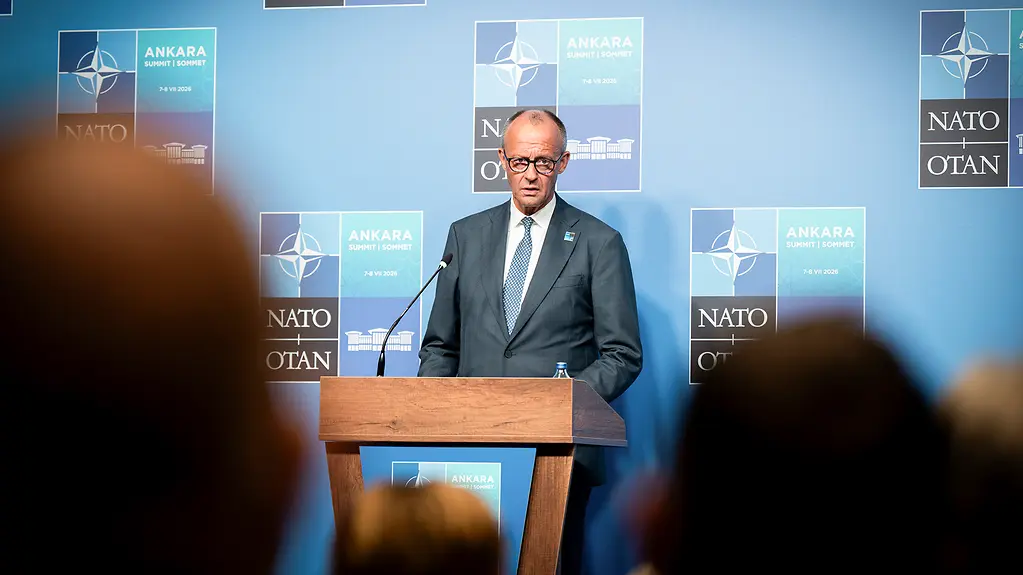
Image context: the cover uses the official summit photograph of Merz at the Ankara NATO press conference, not a missile diagram, map, stock graphic, or generated visual. The story is about alliance signaling and German decision-making in a real diplomatic room.[3]
Fact Line
| Timestamp / source | Key signal | Confidence note |
|---|---|---|
| AP, July 9 | Germany agreed to buy U.S.-made Tomahawks, station them in Germany, and seek August U.S. approval for an undisclosed number of missiles and ground-based Typhon launchers.[1] | High for the announcement and stated structure; quantities, price, delivery schedule, basing, and rules of use remain undisclosed. |
| Bundestag, July 9 | Merz gave a government statement on the current political situation and described the Ankara NATO summit as a major success.[2] | High for parliamentary setting; the Bundestag summary is not a procurement contract. |
| Federal Government of Germany, July 8 | Merz framed Ankara as a step toward a more European but still transatlantic NATO, with Germany saying it had raised defense spending to almost 125 billion euros.[3] | High for German government position; spending levels do not automatically equal usable long-range capability. |
| NATO declaration, July 8 | Allies said European members and Canada are assuming more responsibility, announced more than 50 billion dollars in new procurements, and identified deep precision strike as one capability area.[4] | High for agreed summit language; it is political commitment rather than delivery proof. |
| RTX Tomahawk product page | RTX describes Tomahawk as a precision weapon that can launch from ships, submarines, and ground launchers and strike targets from 1,000 miles away.[5] | Useful for manufacturer capability context; German ground-launch integration still depends on the Typhon package and U.S. export approval. |
| GovInfo, July 10, 2024 | The earlier U.S.-German statement said U.S. long-range fires in Germany would include SM-6, Tomahawk, and developmental hypersonic weapons with longer range than current land-based fires in Europe.[6] | High for historical baseline; the new purchase path is different from U.S.-operated episodic deployments. |
| Council on Foreign Relations, May 2026 | Liana Fix argued that possible cancellation of Tomahawk deployments, not only troop withdrawals, would erode NATO deterrence and expose Europe's strike-capability lag.[7] | Useful independent analysis; it predates the July 9 deal and should be read as context for why Berlin pursued a purchase route. |
What Changed
The deal matters because it changes who must make the capability real. Under the 2024 frame, the United States was expected to bring long-range fires to Germany as part of the Multi-Domain Task Force concept.[6] Under the July 2026 frame, Germany is moving toward owning the missiles and stationing them on German territory, while U.S. personnel are not part of operating the systems described in the letter of intent.[1]
That distinction is not bureaucratic. A U.S.-operated deployment reassures allies by putting American forces, command systems, and political risk directly into Europe. A German-owned Tomahawk and Typhon package asks Berlin to absorb more of the operational burden: procurement approvals, basing politics, training, maintenance, targeting integration, escalation rules, and the domestic debate that follows from stationing ground-launched weapons with deep reach.
The strategic logic is easy to state. Russia has spent years demonstrating that long-range missile and drone attacks can shape the tempo of a war far beyond the front line. NATO's Ankara declaration says allies are investing in deep precision strike, integrated air and missile defense, uncrewed systems, and other capabilities needed across domains.[4] Tomahawks do not solve that whole list, but they do put a visible long-range strike answer on German soil.
The harder question is credibility. A missile in a communique does not deter by itself. It deters when an adversary believes the launcher exists, the crew can use it, the command chain can authorize it, the targeting picture is current, logistics can sustain it, and the political system will not freeze under pressure. The July announcement starts that test; it does not finish it.
Why The August Approval Clock Matters
AP reports that the deal centers on a U.S. commitment to give Germany approval in August to procure the missiles and Typhon launchers.[1] That makes August the first visible gate. If approval arrives with clear quantities, delivery windows, training architecture, and sustainment terms, Berlin can present the deal as a bridge between immediate U.S. technology and future European systems. If approval slips, or if the package remains vague, the announcement risks becoming another deterrence promise waiting for hardware.
The stockpile and production context also matters. CFR's May analysis warned that U.S. stockpile pressure, Iran-war consumption, and possible Tomahawk cancellation could leave Europe with a lag it cannot fill quickly.[7] The July deal partially answers the cancellation risk by shifting toward German procurement. It does not automatically answer availability. A German order still competes with U.S. Navy needs, other allied demand, launcher availability, industrial throughput, and any operational consumption elsewhere.[5][7]
This is why the phrase "strategic gap" should be treated as a checklist, not a slogan. The gap is not only range. It is a chain of things Europe has long depended on the United States to provide: strike planning, command-and-control, intelligence support, launch infrastructure, munitions depth, and escalation management. NATO's summit language says European allies and Canada are assuming greater responsibility for defense.[4] Germany's Tomahawk deal is a concrete test of that sentence.
Decision Impact
Next 24 hours: the immediate question is documentation. Berlin and Washington should clarify whether the August approval covers missiles, Typhon launchers, training support, sustainment, software, and any required data links. Without that, the announcement is politically strong but operationally underspecified.[1][5]
Next 7 days: German officials need to prepare the domestic explanation. The strongest case is not that Tomahawk is a wonder weapon. It is that Germany is replacing an uncertain U.S.-operated deployment track with a German procurement track while still keeping the capability embedded in NATO planning.[1][4][6] Opponents will focus on escalation and arms-race risk; supporters need to answer with basing rules, command authority, non-nuclear framing, and alliance integration.
Next 30 days: NATO planners should treat the deal as one piece of a wider European strike-and-defense stack. Long-range strike without air defense, resilient communications, targeting intelligence, dispersal, reload logistics, and industrial replenishment is fragile. The Ankara declaration's broader list of deep precision strike, air and missile defense, uncrewed systems, technology, and intelligence is the better frame.[4]
Scenario Map
Base case: the United States grants August approval, but the first phase remains slow. Germany gets a path to buy Tomahawks and Typhon launchers, announces a training and basing plan, and uses the purchase as a bridge while European standoff systems mature. Deterrence improves because the signal is credible enough, but the capability still takes time to become fully operational.[1][4][6]
Upside case: the deal becomes a procurement template. Germany pairs U.S. Tomahawks with European development, integrates the launchers into NATO plans, and uses the purchase to drive common training, sustainment, and munitions production with other allies. In that branch, the deal is not a dependency trap. It is a transitional system that buys time for Europe to build its own long-range strike depth.[3][4]
Downside case: approval arrives late, quantities are small, delivery is stretched, and German domestic politics turns basing into a permanent fight. The result would be a visible announcement with thin operational content. Moscow would then read the deal as alliance theater rather than a material change in NATO's conventional strike posture.[1][7]
Uncertainty boundary: none of the public sources establish the number of missiles, cost, basing site, delivery date, operational control rules, target-policy boundaries, or whether Germany will get every capability it needs to use Typhon independently. Those are the facts that would move this analysis from signal-reading to force-structure assessment.[1][5]
Action Checklist
- For German policymakers: publish the non-classified procurement milestones: approval date, launcher path, training plan, delivery range, parliamentary oversight, and how the system fits future European standoff weapons.
- For NATO planners: connect the German purchase to alliance-wide command, targeting, air-defense, and replenishment plans rather than treating Tomahawk as a standalone answer.[4]
- For defense analysts: watch August approval language, not only the headline. The specific authorizations will reveal whether this is a broad system package or a narrower missile purchase.[1][5]
- For investors and industry watchers: follow production capacity, allied demand, and U.S. operational consumption. The limiting factor may be munitions depth, not political appetite.[5][7]
- Invalidation condition: this analysis fails if August approval is denied, if the letter of intent is materially narrower than reported, or if Germany announces that the missiles will not be stationed under German operational arrangements after all.[1]
The clean read is that Germany has bought itself a clock. If the next month produces approvals, quantities, training, basing clarity, and alliance integration, the Tomahawk deal becomes a practical answer to a real deterrence gap. If those details stay missing, it remains a strong summit line waiting for the hard part.[1][4][6]
Sources
- Associated Press, "Germany to buy long-range missiles from US" (July 9, 2026) - current report on the Tomahawk deal, August approval path, Typhon launchers, range, and absence of U.S. operating personnel in the letter of intent.
- Deutscher Bundestag, "Bundeskanzler Friedrich Merz zieht positive Zwischenbilanz der Koalition" (July 9, 2026) - parliamentary context for Merz's government statement after the Ankara NATO summit.
- Federal Government of Germany, "Pressekonferenz von Kanzler Merz nach dem NATO-Gipfeltreffen in Ankara" (July 8, 2026) - German government summit readout, defense-spending context, NATO framing, and source page for the article photograph.
- NATO, "The Ankara Summit Declaration" (July 8, 2026) - official summit text on European responsibility, procurement commitments, deep precision strike, defense-industrial capacity, and Ukraine support.
- RTX / Raytheon, "Tomahawk Cruise Missile" - manufacturer page describing Tomahawk launch modes, range, precision-strike role, and operational history.
- GovInfo / Office of the Federal Register, "Joint Statement by President Biden and Chancellor Olaf Scholz of Germany on United States Deployment of Long-Range Fires Capabilities in Germany" (July 10, 2024) - baseline for the earlier U.S.-German long-range fires deployment plan.
- Liana Fix, Council on Foreign Relations, "Trump Is Pulling Troops From Germany. The Missiles Are a Bigger Problem." (May 4, 2026) - independent context on troop withdrawals, possible Tomahawk cancellation, stockpile pressure, and NATO deterrence risk.