As of 2026-10-18 00:32 UTC, the Pacific Islands Forum Fisheries Agency (FFA) has concluded Operation Kurukuru, reporting 82 at-sea and dockside inspections and one vessel apprehension. The October 5–16 operation brought together its 17 members, supported by Australia, France, New Zealand and the United States.[1]
What the operation found
FFA's October 16 release records three different measures of activity:[1]
- More than 27,000 satellite detections across an operational area of approximately 30.5 million square kilometres.
- 149 vessel sightings, alongside the inspections.
- 13 vessels of interest identified through surveillance and intelligence work.
These categories describe different stages of scrutiny. A satellite detection is an observation; an inspection gives officers an opportunity to examine a vessel and its records. A vessel of interest warrants attention. None of those labels, by itself, establishes a proven offence. The release reports an apprehension but supplies no resulting adjudication.[1]
There is also no sound “catch rate” to calculate by dividing apprehensions by satellite detections. The release does not establish that each detection represents a different vessel. Treating the figures as a single funnel would manufacture a precision the published account cannot support.
How a position becomes a patrol task
The operation's coordination centre in Honiara belongs to a system that works throughout the year. FFA's Regional Fisheries Surveillance Centre combines vessel-monitoring information with automatic identification signals, registration records and licence lists. Analysts use that shared picture to assess risk and help members decide where to direct surveillance.[2]
One component, the satellite-based Vessel Monitoring System, receives transmissions from devices aboard registered fishing vessels. Those signals describe location, speed and direction. They help managers assess activity around closed or restricted areas.[3] Their practical value comes from connecting movement to context: where a boat is, what permissions apply, and whether an observation needs closer examination.
Earlier reporting shows why the distinction between detection and enforcement matters. In November 2023, New Zealand's defence force said its Poseidon aircraft had identified 74 fishing vessels during that year's Kurukuru operation. Three were referred to FFA for potential regulatory breaches.[4] Those were the aircraft deployment's reported findings, not a count of convictions or a directly comparable total for the whole 2026 operation.
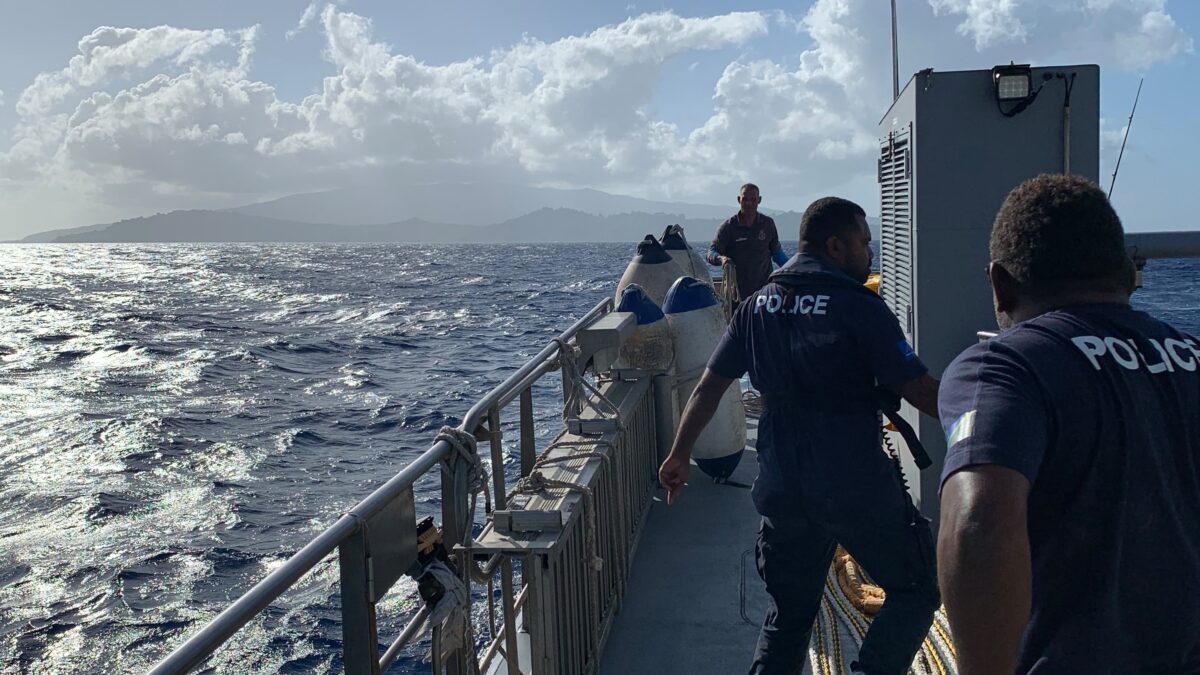
The patrol vessels also answer calls outside fisheries enforcement. During this year's operation, the Solomon Islands patrol boat Gizo diverted to help the disabled MV Awka. A police statement dated October 14 credited a coordinated response involving several vessels and an Australian overflight with rescuing 73 people. Gizo left Lata on October 13 to resume its patrol duties.[5]
That episode gives the surveillance figures a physical setting. Ships and trained crews have to cross long distances, meet other vessels and respond to emergencies. Shared intelligence helps allocate their time; the rescue shows how quickly the task at sea can change.
What comes next
FFA also used Kurukuru to trial its Pacific Guardian Surveillance System, or PacGuard, with an official launch scheduled for November.[1] For fisheries officials and readers following the programme, the immediate question is how operational observations develop into documented outcomes.
The following are possible paths, not agency forecasts:
- Base case: members review referrals through their established processes; follow-up reports distinguish suspected breaches from confirmed findings.
- Upside: published case outcomes and evidence from the system trial show how shared information improved inspection targeting.
- Downside: cases lack sufficient evidence, or the November launch slips. Either would weaken claims that this operation already demonstrates the new system's effectiveness.
Over the next 24 hours, retain the original release as the baseline. During the next week, watch for member-country accounts of inspections and the apprehension. Over the next month, look for the PacGuard launch and evidence of what the trial established. These are reading checkpoints, not promised publication dates.
- Attribute the headline totals to FFA; keep individual national reports separate.
- Update the account when authorities clarify case outcomes or revise the figures.
- Treat a changed launch announcement as superseding the November schedule.
Sources
- Pacific Islands Forum Fisheries Agency, “Operation KURUKURU: FFA wraps largest surveillance operation of 2026” (October 16, 2026) — results and PacGuard trial.
- Pacific Islands Forum Fisheries Agency, “Regional Fisheries Surveillance Centre” — year-round monitoring, information sources and coordination responsibilities.
- Pacific Islands Forum Fisheries Agency, “Vessel Monitoring System & Vessel Register” — transmitted information and fisheries-management uses.
- New Zealand Defence Force, “RNZAF Poseidon finds suspect fishing boats in vast Pacific Ocean search” (November 9, 2023) — historical aircraft findings and referrals.
- Royal Solomon Islands Police Force, “RSIPV Gizo responds to maritime distress and supports rescue of 73 people aboard MV Awka” (statement dated October 14, 2026; published October 15) — rescue response, photograph and return to patrol.