As of 2026-05-07 10:05 UTC, the European Commission has put a long-awaited social package on the table: the EU's first Anti-Poverty Strategy, a Communication on strengthening the European Child Guarantee, and a proposal for a Council recommendation on fighting housing exclusion.[1][2] The formal ambition is large. The package is meant to keep the Union on the European Pillar of Social Rights objective of reducing the number of people at risk of poverty or social exclusion by at least 15 million by 2030, while also backing a longer-run goal of eradicating poverty by 2050.[1][2][3][4]
The more useful immediate reading is narrower. What the Commission has released is a coordination and delivery package: strategy text, two policy communications, one housing recommendation proposal, and a follow-up calendar that now shifts pressure onto member states, social partners, and later Commission action in 2026 and 2027.[2][4][5][6] That distinction matters because it tells readers where the real news sits. The package resets the poverty file from a broad political promise into a more structured implementation test.
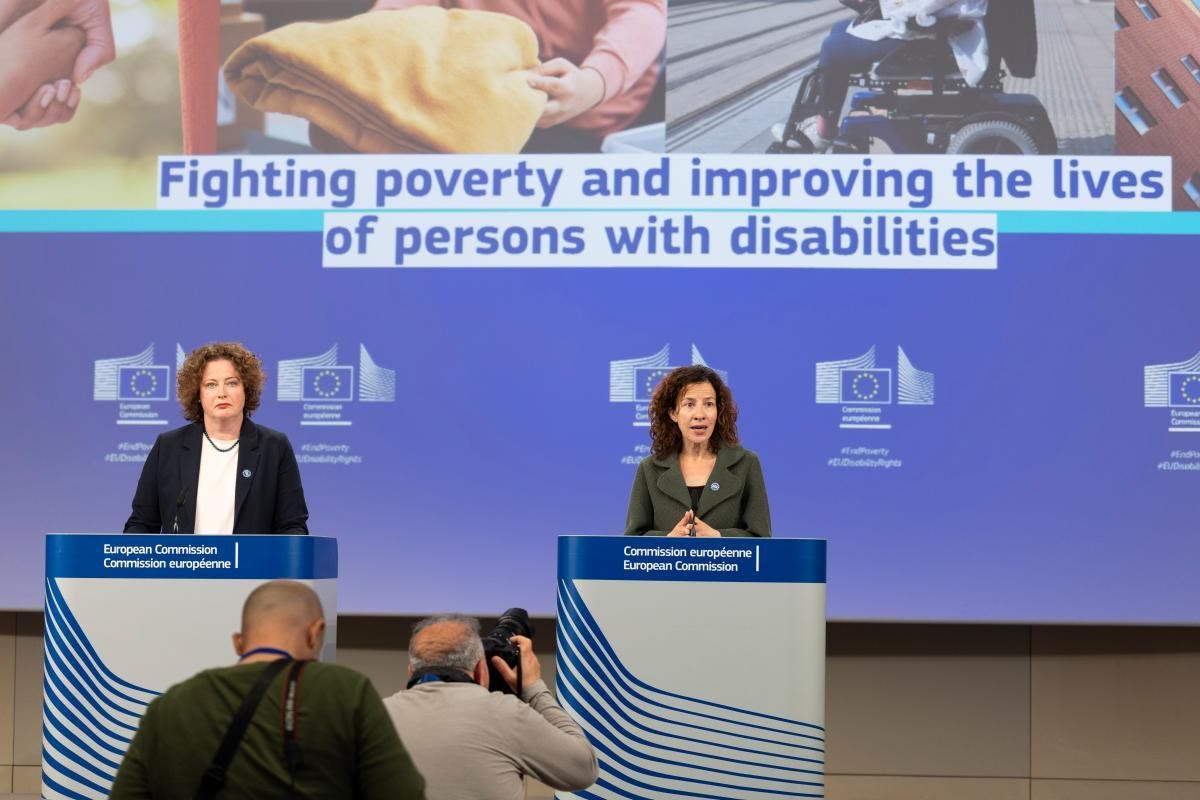
Image context: the cover uses an actual European Commission audiovisual-service press photo from the May 6, 2026 Berlaymont readout on the package.[8] That is more faithful to the story than a generic poverty visual, because the live question is how a Brussels policy package moves from announcement into delivery.
Fact file
| Item | What is live now | Confidence note |
|---|---|---|
| Commission action | On May 6, 2026, the Commission adopted the first EU Anti-Poverty Strategy, a Child Guarantee communication, and a housing-exclusion proposal.[1][2] | High; direct Commission pages. |
| Core 2030 target | The strategy is framed around the existing EU objective of cutting the number of people at risk of poverty or social exclusion by at least 15 million by 2030.[2][3][4] | High; repeated across Commission sources. |
| Longer-run ambition | The Commission explicitly ties the package to a 2050 poverty-eradication goal.[1][2][4] | High; direct source language. |
| Child-poverty lane | The strengthened Child Guarantee communication expands the focus toward family access to jobs, childcare, safety nets, mentoring, and mental-health support.[1][5] | High; direct Commission materials. |
| Housing lane | The proposed Council recommendation on fighting housing exclusion is the package's clearest housing-specific instrument and calls for earlier action against homelessness plus more social and affordable housing.[1][2][6] | High; direct Commission materials. |
| Baseline scale | Eurostat said 93.3 million people in the EU were at risk of poverty or social exclusion in 2024, equal to 21.0% of the population.[7] | High; official statistics page. |
| What remains open | The package has been announced, but major delivery still depends on Council handling, national implementation, and follow-up initiatives already slated for 2026-2027.[2][4][6] | High on process, medium on outcomes. |
Why this changes the file now
What changed this week is not that Brussels suddenly discovered poverty. The EU already had a 2030 social-target framework through the European Pillar of Social Rights Action Plan, an existing Child Guarantee track, and an official statistical baseline that showed the scale of the problem.[3][5][7] What changed is that the Commission has now bundled those strands into a named Anti-Poverty Strategy and attached a visible sequence of follow-up measures to it.[2][4]
That sequence matters more than the 2050 headline. The strategy page lays out upcoming steps that include a 2026 first-stage consultation of European social partners on labor-market exclusion, a 2027 Commission recommendation to combat in-work poverty, and further work on benefit take-up, services access, and dignified old age.[2] In other words, the package is trying to turn an anti-poverty agenda into a policy pipeline rather than a one-day declaration.
The housing piece is especially important because it gives the package a concrete political front.[1][6] The Commission says housing prices have risen 60% since 2013, and it is using the housing-exclusion recommendation to push earlier intervention against homelessness and a stronger social-and-affordable-housing response.[1] That does not let Brussels solve housing supply shortages across the bloc on its own. It does move housing into the center of the anti-poverty file instead of leaving it as a secondary social symptom.
The same is true for child poverty. The strengthened Child Guarantee communication keeps the service-access logic of the existing instrument, but it also widens the framing toward parental employment, childcare, stronger safety nets, mentoring, and mental-health support.[1][5] That is a broader delivery theory than simply promising access to meals or school support. It treats child poverty as a family-system problem that crosses education, labor markets, and social protection.
What the package can and cannot do by itself
The practical limit matters as much as the ambition. The documents released on May 6 do not operate like a single EU-wide entitlement that automatically changes national benefit levels or household budgets on a fixed date.[2][4][5][6] Their force comes from agenda-setting, benchmarking, coordination, guidance, and political sequencing.
That does not make the package empty. In EU social policy, strategies, communications, and Council recommendations matter because competencies are shared and much of the spending power remains national. But it does mean the next test is execution. Readers should judge this file less by the 2050 slogan than by whether member states adjust housing, child-poverty, labor-market, and income-support policies fast enough to move the 2030 number.[2][3][4][6][7]
This is the operational implication of the Commission's own source stack. A strategy can set direction. A communication can sharpen policy expectations. A Council recommendation can guide national handling. None of those documents, by itself, guarantees that the EU-wide poverty count falls on schedule. The gap between policy architecture and measurable decline is where the live news risk now sits.[2][4][6][7]
Decision impact by horizon
Next 24 hours
National social-policy teams, housing ministries, city networks, and anti-poverty NGOs now have a clearer Brussels frame for lobbying and alignment.[1][2][6] The immediate question is which governments start treating the package as a live planning signal rather than a symbolic Commission release.
Next 7 days
Watch the political reaction around the housing recommendation and the funding question. The more governments and parliamentary groups treat housing exclusion as central instead of supplementary, the more durable the package becomes.[1][6] The Child Guarantee file matters here as well because it gives the Commission a more concrete child-poverty delivery story than the older headline target alone.[5]
Next 30 days
The key signal will be whether the package starts generating formal Council and national follow-through, not just approval language. The strategy page already points to 2026-2027 follow-up measures; the real test is whether those become a governing work program rather than a shelf of documents.[2][4][6]
Scenarios
Base case: the package becomes a stronger coordination frame than the EU previously had, with housing exclusion and child poverty moved closer to the center of the 2030 social-target debate, but results remain uneven across member states.[2][5][6][7]
Upside case: member states use the strategy as permission to move faster on affordable housing, benefit take-up, childcare access, and labor-market activation, turning the package into a real acceleration mechanism for the 2030 target.[2][4][5][6]
Downside case: the 2050 language absorbs the headlines while the hard work stalls; the housing recommendation softens in political handling, national governments do little, and the package ends up remembered as a high-ambition umbrella without measurable delivery force.[2][4][6][7]
Action checklist
- For social-policy and housing watchers: separate announcement value from delivery value. The documents are real; the measurable test now shifts to Council handling and national execution.[2][4][6]
- For NGOs and local governments: use the package's own language on housing exclusion, child poverty, and benefit access to pressure for concrete program changes instead of symbolic endorsement.[2][5][6]
- For business and labor-market observers: watch the 2026 social-partner consultation and the 2027 in-work-poverty recommendation, because that is where the employment side of the strategy may gain sharper policy edges.[2]
- Invalidation condition: if follow-up measures slip, the housing recommendation loses force, or national uptake stays thin, the case for calling this a meaningful delivery reset weakens substantially.[2][4][6]
Sources
- European Commission, "Commission proposes new measures to address poverty and the housing crisis" (May 6, 2026).
- European Commission, "EU Anti-Poverty Strategy" (published May 6, 2026).
- European Commission, "European Pillar of Social Rights Action Plan" (accessed May 7, 2026).
- European Commission, Communication on an EU anti-poverty strategy (PDF, May 6, 2026).
- European Commission, Communication on a strengthened European Child Guarantee (PDF, May 6, 2026).
- European Commission, Proposal for a Council recommendation on fighting housing exclusion (PDF, May 6, 2026).
- Eurostat, "People at risk of poverty or social exclusion in 2024" (published April 30, 2025; accessed May 7, 2026).
- European Commission Audiovisual Service, "Read-out of the weekly meeting of the von der Leyen Commission by Roxana Minzatu, Executive Vice-President of the European Commission, on Commission measures to fight poverty and improve the lives of persons with disabilities" photo reportage
P-069656(May 6, 2026).