As of 2026-04-30 07:33 UTC, the European Union's Digital Markets Act has crossed an important threshold. Brussels is no longer asking whether the rulebook exists or whether the first gatekeepers have been named. The Commission's first DMA review, published on 28 April 2026, says the law is already producing visible effects and does not need a major rewrite yet. Parliament's line during this week's Strasbourg session points in the same direction, but with more impatience: the pressure is shifting to how quickly the Commission can move cases, how clearly it can show results, and how aggressively it pushes into AI-linked search and cloud services.[1][2][3][4]
That distinction matters because the easiest way to misread the current moment is to look only for a fresh legislative package. The review says the opposite. The Commission's own position is that it is too early for a major revision because the DMA has been fully operational for only a little over two years, while many business and consumer effects are only now becoming legible.[2][3] So the real 2026 question is narrower and harder: can Brussels make the existing regime move faster and hit the next technical battlegrounds without reopening the text itself?
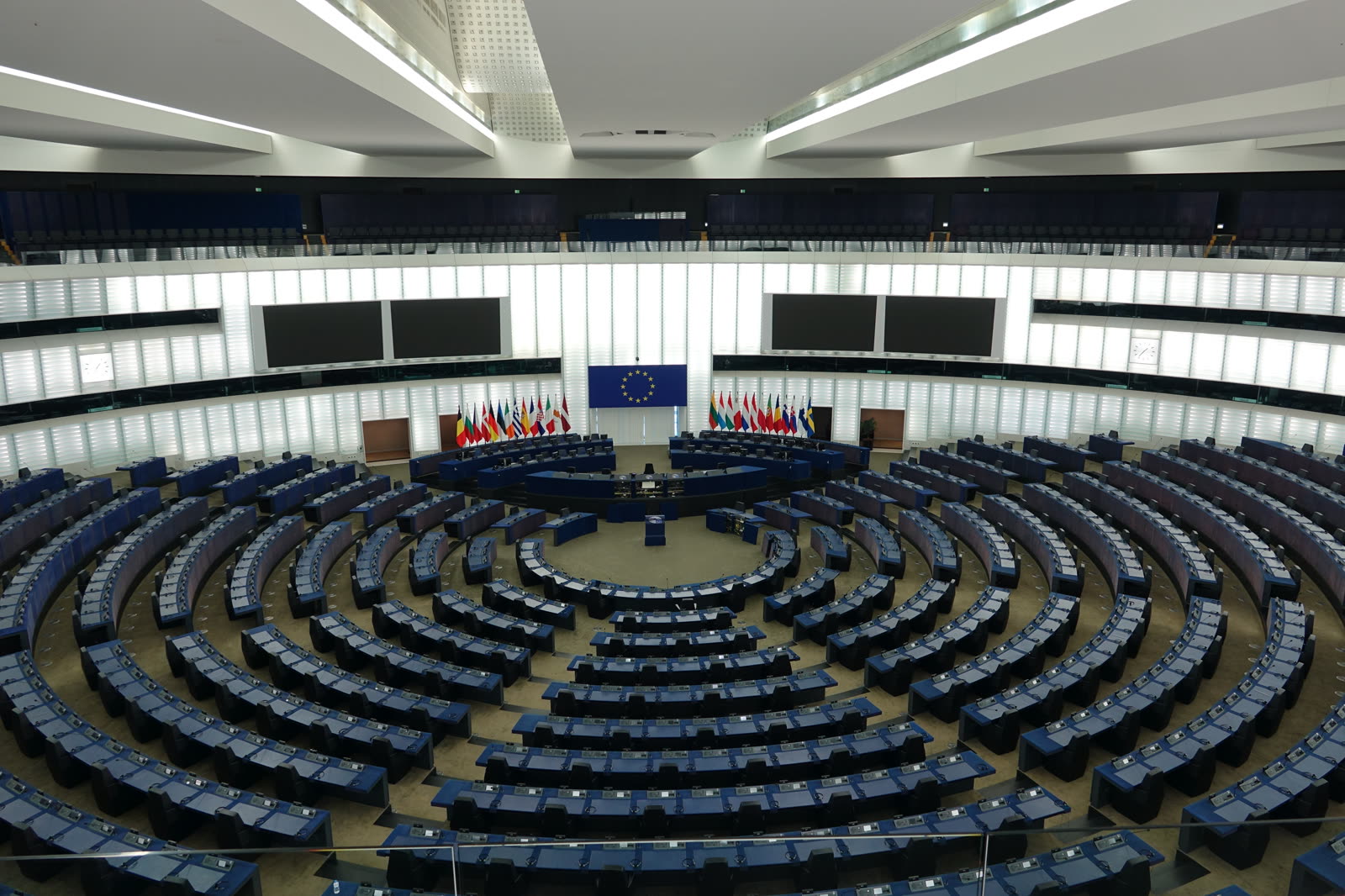
Image context: the cover uses a real Wikimedia Commons photograph of the European Parliament hemicycle in Strasbourg. That is the right documentary image because this brief is about institutional pressure, procedure, and oversight. The live issue is whether the DMA's enforcement machine accelerates under political scrutiny, not whether one company launches a new feature or one platform wins a public-relations round.[8]
Fact file
- Review timing: the Commission published its first DMA review on 28 April 2026; the first review cycle was legally due by 3 May 2026.[1][2][3]
- No rewrite now: the Commission says the DMA remains fit for purpose and that it is too early for a major legislative amendment.[2][3]
- Current scope: the regime covers 7 gatekeepers and 23 core platform services.[3]
- Case count: the Commission says it has opened 7 non-compliance proceedings; 2 have concluded with findings of non-compliance, and 4 are still ongoing.[3]
- Penalty anchor: the two completed non-compliance decisions fined Apple EUR 500 million and Meta EUR 200 million on 23 April 2025.[5]
- Mixed toolkit: on the same day, the Commission also closed one Apple user-choice investigation after design changes, while issuing preliminary findings on Apple's rules for alternative app distribution.[3][6]
- Not automatic expansion: on 5 February 2026, the Commission decided not to designate Apple Ads and Apple Maps under the DMA, saying they were not important gateways for business users to reach end users.[7]
- Next pressure point: Parliament says MEPs are pushing for quicker compliance proceedings and closer scrutiny of AI-driven search tools and cloud services.[4]
Why this is now an enforcement-speed story
The review report gives enough numbers to show that the DMA is past its symbolic phase. Seven gatekeepers and 23 services are already inside the regime, the Commission has run repeated compliance workshops, and the enforcement mix is no longer theoretical.[3] But the same report also admits where the friction sits: some gatekeepers have adopted approaches that may delay or limit effective implementation, and several proceedings remain open.[3] In plain terms, the Commission is saying the hard part is no longer writing obligations. It is forcing usable compliance out of large firms that have every incentive to move slowly, interpret narrowly, and preserve interface advantages wherever they still can.
That is why the headline should not be "Brussels likes its own law." The more useful reading is that Brussels thinks the law is broad enough, but the procedural tempo still needs work. The DMA review Q&A makes that explicit: the focus now is effective enforcement, regulatory dialogue, procedural simplification, and more transparency for the businesses and consumers who are supposed to benefit.[2] Parliament's message sharpens the same point from the outside, pushing for quicker compliance proceedings rather than a leisurely evidence trail that arrives after product markets have already adapted around delay.[4]
The 2025 Apple and Meta decisions show what that looks like when the machinery actually lands. Apple was fined over anti-steering rules, Meta over the obligation to offer a less data-intensive alternative, and the combined result was the first clear proof that the DMA can produce penalties instead of workshops alone.[5] But the same April 23, 2025 enforcement package also showed why this is not a one-note fines story. The Commission closed one Apple investigation after a "constructive dialogue" and design changes, while continuing pressure on other app-distribution terms.[6] The signal was not merely severity. It was that the DMA is trying to use multiple enforcement gears, with speed and legibility now the harder test.
Why AI and cloud are the real expansion edge
If the Commission is resisting a rewrite, it is not because the digital market stopped moving. It is because the review argues the existing framework still has room to stretch. The Q&A page says the next critical priorities are cloud computing and AI, not because they are fashionable buzzwords, but because they are where new gatekeeping patterns may harden next.[2] The Commission says it already opened three market investigations into cloud computing services in November 2025, including whether Amazon Web Services and Microsoft Azure should be designated as gatekeepers.[2] It also points to AI-focused specification proceedings around interoperability and access to search data.[2]
That matters for two reasons. First, it shows the DMA debate has moved beyond app-store politics alone. The next contest is about default settings, data access, cloud dependency, and whether AI services inherit platform power from search engines, operating systems, and large-scale infrastructure.[2][4] Second, it explains why the Commission does not want to rush into a textual rewrite. Brussels seems to believe it can probe these newer sectors with the existing tools first, then decide later whether the statute itself needs targeted modification.[2][3]
The February 2026 Apple Ads and Apple Maps non-designation decision helps clarify that posture.[7] The Commission is not simply trying to expand DMA coverage wherever it can. It is still applying gateway tests and scale judgments service by service. That makes the current story less dramatic, but more important institutionally: the Commission is trying to look both tougher and more discriminating at the same time.
What changes next
In the next 30 days, the most important thing to watch is not another speech about Big Tech power. It is whether the Commission can turn its review language into quicker, more visible procedural movement. Parliament is already framing the file in those terms, and the review itself concedes that transparency and simplification need work.[2][4]
For businesses and developers, the practical question is whether the DMA keeps producing usable openings instead of abstract rights. The review highlights page points to alternative browsers, alternative app stores, interoperability gains, and more meaningful consent choices as evidence that the law is already changing behavior.[1] Those examples matter only if they become easier to use in practice, which is exactly where slower proceedings and formalistic compliance can still choke the benefit.[2][3]
The main invalidation condition would be a clear Commission pivot toward legislative amendment in the near term. The review points the other way. As of 30 April 2026, the live test is execution. Europe has decided, at least for now, that the DMA does not need a fresh rewrite. It needs a faster, clearer, and more technically ambitious enforcement cycle that can keep up with AI search, cloud concentration, and the stubborn ability of gatekeepers to comply just enough while preserving leverage.[1][2][3][4]
Sources
- European Commission, "Review highlights Digital Markets Act remains fit for purpose and has positive impact" (28 April 2026).
- European Commission, "DMA Review Q&A" (accessed 30 April 2026).
- European Commission, Report on the Review of Regulation (EU) 2022/1925 (Digital Markets Act), COM(2026) 178 final (28 April 2026 PDF).
- European Parliament, "Digital Markets Act: push for stronger enforcement amid external pushback" (27 April 2026).
- European Commission, "Commission finds Apple and Meta in breach of the Digital Markets Act" (23 April 2025).
- European Commission, "Commission closes investigation into Apple's user choice obligations and issues preliminary findings on rules for alternative apps under the Digital Markets Act" (23 April 2025).
- European Commission, "Commission finds that Apple Ads and Apple Maps should not be designated under the Digital Markets Act" (5 February 2026).
- Wikimedia Commons, "File:Parlement européen - hémicycle (Strasbourg) (1).jpg" (source page for the Parliament hemicycle photograph).