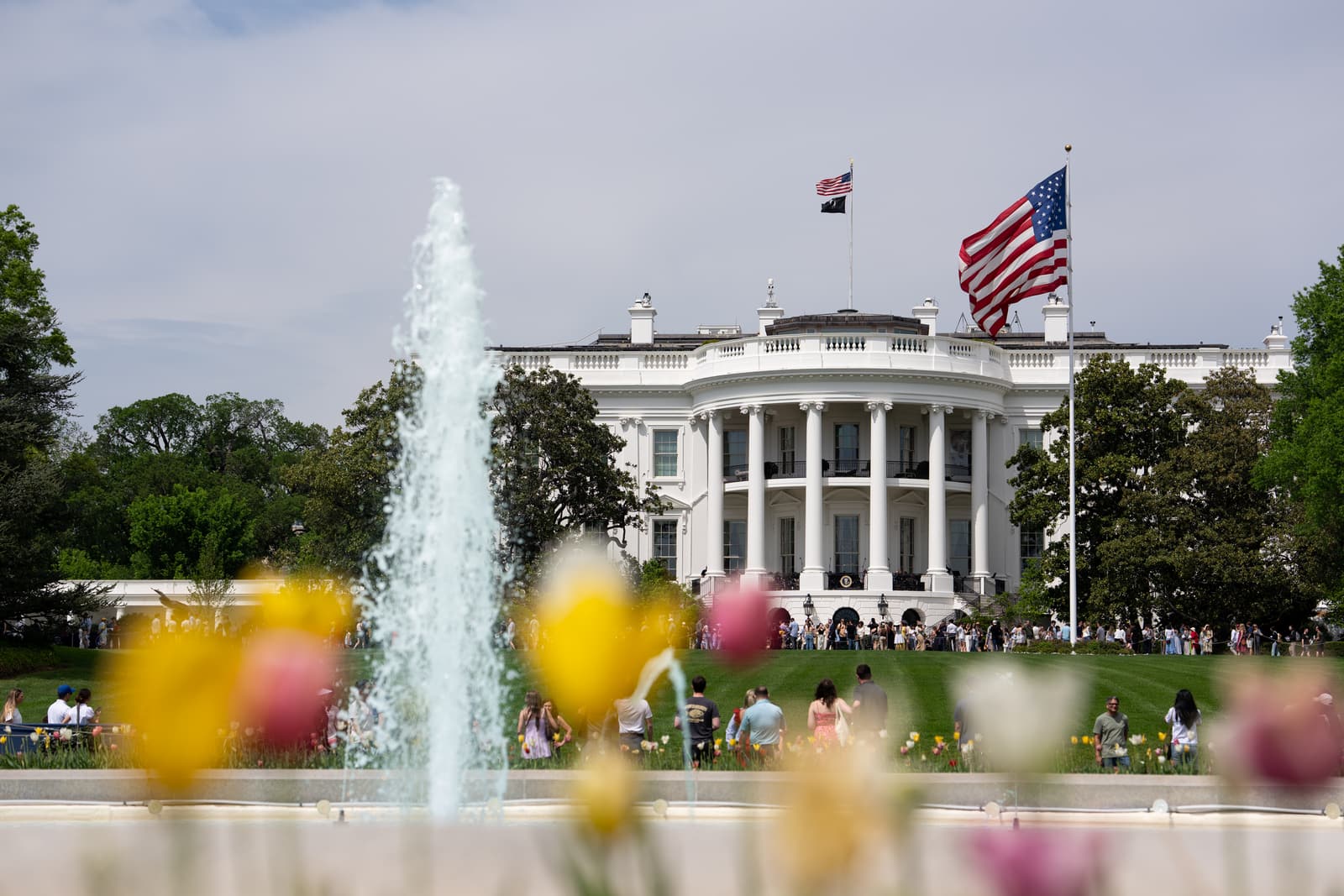
As of 2026-04-24 01:08 UTC, the White House's fiscal year 2027 budget should be read less as a settled government plan than as a negotiating document that tries to set the terms of the next spending fight.[1][2][3] The headline numbers are large enough to command attention: the budget book says base non-defense funding would be cut 10 percent relative to 2026, while base defense function 050 would rise sharply and the administration would also seek additional mandatory defense funding.[2] But the administration's own budget-process chapter makes the institutional boundary clear: Congress does not enact the President's budget as such; it uses budget resolutions, appropriations bills, and other legislation to approve, rewrite, or discard those priorities.[3]
That distinction matters more than usual here. The FY2027 documents were released in April, months before the fiscal year begins on October 1, 2026, and the same Analytical Perspectives volume notes that Congress has managed to enact every regular appropriations bill by that date only three times since 1977.[3] In practice, then, the budget is the opening position for a long appropriations clock. The useful question for readers is not whether the White House "announced the budget." It did. The useful question is which priorities the administration is trying to hard-wire into the October deadline and where the comparison points are already messy.[1][2][3]
Fast facts
| Item | What is known | Confidence note |
|---|---|---|
| What was released | The OMB budget portal lists the Fiscal Year 2027 President's Budget and supporting volumes including the Appendix and Analytical Perspectives.[1] | High. This is the administration's official budget hub. |
| Big aggregate split | The budget message says the proposal cuts non-defense by 10 percent from 2026 levels while requesting $1.5 trillion for national defense, described as a 44 percent increase.[2] | High for the administration's own topline framing. |
| Table-level totals | Table S-3 shows base discretionary budget authority including mandatory resources rising from $1,791.7 billion in 2026 enacted to $2,163.6 billion in the 2027 request, with Defense Function 050 at $1,503.5 billion and Non-Defense at $660.1 billion.[2] | High for the published table. |
| Legislative status | The White House notes that H.R. 7148, the Consolidated Appropriations Act, 2026, was signed on February 3, 2026 for FY2026 appropriations.[4] | High for current-law baseline. |
| Process reality | The budget-process chapter says Congress does not enact the President's budget itself; it enacts budget resolutions, appropriations acts, and related legislation, and the fiscal year begins October 1.[3] | High. |
| Timing complication | The FY2027 budget volume says that when the book was prepared, the 2026 Homeland Security appropriations bill had not been enacted, so the 2026 comparison column for DHS used an annualized continuing-resolution level instead.[2] | High, but important because it makes some year-over-year readings less clean. |
What the request is trying to do
The broad fiscal argument is simple. The administration wants to make the next spending round look like a choice between a much larger security state and a smaller domestic one.[2] The director's message explicitly frames the request around three moves at once: a major military buildup, sustained border and immigration enforcement, and a narrower non-defense state.[2] That is the political shape of the document.
The summary tables give that shape real weight. In Table S-3, the defense-side request is not a marginal trim or add-on; it is a decisive repricing of the federal discretionary mix.[2] At the same time, the cuts are not spread evenly. The same table shows sizable proposed reductions in agencies such as HHS, HUD program spending, EPA, NASA, and NSF, while a few lines either rise or are protected for strategic reasons.[2] The important reading is not "everything is down outside defense." It is that the White House is trying to decide which domestic functions remain compatible with its security-first hierarchy and which ones are available as offsets.
One technical point makes the document more than a slogan. The budget is not only asking for bigger appropriations inside the ordinary annual process; it also proposes additional mandatory defense resources on top of the base presentation.[2] That matters because it signals an effort to reduce the degree to which the whole military buildup must be negotiated only inside the annual appropriations lane. In other words, the administration is trying to shape both the politics of the topline and the mechanics of how that topline could be sustained.
Why this is not operative law yet
The administration's own Analytical Perspectives volume is the best antidote to overreading the release.[3] It says plainly that Congress considers the President's proposals and can approve, modify, or reject them; that Congress does not enact a budget "as such"; and that actual funding arrives through appropriations acts and other legislation.[3] That is not outside criticism. It is the executive branch's own description of the system.
The timeline in the same chapter is also clarifying.[3] Under a normal budget year, the budget resolution is supposed to be completed by April 15, House consideration of annual appropriations can begin by May 15, and the fiscal year begins on October 1.[3] The chapter then immediately reminds readers how often the real world misses that schedule: if appropriations are not enacted by October 1, Congress usually turns to a continuing resolution.[3]
That makes the most useful inference from the sources straightforward. The White House budget matters now because it defines bargaining terrain, not because its agency totals are automatically about to take effect. I infer this from the combination of the budget-process chapter, the October 1 fiscal-year start, and the historical note about how rarely regular appropriations are finished on time.[3] The practical consequence is that the request should be read as an agenda-setting document with some real signaling force, but with a long legislative distance still to travel.
Where the comparison already gets blurry
The budget's own general notes add another important caution.[2] The book says the 2026 Homeland Security appropriations bill was not enacted when the documents were prepared and that the 2026 spending references for DHS therefore reflect an annualized continuing-resolution level.[2] For a story centered on border security and immigration enforcement, that is not a trivial footnote. It means one of the administration's central claimed priority areas is being compared against a baseline that the budget itself flags as provisional rather than fully enacted.[2]
That does not make the request meaningless. It means readers should separate two questions. First: what is the White House trying to prioritize? Second: how clean is the year-over-year comparison in every line item? The first question is answered clearly. The second requires more care, especially in the security agencies the administration most wants to emphasize.[2]
Who should care in the next 24 days, 7 weeks, and 30 weeks
In the next 24 days, congressional appropriators and committee staff matter most. The administration has already put the topline argument on the table, and the next relevant move is how those priorities translate into allocations and markup sequencing.[3] Watch whether lawmakers adopt the White House's security-versus-non-defense framing or start peeling away favored domestic accounts from the cut structure.
In the next 7 weeks, agency heads, governors, universities, hospitals, local governments, and contractors should stop reading only the topline message and start reading their specific accounts.[2] The White House budget portal points readers to the Appendix and Analytical Perspectives for a reason.[1] The operational risk is not "a budget exists." The operational risk is that certain programs become bargaining chips early while others are defended late.
In the next 30 weeks, the core deadline is still October 1, 2026.[3] If Congress cannot pass the regular bills, the fight shifts from agency design to stop-gap governance through a continuing resolution. That is why the budget release matters now: it sets up the autumn conflict over whether the government runs on full appropriations, temporary extensions, or a partial breakdown in funding authority.[3][5]
Scenarios
The base case is a long rewrite. Congress takes the White House request as a directional statement, adopts only part of the non-defense squeeze, protects some politically durable domestic accounts, and enters late-summer bargaining with a real chance of needing a continuing resolution by October 1.[2][3]
The upside case for the administration is structural acceptance. Congressional leadership largely preserves the defense buildup and border-security emphasis, the 10 percent non-defense contraction becomes the organizing benchmark rather than just the opening ask, and mandatory defense supplements survive into the enacted package.[2][3]
The downside case is calendar failure with fragmented priorities. Appropriations stall, agencies spend months under temporary funding, and the budget functions mainly as a message document rather than a governing blueprint.[3] The analytical warning sign would be an inability to finish regular appropriations on time combined with widening disagreement over how much of the domestic cut structure lawmakers will accept.
Action checklist
- If you track federal policy: separate request, enacted baseline, and likely CR path. Those are three different things, and the budget documents themselves say so.[2][3][4]
- If your organization depends on federal funding: read the specific account language in the FY2027 volumes instead of relying on aggregate headlines from defense versus non-defense totals.[1][2]
- If you care about the autumn risk window: put October 1, 2026 at the center of the calendar, not the April release date.[3]
- If you compare agency changes: note where the administration itself warns that the 2026 comparison column is not perfectly clean, especially for DHS.[2]
Sources
- Office of Management and Budget, "President's Budget" portal listing the Fiscal Year 2027 budget volumes and related materials.
- Office of Management and Budget, Budget of the U.S. Government, Fiscal Year 2027 - summary tables, general notes, and director's message.
- Office of Management and Budget, Analytical Perspectives, Fiscal Year 2027 - budget-process chapter, calendar, and continuing-resolution context.
- The White House, "Congressional Bill H.R. 7148 Signed into Law" - notice that the Consolidated Appropriations Act, 2026 was signed on February 3, 2026.
- The White House, "Sequestration Order for Fiscal Year 2027" - April 2026 order tying FY2027 sequestration calculations to OMB's April 3, 2026 report to Congress.
- The White House, "Spring Garden Tours take place on the South Lawn of the White House, Saturday, April 18, 2026" - source page for the photograph used with this article.