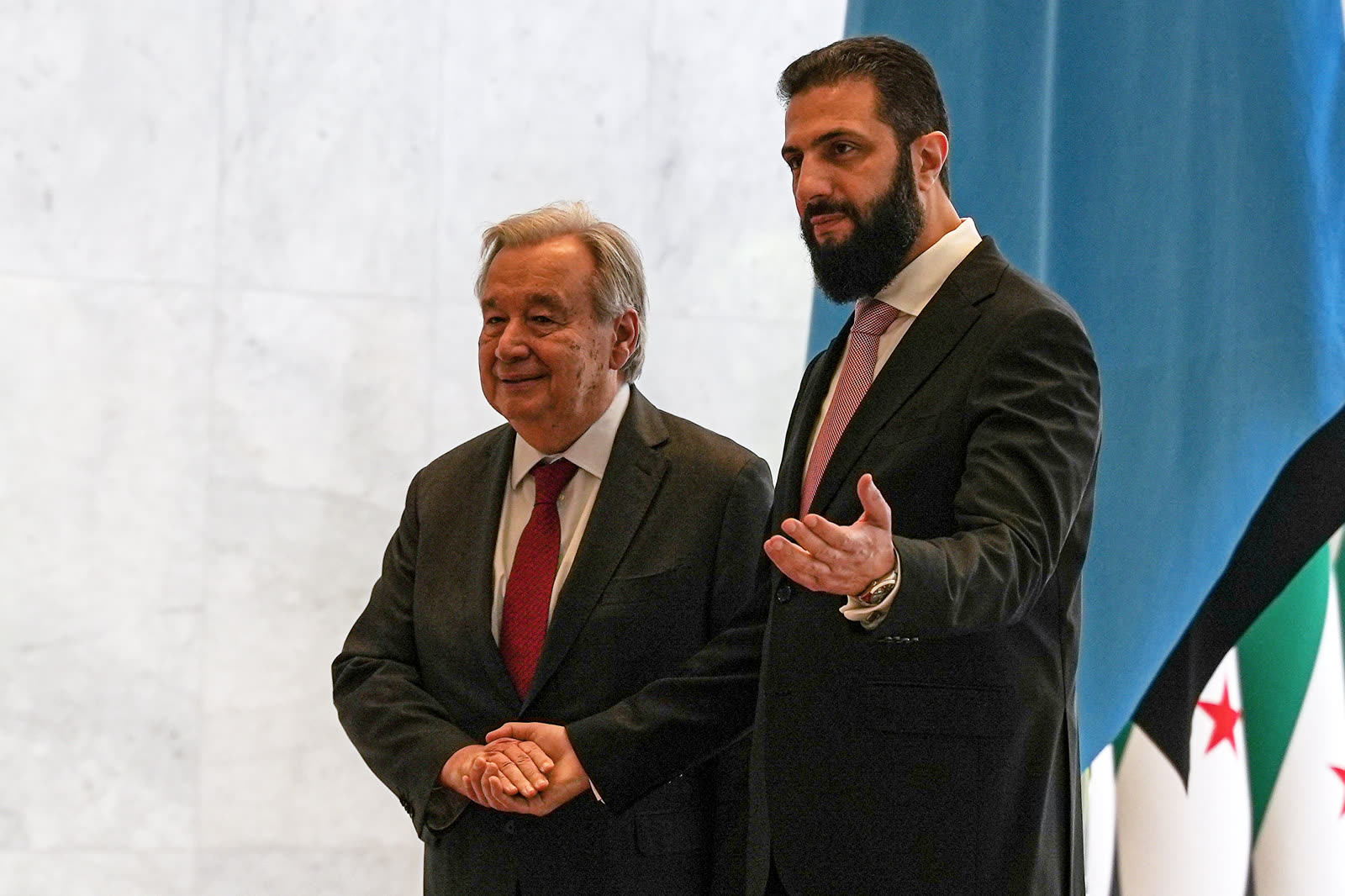
As of 2026-07-25 18:39 UTC, António Guterres is in Syria on the first visit to Damascus by a serving United Nations secretary-general since 2009. On Saturday he met interim President Ahmad al-Sharaa, toured the Old City and Umayyad Mosque, and visited Saydnaya military prison. He appealed for international support for Syrians and criticized Israeli actions in the country's south.[1] His office had not released a full schedule, but he was expected to remain in Damascus for several days.[2]
That is a diplomatic opening, but it is not yet a diplomatic outcome. A meeting can establish access. A prison visit can acknowledge a site of state violence. A call for reconstruction can focus attention. None, by itself, shows that Syria's transition is becoming more inclusive, that families of the missing are getting answers, that returnees can remain home, or that outside support is reaching damaged communities.
The useful way to read this visit is therefore through the files its itinerary opens—and the evidence that would show whether those files move after Guterres leaves.
Image context: the cover is an AP photograph of Guterres and al-Sharaa at the presidential palace on the day of the visit. It documents the official encounter rather than substituting a flag montage, map, or generated scene for the event.[1]
What Is Confirmed, Announced, and Still Unsettled
| Status | Public record | Confidence boundary |
|---|---|---|
| Completed by Saturday evening | Guterres arrived in Damascus, met al-Sharaa, visited the Old City and Umayyad Mosque, and went to Saydnaya prison.[1] | High confidence on the itinerary. Public accounts available at this cutoff do not establish specific agreements produced by each stop. |
| Announced before the trip | The UN said Guterres would hear from civil-society representatives, women's organizations and diverse communities, and planned to visit the UN Disengagement Observer Force (UNDOF). It said he would emphasize Syria's sovereignty, unity and territorial integrity.[3] | Plans are not completed events. Those engagements should be evaluated through subsequent readouts, participant accounts and any follow-up commitments. |
| UN transition benchmark | Deputy Special Envoy Claudio Cordone told the Security Council that confidence requires balanced governance, meaningful participation by women and all parts of Syrian society, progress on accountability and transitional justice, and tangible improvements in daily life.[3] | A stated UN standard, not proof of Syrian implementation. The cited transcript is machine-generated and explicitly says it is not an official UN record. |
| Recovery baseline | The same UN briefing put returns since December 2024 at about 1.7 million refugees and 1.9 million internally displaced people, while warning that recovery depends on whether people can stay, rebuild and survive.[3] | A cumulative movement estimate, not a stable-reintegration count. Returns can reverse, and published totals may be revised. |
This separation matters because the visit is still unfolding. It is accurate to say that Guterres reached places and people that carry political weight. It is premature to treat announced meetings as completed, symbolism as reform, or an appeal for support as funded delivery.
The Itinerary Maps Four Separate Files
The presidential palace is the diplomatic file. Meeting al-Sharaa gives the UN a direct channel to the authority governing from Damascus. That can help with humanitarian access, institution-building and security discussions. The analytical mistake would be to turn access into blanket approval. The first evidence of value will be specific: named follow-up teams, public responsibilities, dates, and points on which the parties acknowledge disagreement.
The Old City and Umayyad Mosque are the national-symbolism file. These stops place the secretary-general inside a shared civic and religious landscape rather than only behind government doors. They may help present Syria as a country re-entering ordinary diplomacy after years of war and isolation. But an inclusive transition is measured by who participates in public power and whose rights are protected, not by the breadth of a camera itinerary.
Saydnaya is the accountability file. The prison is associated with some of the Assad family's worst abuses, according to AP's report.[1] Guterres's presence there gives international visibility to victims, survivors and families of the missing. Yet a visit does not identify a missing person, preserve an archive, protect a witness or establish a credible judicial process. Progress would look like secure access to records and sites, cooperation with independent investigative and missing-person institutions, survivor participation, and procedures that do not trade accountability for political convenience.
Civil society and UNDOF form the inclusion-and-sovereignty file. The UN announced that Guterres would meet women, civil-society actors and diverse communities and visit the peacekeepers monitoring the disengagement area.[3] These are related but not interchangeable concerns. Inclusion asks who gets a voice in Syria's political settlement. UNDOF and the southern border concern territorial security and the risk that external military action destabilizes the transition. Security Council Report noted both continued Israeli positions beyond the ceasefire line and disagreement among Council members over how strongly to demand withdrawal.[6] A photo opportunity with one constituency cannot resolve the other file.
Recovery Has Three Different Ledgers
Calls to “support reconstruction” can blur three distinct ledgers: emergency humanitarian operations, repair of physical assets, and households' ability to rebuild a life.
The immediate funding ledger is strained. In May, the World Food Programme said funding shortfalls had forced it to halve emergency food assistance inside Syria from 1.3 million people to 650,000 and halt a bread subsidy that had supported millions each day. WFP said 7.2 million people remained acutely food insecure and that it needed $189 million for June through November to sustain and restore lifesaving assistance.[7] Those operating figures describe a specific agency and period; they are not a measure of how much the full reconstruction bill has been financed.
The physical-damage ledger is much larger and more uncertain. The World Bank estimated $108 billion in direct physical damage to infrastructure and buildings through 2024. It placed the cost of reconstructing damaged physical assets in a $140 billion to $345 billion range, with $216 billion as its conservative best estimate—nearly ten times projected 2024 GDP. The bank explicitly warns that methodological constraints create significant uncertainty and that the assessment is not finely disaggregated by sector or asset type.[4]
The household ledger is harder to compress into a dollar figure. An International Rescue Committee report hosted on UNHCR's data portal says more than 3.5 million Syrians had returned since December 2024. Its evidence comes from 425 returnee surveys, 31 key-informant interviews and 15 focus groups in seven governorates. The report's central finding is that housing, services, documentation and livelihoods determine whether return holds.[5] That sample gives structured evidence about barriers; it should not be treated as a census of every returnee.
Together, the ledgers show why a single pledge total would be inadequate. A credible package needs lifesaving aid now, transparent priorities for large capital repairs, and household-level measures of safe, voluntary and durable reintegration. Counting arrivals without tracking reversals, housing, documents, school access, health care and income would reward motion rather than recovery.
Decision Impact: 24 Hours, 7 Days, 30 Days
Next 24 hours — establish the encounter record. The UN and Syrian authorities should publish separate, detailed readouts of completed meetings: participants, subjects raised, commitments made, unresolved issues and owners for follow-up. The UN should distinguish what Guterres personally observed from what officials or participants told him. Reporting should keep planned events in the future tense until they occur.
Next 7 days — convert themes into workstreams. Watch for technical follow-up on humanitarian access, missing persons and detention records, return monitoring, civil-society participation and UNDOF operations. Donors should specify whether new money is for emergency response, early recovery or capital reconstruction, because those categories have different timelines and safeguards. Civil-society participants should be able to describe their engagement without retaliation or pressure to endorse a common line.
Next 30 days — look for changes outside the visit. The meaningful indicators are operational: more predictable aid access; published procedures for missing-person and transitional-justice work; broader and consequential participation by women and minority communities; funded repairs to services in high-return areas; fewer failed or reversed returns; and respect for UNDOF's ability to operate. A month is a monitoring horizon, not a promise that every issue can be solved within it.
Three Paths After Damascus
Base case — sustained engagement, limited conversion. The visit produces regular UN-government contact and several technical meetings, but funding remains thin and political benchmarks advance unevenly. Triggers: published follow-up groups and continuing access, without substantial new financing or independently verifiable movement on accountability and inclusion.
Upside — calibrated support follows transparent milestones. Donors and UN agencies fund essential services and early recovery while Syrian authorities widen participation, protect civic space and cooperate on missing persons and justice. Southern tensions ease enough for UNDOF to function without new impediments. Triggers: named, financed projects; public implementation dates; representative appointments with real authority; independent access to records and affected communities; and evidence that more returnees remain safely in place.
Downside — visibility outruns reform. Official images circulate as evidence of international acceptance while civic space narrows, accountability stalls, aid access remains selective, or new violence and external strikes damage the recovery. Triggers: restrictions on participants after UN meetings, obstruction of independent monitors, renewed communal violence, forced or premature returns, further incursions in the south, or repeated pledges without disbursement and delivery data.
These are scenarios, not forecasts with assigned probabilities. Their purpose is to state in advance what evidence would strengthen or weaken each reading.
Action Checklist—and the Invalidation Condition
- For the UN: publish meeting readouts and a follow-up register with responsible offices, dates and status updates. Report cancelled or blocked engagements as clearly as completed ones.
- For Syrian authorities: demonstrate inclusion through decision-making power, not attendance alone; secure records and sites connected to detention and disappearance; and provide independent humanitarian and monitoring access.
- For donors: fund urgent operations and early recovery without waiting for a perfect political settlement, while attaching transparent procurement, beneficiary and audit safeguards to large reconstruction commitments.
- For return agencies: report durable outcomes alongside movement totals—safe housing, documentation, services, livelihoods, protection incidents and reversed returns—with methods and gaps visible.
- For journalists and diplomats: avoid scoring the trip as either “normalization achieved” or “mere optics.” Track what changed, for whom, under whose authority and by what date.
Invalidation condition: revise this analysis if the visit produces a financed, public implementation agreement with responsible parties, deadlines, independent monitoring and measurable commitments across inclusion, accountability, recovery and southern security. That would make the trip more than an opening. Revise it in the other direction if promised access collapses or announced engagements do not occur; then even the claim of a durable opening would be too generous.
For now, Damascus has supplied the UN with access and powerful symbols. The harder record begins after the motorcade moves on.
Sources
- Associated Press, “The UN chief on a visit to Damascus urges the international community to support Syrian people” (July 25, 2026).
- Reuters via Cyprus Mail, “Guterres makes first visit to Syria by UN chief since before civil war” (July 25, 2026).
- United Nations, “Trip Announcement/Syria, Security Council, Syria/Transitional Justice & other topics — Daily Press Briefing” (July 21, 2026).
- World Bank, “Syria's Post-Conflict Reconstruction Costs Estimated at $216 billion” (October 21, 2025).
- International Rescue Committee via UNHCR Data Portal, “Home, But Not Whole: The Fragile Return and Reintegration of Syrian Returnees” (July 6, 2026).
- Security Council Report, “Syria — July 2026 Monthly Forecast” (June 30, 2026).
- World Food Programme, “WFP scales back food assistance in Syria amid funding shortfalls” (May 13, 2026).