As of 2026-05-29 17:32 UTC, the EU's new science-diplomacy framework should not be read as a polite culture note about researchers meeting across borders. The Council of the European Union adopted a recommendation today on a European framework for science diplomacy, putting research cooperation inside a harder policy triangle: openness, strategic influence, and security screening.[1]
That change matters because science diplomacy used to sound like the softest part of foreign policy. In the Council's new framing, it becomes a control surface. The EU wants research to help build alliances, set standards, respond to crises, and attract talent, but it also wants member states and institutions to manage foreign interference, knowledge leakage, and dual-use risk before "openness" becomes an unmanaged vulnerability.[1][3][6]
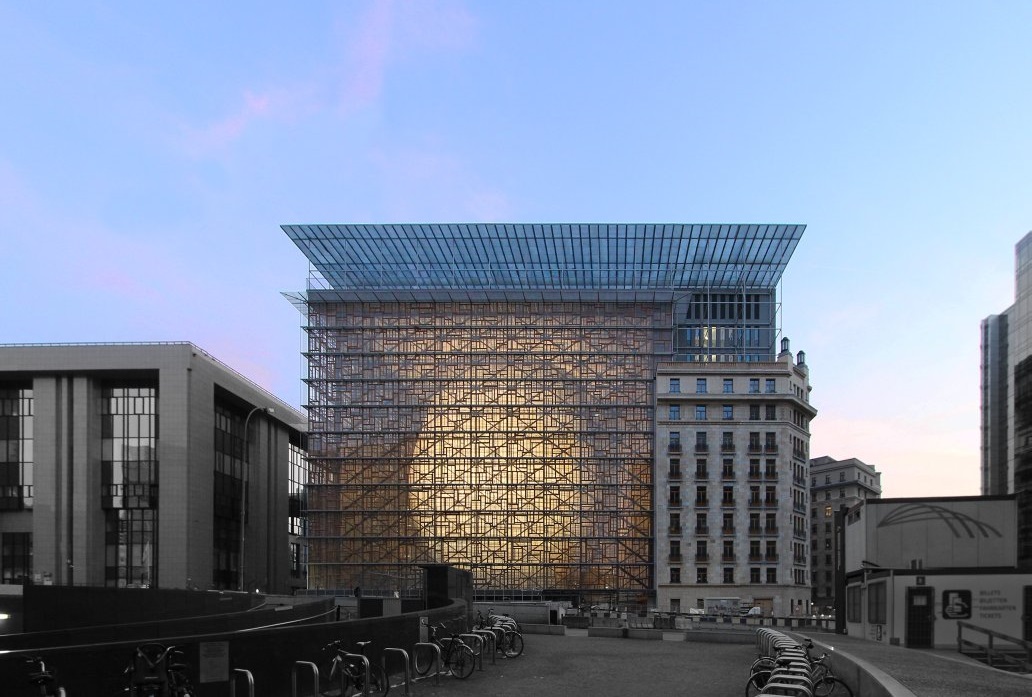
Image context: the cover uses a real photograph of the Europa building in Brussels, where the Council's work is physically housed.[7] The choice is institutional rather than laboratory-focused because the live news is not a single discovery. It is the decision to move science cooperation into a Council-endorsed governance frame.
Fact file
| Item | What is confirmed now | Confidence note |
|---|---|---|
| Decision | The Council adopted a recommendation on a European framework for science diplomacy on May 29, 2026.[1] | High; direct Council release. |
| Meeting context | The adoption came during the Research and Space configuration of the Competitiveness Council in Brussels.[2] | High; direct Council meeting page. |
| Policy baseline | The Commission had framed science diplomacy as a way to use research and innovation in external action while protecting European interests.[3][6] | High; direct Commission materials and proposal text. |
| Wider research setting | Horizon Europe remains the EU's main R&I programme, with a stated €93.5 billion budget for 2021-2027.[4] | High; direct Commission page. |
| Talent backdrop | The Commission's Choose Europe for Science initiative is trying to make Europe more attractive to researchers in a more competitive global talent market.[5] | High; direct Commission page. |
| Main uncertainty | Today's Council conclusions are a political framework, not a single enforcement rule or grant call.[1][6] | Medium-high; the importance depends on follow-through by member states, universities, funders, and future EU programmes. |
What changed today
The Council's move gives science diplomacy a shared EU vocabulary at a time when research policy is carrying more weight than before. The immediate text is about a framework, not a dramatic legal ban. Still, frameworks matter in Brussels because they tell institutions which tradeoffs are legitimate. The Council is saying that international scientific cooperation belongs in the same conversation as economic security, external partnerships, technological sovereignty, and values-based diplomacy.[1][2]
The Commission had already laid the groundwork. Its science-diplomacy page presents the idea as a bridge between research and external action, and its formal proposal describes a need for coordination across EU institutions, member states, research organizations, and diplomatic services.[3][6] Today's Council adoption turns that preparation into a ministerial signal: the EU wants science cooperation to be more deliberate, less ad hoc, and more consistent across capitals.
The timing is important. The EU is preparing the next phase of research funding after Horizon Europe, while the current programme's €93.5 billion budget has made research cooperation one of the bloc's major external-policy tools.[4] At the same time, the Commission is trying to attract researchers through Choose Europe for Science, presenting Europe as a stable, open, values-based place to work.[5] The new framework sits between those two impulses. It promises openness, but it makes clear that openness now has operating rules.
Why this is not just soft power
The easy reading is that science diplomacy means using universities, labs, and research grants to make Europe liked. That is too thin. The Council's framing is closer to policy infrastructure: science can help the EU keep channels open with partner countries, shape global standards, support crisis response, and build trust where ordinary diplomacy is strained.[1][3] Those are practical outputs, not ambient goodwill.
The harder edge is research security. The Commission's proposal links science diplomacy to an environment in which research can be exposed to foreign interference, unwanted technology transfer, and strategic dependence.[6] That does not mean every international collaboration becomes suspect. It means the EU is trying to distinguish between open cooperation and naive exposure. The policy problem is to keep the former while reducing the latter.
Universities and research organizations will feel the difference most directly. A good EU science-diplomacy posture is not only about sending delegations abroad. It is about knowing which partnerships need due diligence, which data or facilities require access controls, which collaborations are strategically valuable, and which values the EU expects partners to respect.[1][3][6] The framework therefore asks research institutions to behave more like geopolitical actors without losing the habits that make science useful: peer review, openness, reproducibility, and international exchange.
The practical test
The practical test is whether the framework changes behavior before the next large funding cycle locks in. If science diplomacy remains a set of speeches, it will add little. If it becomes a repeatable way to screen partnerships, coordinate external scientific engagement, and support researchers in sensitive fields, it could become one of the more important pieces of the EU's resilience strategy.[1][4][6]
The talent angle is especially delicate. Choose Europe for Science depends on Europe being legible as an open research destination.[5] Too much security language, applied clumsily, can make a system look suspicious and slow. Too little, and the EU risks treating knowledge, infrastructure, and talent as if they move in a frictionless academic world. The Council's framework is trying to hold both truths at once: science thrives on international contact, and some international contact now has strategic consequences.[1][5][6]
There is also a standards angle. Research partnerships often shape technical norms long before formal regulation arrives. If the EU wants influence over climate technology, health preparedness, AI safety, space systems, critical materials, or biosecurity, it needs scientific relationships that are credible abroad and coordinated at home.[1][3] Science diplomacy becomes a way to turn research excellence into rule-shaping capacity.
What remains uncertain
The biggest uncertainty is implementation. A Council recommendation can set direction, but it does not automatically make university compliance offices stronger, make member-state screening practices consistent, or decide how future framework-programme money will be conditioned.[1][6] The gap between a shared framework and daily grant administration can be large.
A second uncertainty is how the EU will balance central coordination with national competence. Research systems are deeply national in funding, language, institutional culture, and strategic priorities. The Council can encourage a common framework, but member states will still differ in how aggressively they screen collaboration, how they define sensitive sectors, and how they weigh economic opportunity against security exposure.[1][2]
The third uncertainty is external reception. Partner countries may welcome a clearer European offer if it brings stable funding, shared infrastructure, and predictable principles. They may resist it if "science diplomacy" feels like another name for strategic conditionality. The framework's credibility will depend on whether Europe can be both open enough to be worth partnering with and disciplined enough to protect its own research base.[3][5][6]
Decision impact
For research institutions, the next 30 days should be about mapping current international partnerships against likely science-diplomacy concerns: sensitive fields, data access, export-control exposure, foreign-interference risk, and dependence on a small set of partner countries. For funders, the near-term task is to watch whether future calls and evaluation criteria start using the Council's language. For policymakers, the next year matters more than the press release: the test is whether the framework appears in Horizon Europe work programmes, association talks, talent policy, research-security guidance, and diplomatic engagement with partner countries.[1][4][5][6]
The base case is that today's decision becomes a coordination layer. It gives Brussels and member states a common script for using science in foreign policy while keeping research security visible. The upside case is stronger: Europe turns scientific openness into a strategic advantage by pairing attractive funding and talent policy with credible guardrails. The downside case is that the phrase becomes a slogan, leaving institutions to manage hard partnership risks with uneven tools.
The falsifier is straightforward. If, over the next funding cycle, EU research cooperation remains mostly unchanged in partner selection, security review, talent policy, and external engagement, then today's framework will have been more language than leverage. If those processes start changing, the Council's May 29 decision will look less like soft power and more like the moment science diplomacy became an operating rulebook.
Sources
- Council of the European Union, "Council defines a new framework for science diplomacy" (May 29, 2026).
- Council of the European Union, "Competitiveness Council (Research and Space), 29 May 2026" (meeting page).
- European Commission, "Science diplomacy" (policy page).
- European Commission, "Horizon Europe" (programme page).
- European Commission, "Choose Europe for Science" (initiative page).
- European Commission, Proposal for a Council Recommendation on a European framework for science diplomacy (COM(2026) 97 final).
- Wikimedia Commons, "File:Europa building February 2016.jpg" - source page for the cover photograph.