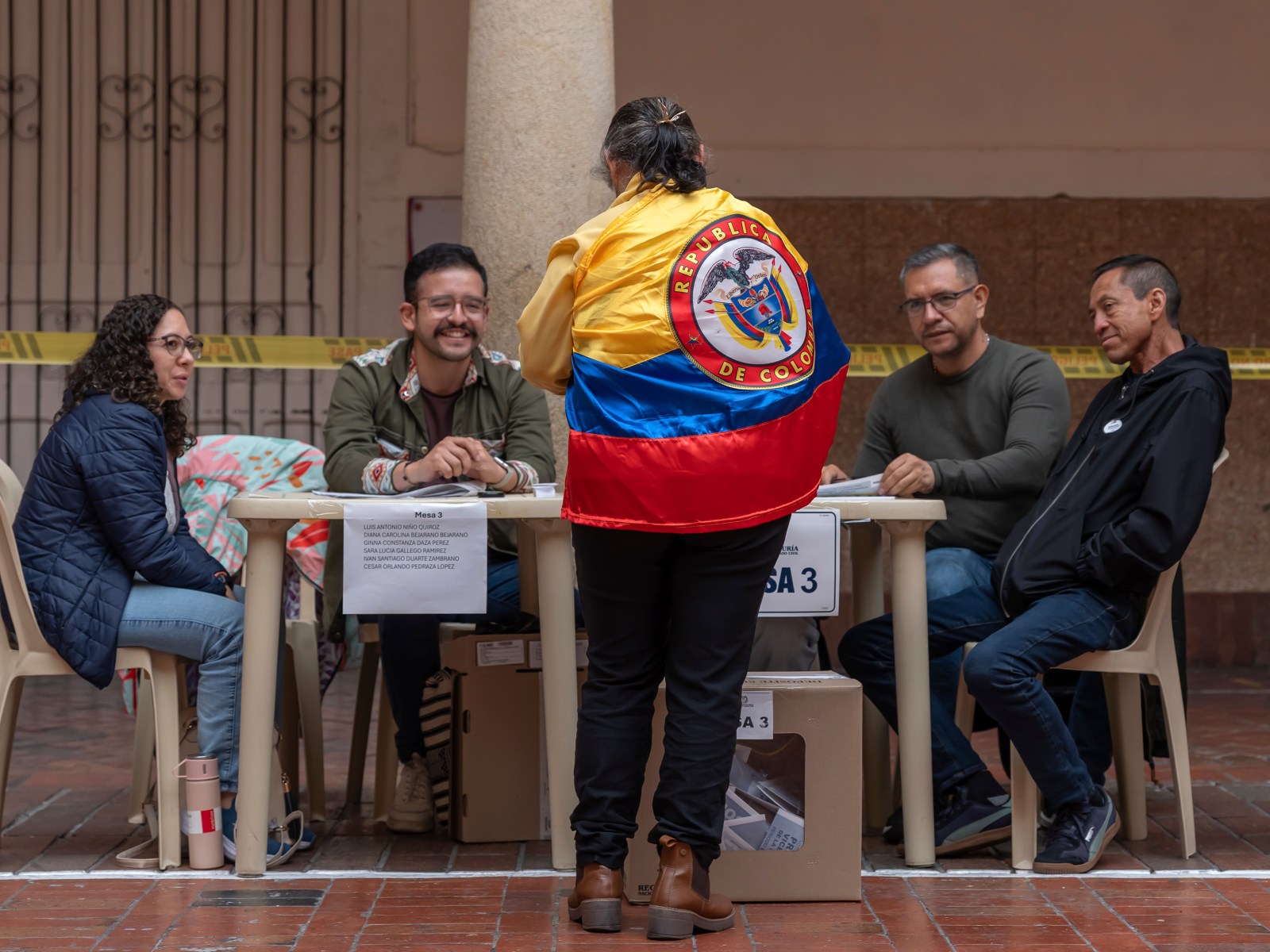
As of 2026-06-21 19:31 UTC, Colombia's presidential runoff is still a live election, not a settled result. Polls opened at 8:00 a.m. local time and were scheduled to close at 4:00 p.m.; El Pais reported 41,421,973 eligible voters, including Colombians abroad, while AP described a sharply polarized contest between progressive senator Ivan Cepeda and conservative outsider Abelardo de la Espriella [1][4][6].
That makes the vote easy to frame as a simple ideological swing after President Gustavo Petro. It is not that simple. The more useful reading is that Colombians are choosing what kind of security mandate they want after the 2016 FARC peace accord, Petro's strained "total peace" strategy, renewed armed-group violence, and a first round that left both sides arguing about legitimacy as much as programs [1][3][5].
The Verified Shape
| Item | What is known now | Confidence note |
|---|---|---|
| Election stage | Colombia is holding a second-round presidential vote on June 21, 2026, after no candidate secured a first-round majority on May 31 [1][5]. | High. Multiple current sources and the electoral calendar align. |
| Candidates | The runoff pits Ivan Cepeda, aligned with Petro's left-wing movement, against Abelardo de la Espriella, a hard-right lawyer and businessman running as an outsider [1][2][3]. | High for identities and broad political positioning. |
| Polling hours | Voting in Colombia runs from 8:00 a.m. to 4:00 p.m.; Colombians abroad voted through consular windows ending June 21 [4][6]. | High for procedure, though local incidents can affect specific sites. |
| Electorate | El Pais reported 41,421,973 eligible voters for the runoff [4]. | High for the current reported figure; final turnout comes later. |
| Main uncertainty | As of this timestamp, the result is not yet known; the live question is turnout, acceptance of the count, and the governing mandate produced by the winner [1][4][5]. | High for uncertainty; outcome claims would be premature. |
Why The Security Question Comes First
The campaign's deepest divide is not tax policy or cabinet arithmetic. It is whether Colombia should double down on negotiated demobilization or move back toward a more coercive state-security model. AP says both candidates are campaigning around the resurgence of violence tied to internal conflict and drug trafficking, but with sharply different answers: Cepeda would continue and revise Petro's peace agenda, while de la Espriella argues for a harder security line [1].
The Guardian's election-day analysis puts the same point in historical terms. The runoff is expected to affect Colombia's decades-long armed conflict, which changed after the 2016 peace accord but did not disappear. Dissident factions, criminal economies, territorial control, and drug routes have kept security politics alive even as the country moved beyond the old FARC-centered war story [3].
That is why "left versus right" is too thin. Cepeda represents continuity with the idea that armed actors can be pulled into state order through talks, incentives, and partial reform. De la Espriella represents a backlash against the idea that talks have produced security. For voters in urban neighborhoods worried about extortion, rural communities caught between armed groups, and businesses watching transport corridors, the issue is practical before it is ideological: which approach is more likely to make the state present without making the conflict worse?
The Post-Petro Layer
Petro cannot run again, but he is everywhere in the vote. Al Jazeera frames the contest as a choice between leftist Cepeda and a hardliner opposition figure, with Petro's record and political inheritance shaping the campaign [2]. AP likewise identifies Cepeda as heir to the outgoing president's movement, while de la Espriella presents himself as an outsider alternative to that project [1].
The risk for Cepeda is that continuity can sound like ownership of every disappointment under Petro: slow reforms, security frustration, economic anxiety, and institutional confrontation. The risk for de la Espriella is the opposite. Outsider energy can win anger, but it does not automatically produce congressional coalitions, administrative capacity, or a credible way to fight armed groups without reopening old patterns of abuse and impunity.
AS/COA's poll tracker shows why the election reached this knife-edge. De la Espriella came out of the first round in the top position and entered the runoff against Cepeda after a volatile campaign season, with polling earlier in 2026 swinging across several candidate matchups [5]. That volatility matters because it makes the eventual winner's mandate easy to overstate. A runoff victory gives constitutional authority. It does not erase the fragmented electorate that produced it.
The Count Is Part Of The Story
Colombia's immediate institutional test starts when polls close. El Pais reported that voting sites are open until 4:00 p.m. and that citizens should vote at the same assigned polling place used in the first round, with the physical or digital national ID card accepted [4][6]. Those procedural details sound ordinary, but they matter in a polarized election because legitimacy is built from boring, repeatable steps: the same stations, the same document rules, a visible ballot order, a clear close, then pre-count and scrutiny.
AP reports that Petro questioned the first-round result without providing evidence, while the runoff has carried accusations of fraud, vote buying, and foreign interference around the edges of the campaign [1]. That does not prove the count is compromised. It does mean the political system needs the result to be boringly auditable. In a close race, the loser can damage the next presidency before inauguration if supporters believe the margin was engineered rather than counted.
This is where international readers should be careful. Colombia has a long record of electoral competition and institutional resilience, but it also has a long history of political violence. Treating the election only as a "Latin America swings right" or "left survives" headline misses the thing that will decide governability: whether the defeated side accepts the mechanics of defeat quickly enough for the winner to form a cabinet, negotiate with Congress, and address security without starting under a cloud.
The Two Mandates
If Cepeda wins, the mandate is not simply "more Petro." It would be a conditional vote for keeping the peace-and-social-reform route alive while correcting its weakest points. He would need to show early that talks with armed groups are not an open-ended license for territorial coercion, and that social policy can reach communities without leaving security vacuums. The proof would be local: fewer threats, usable roads, credible police and prosecutors, and visible state services in places where armed actors currently arbitrate daily life.
If de la Espriella wins, the mandate is not simply "order." It would be a demand for a more forceful security turn, but one constrained by Colombia's own history. A hard-line presidency would be judged by whether it can reduce extortion, kidnapping, and territorial control without reviving paramilitary tolerance, indiscriminate operations, or civilian abuse. The first appointments would matter: defense, interior, justice, peace commissioner or its replacement, and the officials who handle relations with prosecutors and regional governments.
In both cases, the winner inherits an electorate that is asking for a state that can do two things at once. It must be strong enough to protect citizens from armed groups and disciplined enough not to become another source of fear. That is a narrow path. Colombia's runoff is therefore less a referendum on one slogan than a mandate test: how much coercion, negotiation, reform, and institutional patience voters are willing to authorize at the same time.
What To Watch After 4:00 P.M.
First, turnout. A high turnout gives the winner a cleaner democratic argument; a low or uneven turnout makes regional legitimacy more fragile, especially if violence or logistics affected participation in contested areas [1][4].
Second, concession behavior. The most important speech may not be the winner's. If the losing camp concedes clearly, the next government starts with a hard opposition but not a disputed birth. If the losing camp alleges fraud without evidence, the transition becomes a legitimacy fight before policy begins [1].
Third, the security language in the first 48 hours. Watch whether the winner talks about armed groups, police, the military, prosecutors, victims, and local governments as one system or as separate applause lines. Colombia's next security policy will fail if it is only a battlefield promise or only a negotiation promise.
Fourth, Congress. Neither candidate can govern the conflict, health care, fiscal policy, and regional investment alone. The runoff winner's coalition discipline will show whether the mandate can become legislation or whether the presidency immediately turns into permanent confrontation [5].
The falsifier for this analysis is straightforward: if the result is decisive, promptly accepted, and followed by broad coalition signals, then the security-mandate problem will look less acute than it does before the count. Until then, the main story is not who occupies the ideological label. It is whether Colombia can turn a polarized runoff into a governable presidency.
Sources
- Associated Press, "Colombians vote in a presidential runoff that pits an outsider against a progressive" (June 21, 2026).
- Al Jazeera, "Polls open in Colombia presidential race pitting leftist against hardliner" (June 21, 2026) - election report and source page for the article image.
- Tiago Rogero, "Colombians vote in runoff election expected to trigger shift in decades-long armed conflict," The Guardian (June 21, 2026).
- El Pais, "Elecciones Colombia 2026, en vivo | la segunda vuelta de las presidenciales" (June 21, 2026).
- Chase Harrison, "Poll Tracker: Colombia's 2026 Presidential Election," Americas Society/Council of the Americas (updated June 2026).
- Alcaldia de Bogota, "Desde que hora se puede votar elecciones presidenciales 21 junio 2026" (June 21, 2026).