As of 2026-11-05 11:35:13 UTC, UNESCO’s account of the Alexandria Declaration has brought a demanding question into view: what should a protected underwater site deliver for the people around it? Published on October 28, the announcement describes a declaration endorsed at the Bibliotheca Alexandrina on August 20. Its ambition is to judge progress through knowledge, opportunities and social benefits as well as the heritage preserved.[1]
That gives tourism a place in the argument, but also a harder test. A growing audience can help a submerged site acquire supporters, guides and an educational life. Visitor numbers alone cannot establish that its archaeology is secure or that nearby communities share the benefit. Those outcomes need their own evidence.
The announcement changes the question of success
Three records establish the starting point:
- August 20, 2026: participants endorsed the declaration in Alexandria, according to UNESCO’s subsequent announcement.[1]
- October 28, 2026: UNESCO published its account, emphasizing education, research, environmental stewardship, sustainable tourism and community benefits. This is evidence of stated priorities, not measured results.[1]
- November 2, 2001: UNESCO adopted the existing underwater heritage convention. Its text already encouraged responsible, non-intrusive public access, subject to protection and management.[2]
The distinction matters. Public enjoyment is not a newly discovered exception to preservation. The convention placed the two together from the outset. Reading the declaration as an invitation simply to open more sites would miss the harder task: making access serve a place whose value depends on what survives there.
UNESCO’s announcement provides no site-by-site outcome assessment or funded implementation timetable.[1] The appropriate reading is therefore an agenda to test. Its eventual strength will depend on whether institutions can connect the benefits they claim to the work that protects the evidence.
Keeping a site underwater still requires work
The convention makes preservation in situ—at the site itself—the first option. That is a starting preference, not a universal instruction to leave every object untouched. UNESCO’s explanation allows recovery when it significantly advances protection or knowledge, including endangered objects destined for research or a museum.[3]
A further boundary concerns what is being commercialized. The convention prohibits commercial exploitation of underwater heritage; its annex specifically addresses trade, speculation and irreversible dispersal. It also requires project planning, conservation arrangements and adequate resources for archaeological work.[2] Selling an excavated cargo and organizing a responsible encounter with a surviving site cannot be treated as interchangeable forms of development.
This is where an apparently attractive tourism proposal needs scrutiny. Who pays for condition surveys? Who can restrict access when conservation requires it? What remains available to researchers after the visitors have gone? These are analytical tests of the proposal, rather than results established by the declaration.
Baia makes the hidden work visible
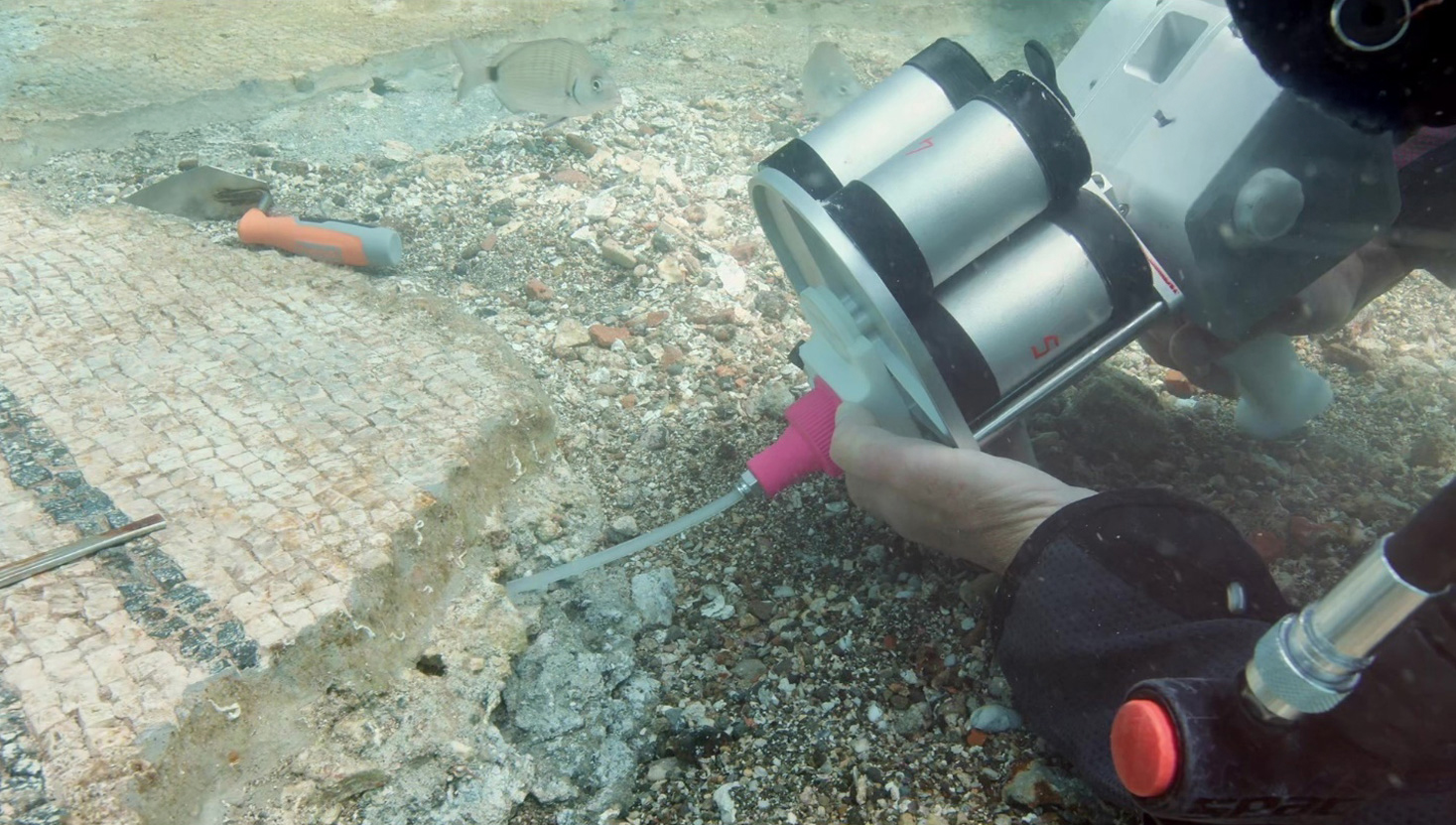
At Baia in Italy’s Gulf of Pozzuoli, the seabed contains Roman villas, baths and mosaic floors. The Ministry of Culture’s Amphitrite project describes conservation alongside technologies for visitors: underwater surveys produce three-dimensional records for monitoring, while restoration addresses damaged mosaic surfaces. Visitor tools include underwater audio guidance and waterproof devices.[5]
The pairing is instructive. Interpretation can help people understand what they are looking at, but it sits beside a separate effort to keep the material legible and intact. A good visit depends on work that may be almost invisible during the visit itself.
Baia’s administration also published a March 19 notice inviting applications for authorization to conduct guided visits in 2026 under the park’s provisional regulation.[6] The notice establishes a permissions process. By itself, it does not establish how effectively permissions are enforced, how much income reaches conservation, or whether visitor pressure is changing the site.
Baia is an existing example, not an outcome of the August declaration. Its usefulness lies in making the implementation questions concrete. An authority can describe a route, authorize an operator and document restoration; judging success means examining how those activities function together.
More participants need a useful role
The diving federation CMAS’s August 27 account of the Alexandria meeting supplies another clue. It reports discussion of scientific-diver education and plans to renew citizen-science courses involving recreational divers.[4] This is a participant’s report of intentions, not an independent evaluation of those courses.
Even so, it identifies a plausible route from interest to stewardship. Training could make a visitor’s observation useful to the people managing a site. That connection requires an agreed method, someone to receive the observation and a way to act on it. Recruiting more observers without that chain would enlarge participation without necessarily improving knowledge.
The same test applies to the promise of local benefit. A project should be able to explain which jobs, learning opportunities or services it supports, who can access them and how those gains relate to preservation. Counting arrivals is easier than answering those questions. The declaration’s broader ambition makes the questions unavoidable.
What would make the promise credible
The base case is gradual change through existing institutions: the declaration influences plans, while practical access remains governed by site arrangements. Publication of revised management plans would be the first evidence to examine. The upside would be funded conservation and training accompanied by public reporting on site condition and community participation. The downside would be promotion and visitor growth outrunning the capacity to supervise them, visible in deterioration or unresolved management gaps. These are conditional scenarios, not reported outcomes.
For readers, editors and heritage organizations following the announcement:
- Within 24 hours: distinguish the August endorsement from October’s publication, and keep the convention’s existing provisions separate from the declaration’s ambitions.
- Over the next week: check any claimed local rollout against the relevant authority’s permissions and published management arrangements.
- Over the next month: look for named responsibilities, resources and measures of both conservation and public benefit. A visitor count alone cannot validate a claim of success; worsening site condition would undermine it even if attendance rose.
Sources
- UNESCO, “From Protection to Development: The Alexandria Declaration on Underwater Cultural Heritage,” October 28, 2026, updated October 29 — endorsement date, priorities and proposed measures of progress.
- UNESCO, Convention on the Protection of the Underwater Cultural Heritage, adopted November 2, 2001 — Article 2 and Annex Rules 1–2, 9–10, 17 and 24 on preservation, access, commercial exploitation and project planning.
- UNESCO, “Principles of the 2001 Convention,” updated August 20, 2024 — in situ preservation as the first option and the circumstances for recovery.
- CMAS, “UNESCO-CMAS Underwater Cultural Heritage 25 years,” August 27, 2026 — participant account of the Alexandria meeting, diver education and proposed citizen-science courses.
- Italian Ministry of Culture, Progetto Amphitrite, “Parco Archeologico Sommerso di Baia,” accessed November 5, 2026 — archaeological context, conservation, visitor technologies and the photograph of mosaic consolidation.
- Parco Sommerso di Baia, “Presentazione domande per lo svolgimento di attività nel Parco sommerso di Baia per il 2026,” March 19, 2026 — official notice inviting applications for guided-visit authorization.