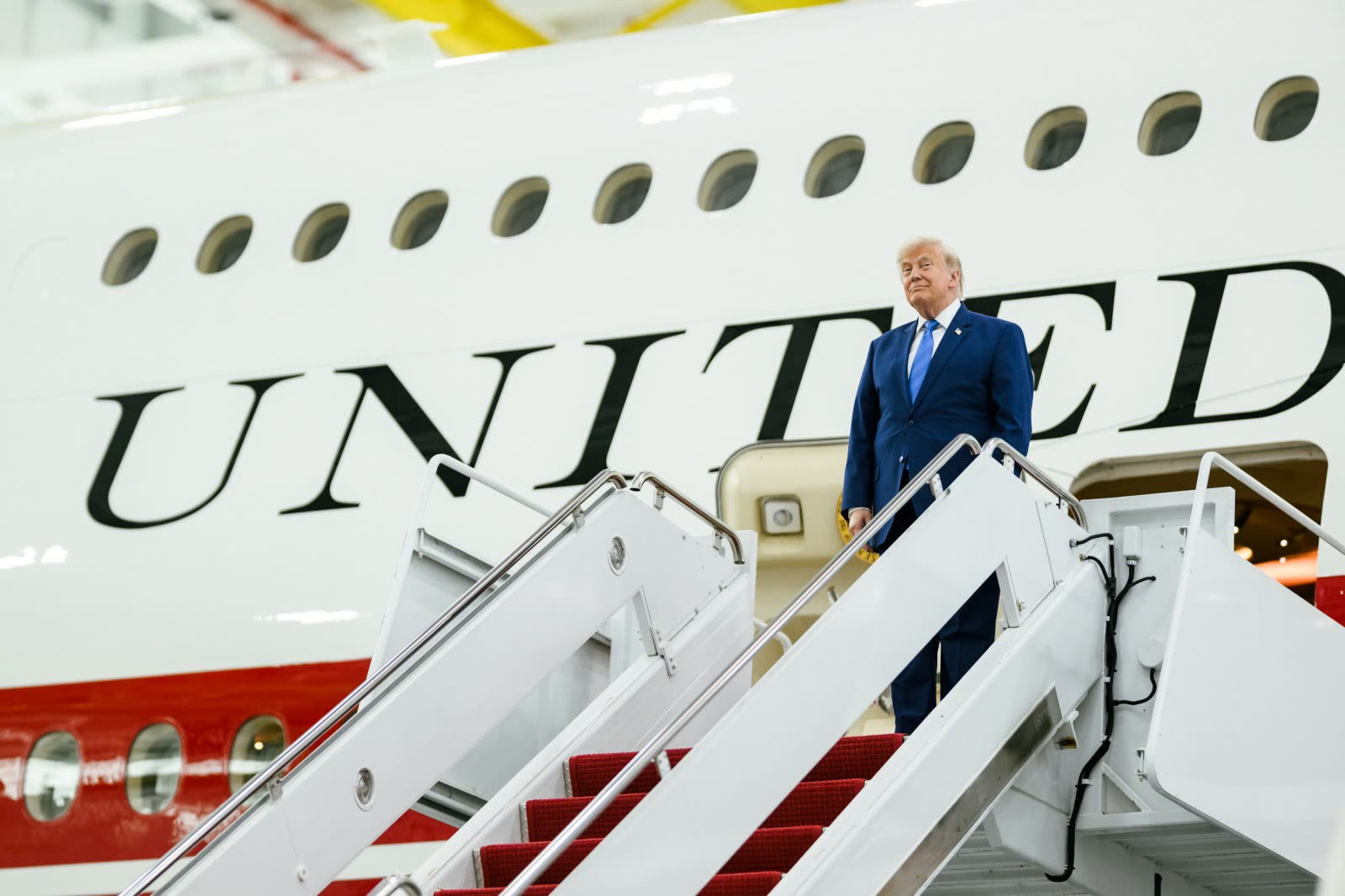
As of 2026-07-01 22:34 UTC, the new Air Force One has moved from hangar display to presidential service. President Donald Trump took his first flight Wednesday on a retrofitted Boeing 747-8 aircraft gifted by Qatar and prepared as an interim presidential jet.[1]
The important part is not only the paint scheme or cabin. The first flight turned three slower stories into one visible aircraft: a delayed VC-25B replacement program, a compressed bridge-aircraft conversion, and a foreign-gift governance problem that now travels with the president.[1][2][4][6]
The safest read is narrow. The plane is operational enough for the first presidential trip. It is not proof that the final Air Force One replacement problem has been solved, that every security tradeoff is publicly understood, or that the ethics controversy has disappeared.
Fact File
| Timestamp / source | Key signal | Confidence note |
|---|---|---|
| AP, July 1 | Trump made the aircraft's first presidential flight from Joint Base Andrews to North Dakota. AP identifies it as a Qatari-gifted, retrofitted Boeing 747-800 valued at about $400 million.[1] | High for the first-flight event and reported value; the value is not the same thing as full conversion cost or lifetime operating cost. |
| AP, July 1 | AP reports that the aircraft is meant as a bridge until delayed replacement jets arrive, and that some features of the outgoing presidential aircraft appear absent from the bridge jet. The Air Force says the rapid conversion did not accept safety, security, or communications risk.[1] | Medium-high. The public can see only part of the aircraft's configuration; classified details and full test results are not public. |
| U.S. Air Force, June 19 | The service said the VC-25B Bridge aircraft had arrived at Joint Base Andrews and would begin commissioning flights to support presidential airlift continuity while the older VC-25A fleet ages.[2] | High for the Air Force's official program position; not an independent audit. |
| L3Harris, June 19 | The contractor said it transformed a 747-8i into the first VC-25B Bridge aircraft within 10 months, using accelerated production and a new communications system.[3] | High for contractor-reported delivery claim; still a vendor description of its own performance. |
| DoD selected acquisition report, December 2022 | The formal VC-25B program had already recorded delivery delays of 28 months for the first aircraft and 26 months for the second, with extended VC-25A operations funded through calendar year 2028.[4] | High for the official delay baseline as of 2022; current delivery timing may have shifted since that report. |
| GSA / U.S. Code / Constitution Annotated | The foreign-gifts framework distinguishes low-value courtesy gifts from higher-value gifts accepted for the United States, while the Foreign Emoluments Clause remains legally sensitive and under-litigated for presidential benefits.[5][6][7] | High for the legal materials; uncertain for final application without a definitive public legal ruling on this aircraft transaction. |
What The Flight Actually Proved
The first flight proved that the bridge aircraft can enter the presidential travel system. That is a real milestone. Air Force One is not a normal executive jet assignment: it has to carry a moving White House, secure communications, staff, press, medical support, and symbolic continuity. The Air Force's June 19 statement framed the aircraft as a way to relieve pressure on the older VC-25A fleet while the long-term Boeing replacement aircraft remain under development.[2]
It did not prove that the bridge aircraft equals the final replacement. AP's reporting draws a practical distinction between a compressed interim conversion and the more complete presidential aircraft still delayed in the background. The Air Force itself, as AP reports, says several complex modifications required for the final aircraft were intentionally left out of the Bridge aircraft, while also maintaining that the bridge version remains safe and secure for its assigned mission.[1]
That distinction matters because "Air Force One" can hide different levels of capability under one famous call sign. The public sees the same presidential seal, stairs, livery, cabin images, and departure ceremony. Operators see a mission envelope: domestic hops, international routes, backup aircraft, secure communications, defensive systems, maintenance risk, airport constraints, and classified contingencies. The current uncertainty is not whether the plane can fly the president. It is how far the bridge mission envelope extends compared with the outgoing VC-25A and the delayed purpose-built replacements.[1][2]
Why The Bridge Became Political
The aircraft exists because the replacement program ran late. The 2022 selected acquisition report is blunt enough: Boeing's VC-25B schedule had slipped by more than two years for each of the two planned aircraft, forcing continued operations of the older VC-25A fleet through 2028.[4] Once a presidential aircraft program is late, every workaround becomes political. Leasing, buying, accepting, or modifying an interim aircraft all require someone to decide which risk is worse: aging airframes, rushed conversion, extra cost, or symbolic compromise.
The Qatari gift made the workaround louder. GSA's current foreign-gift guidance says the 2026 minimal-value threshold is $525 and that gifts above that level belong to the U.S. government when accepted under the foreign-gifts framework.[5] The statute itself provides for certain higher-value tangible gifts to be accepted on behalf of the United States and deposited or used officially under agency rules.[6] That is the administration's strongest procedural argument: the jet is not a personal keepsake if it is accepted and used as U.S. government property.
But procedure is not the whole public-trust problem. The Constitution Annotated discussion of the Foreign Emoluments Clause emphasizes that recent litigation left major questions without definitive Supreme Court settlement, including the clause's presidential reach and the meaning of "emolument" in contested settings.[7] That does not prove illegality here. It does mean the public controversy cannot be dismissed merely because the aircraft has a tail number and an official mission. A foreign-state gift this large naturally raises the demand for transparent ownership, cost, modification, future-disposal, and conflict-management records.[5][6][7]
The Real Operating Question
The highest-stakes question is not whether the new plane looks presidential. It is whether the bridge plan makes presidential airlift more resilient without creating hidden dependencies.
In the base operational case, the bridge aircraft reduces strain on aging VC-25As and gives the president a larger, newer interim platform while the long-term replacements continue. L3Harris says it converted the aircraft in 10 months and equipped it with secure connectivity for global-event response.[3] If that performance holds under commissioning, maintenance, and real travel schedules, the bridge aircraft may buy time.
The downside case is different. If the aircraft's mission envelope is narrower than public rhetoric suggests, it could become a prestige asset that still requires the older fleet for the hardest trips. AP's reporting already points to the tension: rapid delivery, fewer visible defensive-system cues, and official assurances that security was not compromised.[1] Those claims can coexist. A bridge aircraft can be safe for some missions and still not be equivalent to the final aircraft.
The governance case is just as important. If the aircraft remains clearly U.S. government property, if conversion costs are traceable, if disposal rules are explicit, and if Congress receives enough information to perform oversight, the controversy narrows. If records are opaque, if future personal use becomes plausible, or if Qatar-related policy decisions appear alongside aircraft favors, the plane will keep functioning as an ethics symbol no matter how well it flies.[5][6][7]
Decision Impact
Next 24 hours: the administration should treat the first flight as an operating start, not a victory lap. The useful disclosure is not cabin decor. It is the accepted ownership path, the official-use rationale, the conversion-cost range, and the mission boundaries that can be discussed without exposing classified systems.[1][5][6]
Next 7 days: congressional overseers should separate four questions that often get blurred: whether the aircraft was legally accepted, whether the conversion was cost-effective, whether the bridge aircraft meets its assigned security envelope, and whether the final VC-25B program is still late enough to justify this workaround.[2][4][6]
Next 30 days: the proof will be travel behavior. If the bridge aircraft is used mostly for domestic or lower-complexity routes while the old VC-25As remain central for more demanding trips, that tells one story. If it handles broader presidential travel without disruptions, maintenance surprises, or unexplained backup dependence, that tells another.[1][2]
Scenarios
Base case: the aircraft becomes a limited but useful bridge. It handles many presidential trips, reduces pressure on the aging fleet, and gives the Air Force time while the final replacements proceed. The ethics controversy remains active but manageable if official ownership and cost records are clear.[2][3][5][6]
Upside case: the bridge aircraft performs reliably, its conversion cost remains bounded, and oversight records make the foreign-gift pathway legible. The first flight then becomes a rare case where a messy workaround still improves operational resilience.[2][3][6]
Downside case: the aircraft proves politically expensive and operationally narrower than advertised. The warning signs would be repeated reliance on older jets for sensitive trips, delayed answers on conversion cost, unresolved future-disposal questions, or public evidence that the aircraft gift is affecting U.S.-Qatar policy perception.[1][5][7]
Action Checklist
- For the White House: publish the nonclassified acceptance, ownership, official-use, and disposal rationale in plain language.[5][6]
- For the Air Force: distinguish bridge-aircraft capability from final VC-25B capability without revealing classified details.[1][2]
- For Congress: ask separately about gift law, procurement delay, conversion cost, mission envelope, and future aircraft delivery, because each has a different answer and evidence base.[4][6][7]
- For reporters: do not collapse "gifted aircraft," "Air Force One," "VC-25B Bridge," and "final VC-25B replacement" into one object. The whole story is the gap between those categories.[1][2][4]
- For readers: treat luxury-cabin images as atmosphere, not evidence. The hard questions are ownership, security scope, maintenance reliability, and whether the bridge actually buys time.[1][3][6]
The invalidation condition is concrete: if the administration releases records showing clean U.S. government ownership, bounded modification costs, a clear disposal path, and a publicly defensible mission envelope, the ethics and security story narrows. If those records remain thin while the aircraft becomes a recurring political stage, the first flight will look less like the end of the controversy than the moment it became operational.[1][5][6][7]
Sources
- Associated Press, "Retrofitted Qatari jet takes flight as Air Force One for Trump's trip to North Dakota" (July 1, 2026) - first-flight report, bridge-aircraft context, reported value, mission-scope caveats, and Air Force response.
- U.S. Air Force, "VC-25B Bridge aircraft arrives at Joint Base Andrews, begins commissioning flights" (June 19, 2026) - official service statement on bridge-aircraft delivery, commissioning, continuity, and security requirements.
- L3Harris, "L3Harris Delivers VC-25B Aircraft to US Air Force" (June 19, 2026) - contractor statement on 747-8i conversion timeline, communications system, and delivery to the Air Force.
- U.S. Department of Defense, VC-25B Selected Acquisition Report, December 2022 - official acquisition-report baseline on delivery delays and extended VC-25A operations.
- U.S. General Services Administration, "Foreign gifts" (updated April 23, 2026) - current minimal-value threshold and federal handling rules for foreign-government gifts.
- Legal Information Institute, Cornell Law School, "5 U.S. Code § 7342 - Receipt and disposition of foreign gifts and decorations" - statutory text on acceptance, official use, deposit, reporting, and disposition of foreign gifts.
- Library of Congress, Constitution Annotated, "Foreign Emoluments Clause Generally" - legal background on recent litigation, presidential questions, and unresolved scope issues.
- The White House, "Gallery" - official June 19, 2026 photograph of President Trump touring the new Air Force One at Joint Base Andrews, used as the article image.