The famous opening shot of Touch of Evil is often praised as a stunt: a bomb is placed in a car, the camera rises and travels through a border-town night, newlyweds Miguel and Susan Vargas cross paths with the doomed vehicle, and the explosion finally arrives after the car has crossed from Mexico into the United States.[1][2] That description is accurate, but it makes the sequence sound like a virtuoso flourish attached to a crime story. The stronger reading is that the shot teaches the whole film how to behave.
Orson Welles and cinematographer Russell Metty do not use the long take to prove that cutting is unnecessary. They use it to make space morally unstable. The camera knows about the bomb. The pedestrians do not. The border gate appears to divide jurisdictions, yet the shot refuses to divide danger. Music, street noise, neon, traffic, and bodies run together. By the time the car explodes, the film has already made its central point: corruption is not hidden in one room or one official. It circulates through systems that pretend to be separate.[1][3]
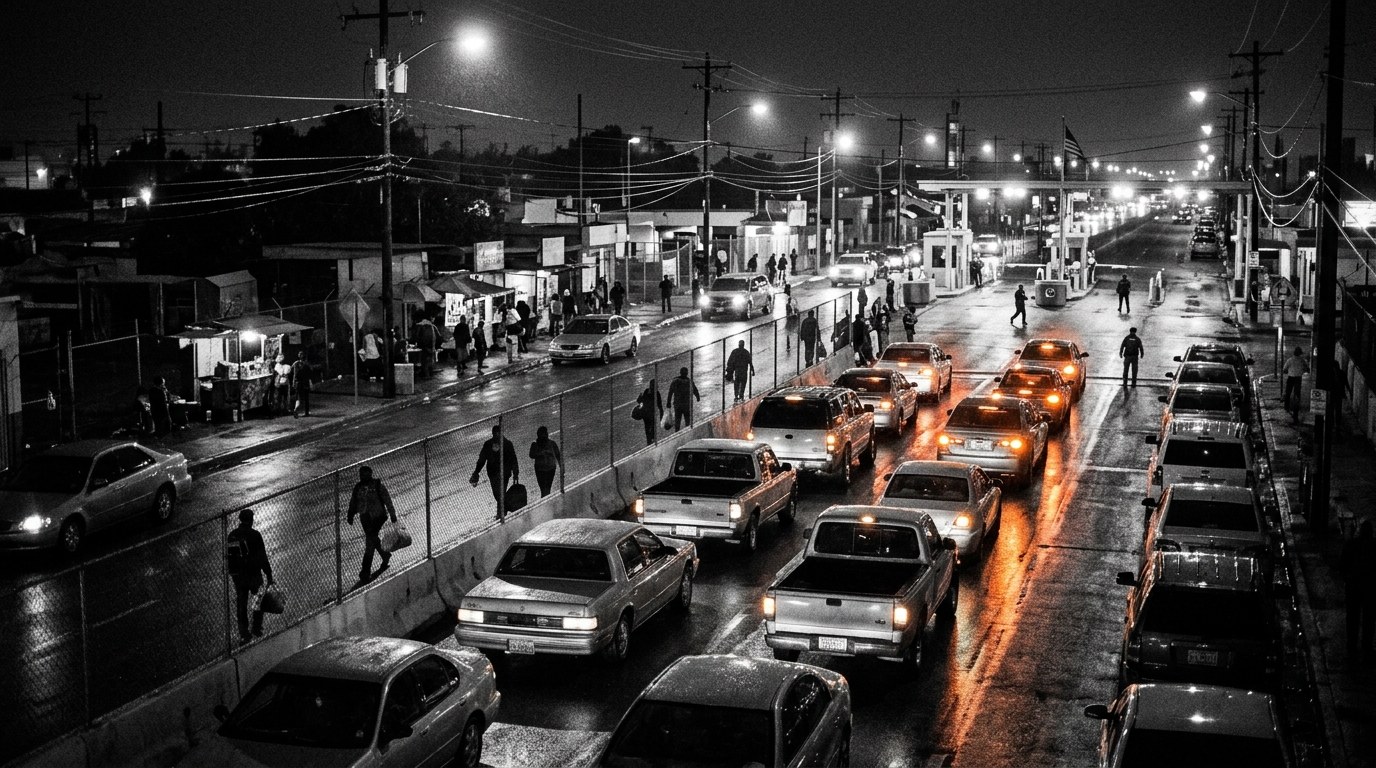
The long take is a map, not a flex
AFI's production history calls the opening sequence one of the most frequently cited examples of Welles's unusual camera work, and BFI singles it out as a celebrated three-minute tracking shot that begins with the bomb and ends after the border crossing.[1][2] The reason it survives beyond technical admiration is that it refuses a clean subject. The camera does not belong only to the criminals, the victims, the Vargases, the city, or the audience. It drifts between all of them, making knowledge and helplessness share the same movement.
That drift matters because Touch of Evil is a film about procedures that no longer guarantee justice. Vargas is a narcotics official who believes in evidence, jurisdiction, and law. Hank Quinlan, the police captain played by Welles, believes in instinct, confession, planted proof, and the authority of his own record. The opening shot places those philosophies inside a single moving system before the men have properly collided. The bomb is a fact. The border is an administrative line. The camera makes both feel insufficient.
The sequence also turns suspense into contamination. In a conventional setup, the audience might be asked to identify with a victim or investigator. Here, the viewer's knowledge floats above the crowd. We watch the car pass through ordinary night life, and that ordinary life becomes intolerable because it keeps moving at the wrong speed. The craft is not just duration. It is duration with uneven knowledge. The shot stretches time until public space becomes complicit by accident.
Welles turns noir lighting into civic weather
The movie's visual grammar does not relax after the opening. AFI lists Metty as cinematographer and notes that the film's later reputation rests partly on Welles's innovative use of sound, lighting, and camera.[1] The American Society of Cinematographers account frames the film as a shadowy maze of crime, squalor, and moral decay, with Welles and Metty bringing panache to material that began as a pulp crime property.[3] That is the useful production fact: Touch of Evil is not elevated by ignoring its pulp machinery. It is elevated by making the machinery grotesque.
Low angles make Quinlan look less like a man in rooms than a mass rooms must accommodate. Deep shadows do not merely hide evidence; they make evidence feel politically compromised before it is found. Crowds, doorways, hotel desks, cramped apartments, motel cabins, and police interiors all seem to have too many lines of force running through them. Welles's noir is not minimal. It is congested.
That congestion is essential to the film's border setting. AFI notes that Welles changed the source material by making Heston's character a Mexican narcotics agent, making Janet Leigh's character American, shifting the setting to a Mexican-American border town, and heightening racial and sexual tensions.[1] The casting and brownface remain a serious limit on the film's representational politics; the movie asks Heston to embody a Mexican official through a convention that now reads as false and damaging. Yet the screenplay's structural move still matters. Welles makes the border the place where law, race, tourism, policing, sex, and media rumor rub against one another without resolving into a stable civic order.
Quinlan is staged as institutional weight
The relationship between Joseph Calleia's Pete Menzies and Welles's Quinlan captures one of the film's craft principles: corruption is staged through proximity.[6] Menzies is not a simple villain. He is a loyal subordinate whose decency has been bent by years of working inside Quinlan's orbit. Welles turns that relationship into blocking. People do not merely argue with Quinlan; they lean toward him, circle him, trail him, hesitate around him, or get swallowed by his frame.
That is why Quinlan's body is not just characterization. It is mise-en-scene. His limp, bulk, hat, cane, and heavy face make power visible as inertia. He enters scenes like a prior verdict. The film's recurring question, sharpened in the ASC account through Vargas's challenge about whether the cop or the law is boss, is not abstract jurisprudence.[3] It is spatial. Who controls the room? Who can force others to move? Who can make a planted object become an official fact?
The apartment interrogation sequence extends the opening-shot lesson into a tighter register. AFI notes that this other long take was filmed early to show the studio that Welles could work quickly and efficiently.[1] In the film, efficiency itself becomes frightening. The scene has the procedural surface of an investigation, but the camera and blocking keep exposing the pressure behind the procedure. The room becomes a trap because the law's choreography has already been captured by Quinlan's certainty.
Sound is part of the border system
The 1998 reconstruction is not a side note to the film's craft history. It proves how much Welles thought sound and editing mattered. AFI records that the restored version used editorial changes based on Welles's 1957 memo to Universal and credits the restoration to Walter Murch, Rick Schmidlin, Bob O'Neil, and Jonathan Rosenbaum.[1] Wellesnet's account of the memo history likewise describes a 58-page document in which Welles urged changes that Universal ignored, with Schmidlin and Murch later following those recommendations to create a version closer to Welles's plan.[5]
The most famous alteration is the opening: removing the imposed credits and non-diegetic scoring lets the street sound breathe differently. That change is not cosmetic. It shifts the shot away from title-sequence display and back toward environmental dread. The bomb moves through a living border strip of music leaking from clubs, vehicle noise, footsteps, voices, and public motion. The audience is still guided, but the guidance feels embedded in the world rather than laid over it.
This is why Touch of Evil has an unusually complicated authorship afterlife. The Library of Congress registry lists the film as a 1993 National Film Registry selection, and the expanded essay treats it as a jolting ride through a seedy border town with glamorous stars forced against grotesque powers.[4][5] Its preservation status does not freeze one simple object. It preserves a film whose strongest modern form depends on reading the damaged production history back into the craft.
The technique still feels dangerous
The opening shot is remembered because it is spectacular, but its real lesson is harsher. A camera movement can be beautiful and morally ugly at the same time. A border can be legally precise and dramatically useless. A police procedure can look organized while serving a lie. A restoration can clarify a director's method without pretending that history has been erased.
That is why Touch of Evil still plays as more than a late noir landmark. It is a film about how systems produce atmosphere. Welles and Metty build a world where the camera cannot find a neutral position because no neutral position exists. Every movement crosses a line. Every room has already been pressured. Every piece of evidence has to answer the question the film keeps asking in visual terms: who has the power to make a frame look true?
Sources
- AFI Catalog, Touch of Evil (1958) - credits, production history, Welles's screenplay changes, opening sequence, Venice locations, restoration notes, and long-take context.
- BFI, Touch of Evil (1958) film page - overview of the border bombing, three-minute tracking shot, noir status, and Welles's baroque style.
- George E. Turner, "A Cop Gone Wrong: Touch of Evil," American Society of Cinematographers - 1998 article on Welles, Russell Metty, noir style, police power, and visual atmosphere.
- Library of Congress, Complete National Film Registry Listing - registry entry showing Touch of Evil (1958) inducted in 1993.
- Library of Congress, Touch of Evil expanded National Film Registry essay - plot, border setting, star configuration, Quinlan, and critical framing.
- Wikimedia Commons, "File:San Ysidro Border Traffic (8653120372).jpg" - real border-crossing traffic photograph used to keep the article image grounded in cars, lanes, and checkpoint space.