Most readings of The Godfather start with power: who holds it, who loses it, who inherits it. A more durable reading starts with ritual. Francis Ford Coppola’s film repeatedly shows that force alone is unstable; force becomes durable only after being wrapped in ceremony, kinship language, and recognizable social forms.
That is why this 1972 crime epic still feels current in 2026. It is not simply a story about organized crime. It is a story about how institutions—family, church, business, even hospitality—can normalize coercion by giving it familiar choreography.[1][2][3]
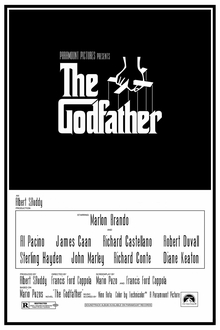
Image context: the official 1972 poster’s marionette-hand motif previews the essay’s central claim—power looks legitimate when control is staged as ritual rather than chaos.
The opening lesson: violence enters through a formal petition
The film opens not with a shootout, but with a request process. In the first office scene, Amerigo Bonasera asks Don Corleone for justice while Connie’s wedding unfolds outside.[6] The staging creates a constitutional feel: there are procedures, witnesses, and implied obligations. Don Corleone refuses immediate compliance, then grants conditional help only after Bonasera performs the language of loyalty.
This matters because the scene establishes the core rule: legitimacy in the Corleone world is produced through ritualized exchange, not through naked command. The room is dark, the blinds are partially closed, and the camera gives the office the gravity of a private court. The wedding outside is not decorative contrast; it is the social mask that makes the private tribunal appear natural.
In practical terms, the film’s first act teaches viewers to read the Corleones less as a gang and more as a parallel governance system that borrows forms from family life.
Michael’s arc is not a corruption arc alone; it is a ceremonial training arc
Michael’s famous early line to Kay—“That’s my family, Kay, that’s not me”—is often treated as moral distance before collapse.[1] But the structure of the film suggests a second layer: he is initially outside the ritual grammar, not only outside the violence.
His movement into power follows a sequence of rites:
- first, emergency participation (hospital protection scene),
- then blood initiation (restaurant killing of Sollozzo and McCluskey),
- then exile and return,
- then marriage and domestic consolidation,
- finally, liturgical confirmation during the baptism montage.
Seen this way, Michael does not merely become “more ruthless.” He becomes fluent in converting exceptional force into normalized authority. By the final act, his decisions are no longer presented as impulsive revenge but as administrative closure across a portfolio of enemies.
That distinction explains why his transformation remains so unsettling. The film does not dramatize a man losing control. It dramatizes a man gaining procedural control over violence.
The baptism montage: the film’s central theorem
The cross-cut between Michael at a church baptism and coordinated assassinations is frequently praised as editing virtuosity. It is more than that. It states the film’s core theorem in formal terms: sacred language and lethal execution can be synchronized into one political act.
The scene’s power comes from timing, not surprise. The audience already understands the stakes. What changes is the frame. By interlocking church vows with killings, the film demonstrates that legitimacy can be manufactured by sequence design: first perform innocence publicly, then finalize coercion privately, and let chronology collapse moral contradiction.
This is where The Godfather exceeds gangster spectacle and enters institutional analysis. It asks whether modern authority depends less on truthfulness than on successful management of symbolic surfaces.
Why the film’s domestic spaces matter more than its gunfights
The movie’s architecture reinforces this reading. Key decisions happen in interiors that belong to family or business routine: offices, dining rooms, wedding compounds, study-like chambers. Violence often occurs elsewhere, but command decisions remain embedded in ordinary social rooms.
That separation does two things:
- It lowers the emotional temperature of command. Orders sound like household or corporate coordination, not battlefield frenzy.
- It protects the core institution from visual contamination. The family space remains formally intact even when the network commits escalating violence.
This strategy is one reason the film aged better than many crime contemporaries. It treats violence as logistics managed by institutions, not as adrenalized chaos. In modern terms, it is closer to a control-plane film than an action film.
The long afterlife: why this structure became a genre template
The Godfather’s cultural status is measurable, but raw accolades matter less than what they indicate about durability. It won Best Picture at the 45th Academy Awards, taking 3 wins from 8 nominations.[2] It posted a long-tail global box-office life through original run and multiple rereleases, with Box Office Mojo listing $250,933,053 worldwide gross.[1] It was later selected for preservation by the U.S. National Film Registry.[4] AFI’s list places it among the top canonical American films.[3]
Those markers reflect more than prestige. They indicate that later filmmakers, critics, and viewers kept finding reusable grammar in its design. You can see echoes of this ritual-legitimacy template across crime, political, and corporate dramas: public virtue performance paired with private coercive consolidation.
In that sense, The Godfather did not merely influence “mob movies.” It provided a general cinematic model for depicting institutions that maintain social consent while conducting exclusionary violence.
What this reading clarifies in 2026
A lot of contemporary discourse reduces legitimacy crises to messaging failures. The Godfather suggests a harder diagnosis: legitimacy can persist even when violence is visible, as long as institutions still control ceremony, sequence, and social vocabulary.
That is why the film remains analytically useful. It trains viewers to ask not only “Who used force?” but “Which ritual converted that force into something others accepted as order?”
Once that question is active, the film stops being nostalgic mafia myth and becomes a working lens for modern power.
Sources
- Box Office Mojo — The Godfather totals, budget, runtime, and release summary
- Oscars.org — The 45th Academy Awards (1973), The Godfather wins and nominations
- American Film Institute — AFI’s 100 Years…100 Movies list
- Library of Congress — National Film Registry program overview and essay index
- Encyclopaedia Britannica — The Godfather overview and reception context
- IMSDb — The Godfather screenplay draft (opening office/wedding sequence dialogue and staging)
- Wikipedia — The Godfather production/release reference page
- Wikipedia file page — poster source used in this article