Spoiler note: this article discusses the moral shape and ending of the film.
Larisa Shepitko's The Ascent (1977) begins as if it might be a partisan survival film: two men leave a retreating unit to find food, cross a frozen Belarusian landscape, encounter collaborators and civilians, and fall into German hands.[1][2][5] That outline is simple enough to summarize, but the movie is much less interested in suspense mechanics than in pressure. It wants to know what happens when the body is cold, hungry, wounded, watched, and afraid, and when the vocabulary of honor arrives too late to make fear disappear.
That is why the film still feels severe rather than merely solemn. Mosfilm's own synopsis frames the story around interrogation, torture, fear, and the search for a way out without losing a human face.[1] Criterion places the film in the final position of Shepitko's short career and emphasizes its movement from wartime ordeal toward religious allegory.[2] KVIFF's program note makes the same double register useful: this is a physically immediate war film, full of cold and hunger, and also a parable of rise and fall.[5] The achievement lies in the fact that those registers never separate. The metaphysical argument is carried by snow, breath, exhausted walking, a wounded leg, a cellar, and a face that can no longer hide from itself.
Snow makes every choice visible
The first great formal decision is the snow. Shepitko does not use winter as a picturesque punishment added to the plot. She makes it the film's basic medium. The white fields flatten distance and erase shelter. Bodies appear as dark marks, then nearly vanish. Men who are supposed to be fighters become fragile figures in an environment that refuses heroic scale.[3][4] The partisan story could have been staged around tactics: routes, patrols, weapons, escape corridors. Instead, the landscape keeps returning every action to exposure.
That exposure changes how movement feels. When Rybak and Sotnikov go out for supplies, they are not moving through a neutral war map. They are moving through a field that records weakness and then threatens to cover it. Senses of Cinema is especially strong on this point, reading the hostile natural setting as more than backdrop and noting how snow, ice, branches, and reduced visibility heighten the film's physical experience.[4] The snow makes survival a labor before it becomes a moral problem. Each step asks whether the men can keep going; each trace risks discovery; each pause feels like surrender.
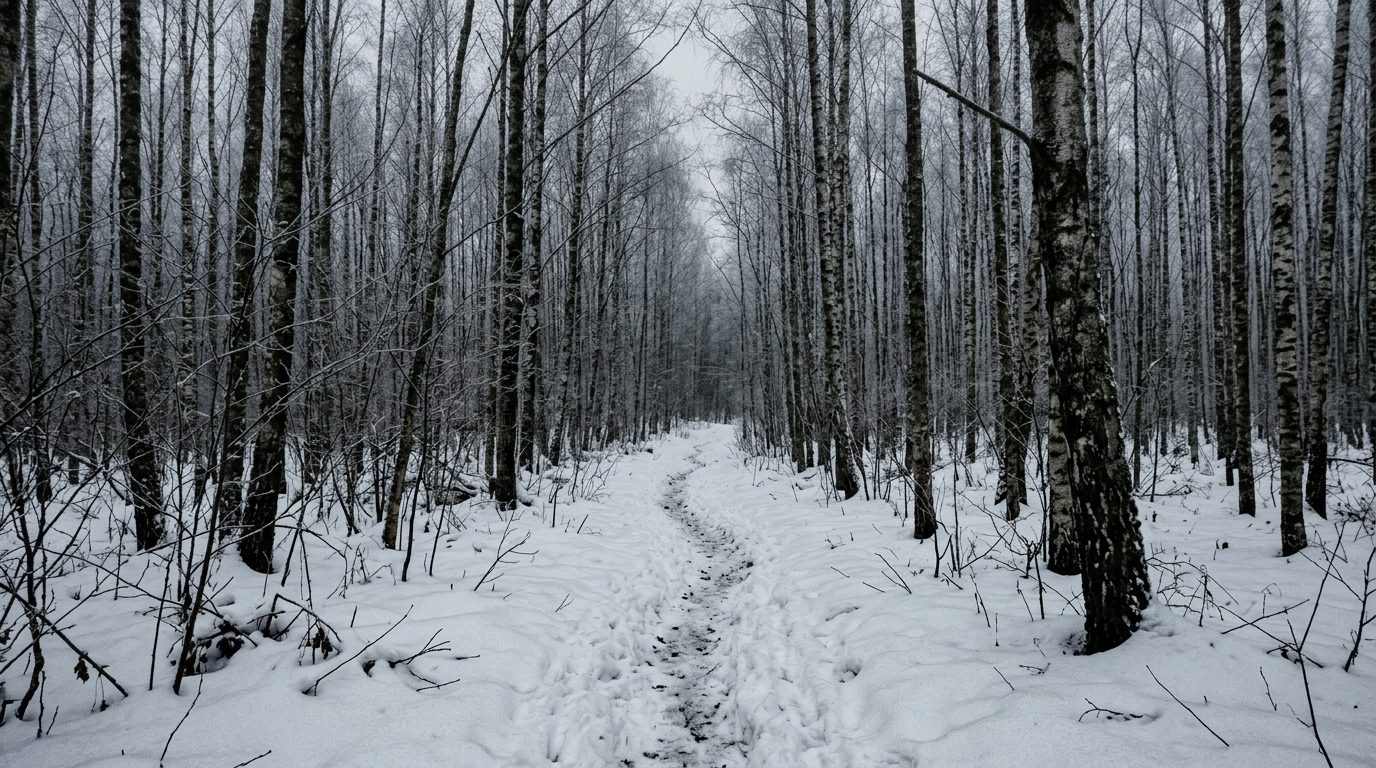
The lead image is not a film still, and that is deliberate: a real winter landscape can still carry the film's pressure cleanly. The human figure is absent, but the ethical weather remains—snow, exposure, a path that records movement, and a world with almost no shelter. That visual imbalance is central to the film's ethics. Shepitko does not flatter endurance by making it look noble from the beginning. She first makes endurance heavy, awkward, animal, and dependent on another person's hands. Rybak's practical strength is real. Sotnikov's weakness is real. The movie's cruelty is that neither fact settles the moral question.
Faces become the real battlefield
Once the men are captured, the film narrows. The open snowfields give way to interiors, interrogation rooms, and a cellar, but the pressure does not lessen. It concentrates on faces. Sotnikov's face is fevered, wounded, and increasingly luminous; Rybak's is mobile, calculating, angry, terrified, and then trapped inside the knowledge of what he has done.[3][4] This is not a simple contrast between saint and coward. The film is sharper because it lets fear remain understandable even when the choices made under fear become unforgivable.
Fanny Howe's Criterion essay is useful here because it treats Shepitko's camera as an instrument of moral astonishment rather than illustration.[3] The film keeps asking what it means to look at a person when social categories have collapsed into immediate danger: soldier, prisoner, collaborator, mother, child, witness, victim. The cellar scenes matter because they gather different forms of exposure into one black space. The prisoners no longer have tactical options, but they still have faces, names, allegiances, and the possibility of refusing to cooperate.[3][4]
Sotnikov's transformation depends on that narrowing. Senses of Cinema notes that the film interweaves religious and political elements, giving Sotnikov a Christ-like role while keeping his declaration of identity rooted in Soviet and partisan commitments.[4] That mixture is the film's force. Shepitko does not ask the viewer to choose between political resistance and spiritual allegory. She lets them cross. Sotnikov's refusal matters because it is concrete: he will not give information, will not trade names, will not become useful to Portnov's system. It also matters because his refusal alters the light around him. The film makes moral resistance visible without making it easy.
Rybak is investigated, not excused
Rybak is the harder achievement. A lesser film would turn him into a neat Judas figure and move on. The Ascent does invoke that structure, and Shepitko's own comments, as discussed by Senses of Cinema, point toward the old pattern of Christ and Judas living inside human beings.[4] But the movie does not reduce Rybak to a symbol. It watches the process by which his desire to live becomes a chain of accommodations. First survival looks like practical intelligence. Then it becomes speech under pressure. Then it becomes collaboration. Finally, it becomes participation in the public machinery of execution.
This progression is what makes the film morally frightening. Rybak does not begin as a monster. He drags Sotnikov through the snow, tries to keep him alive, and repeatedly behaves like the more capable partisan. His failure comes from something painfully ordinary: he cannot bear the final cost of his own courage. The will to live, which had been his strength in the wilderness, becomes unstable once the occupying system offers him a path that preserves his body at the price of his allegiance.[1][4]
Shepitko's harshest insight is that betrayal is not only a decision; it is a position one may keep occupying after the decision has been made. The execution does not release Rybak into relief. It leaves him inside the world he chose. The accusation of "Judas" wounds him because it names a truth he has not yet learned how to inhabit, and his failed attempt to kill himself makes survival look like another sentence rather than an escape. The film therefore "investigates" him in the strongest sense: it follows the afterlife of compromise inside the person who compromised.[4]
Why the ending rises
The title's ascent is not a clean spiritual lift away from history. It is a grim upward movement through snow, villagers, soldiers, collaborators, gallows, and witnesses.[4][5] KVIFF's note describes the final moral pattern as a rise and fall retold through the Christ-and-Judas parallel, but what gives the sequence its power is that it stays crowded and material.[5] The hanging is not an abstract icon. It is staged as a public event under occupation, with bodies arranged by force and watched by people who must carry the image afterward.
That is why the boy's gaze matters. The ending asks what kind of evidence survives when snow covers tracks and fear corrupts speech. The answer is not comfort. It is witness. Sotnikov's death does not redeem the war, save the prisoners, or erase Rybak's betrayal. It gives one watching child a form he cannot unsee. The movie has spent its whole running time making human beings small against weather and power. In the final movement, it gives one face the burden of memory.
Seen this way, The Ascent is not great because it adds religious imagery to a war story. It is great because it makes moral choice feel as physical as cold. Snow strips the world to exposure. Faces reveal what ideology, panic, and pain are doing inside the body. Rybak's survival shows how the wish to live can be captured by violence. Sotnikov's refusal shows that resistance may have no practical reward and still change the meaning of the scene. Shepitko made a film in which the body is always at risk, but the face remains accountable.
Sources
- Mosfilm, "Voskhozhdenie" official film page, with synopsis, credits, restoration year, runtime, format, and awards.
- The Criterion Collection, "The Ascent (1977)" film page, with credits, restoration notes, release details, and official stills.
- Fanny Howe, "The Ascent: Out in the Cold," The Criterion Collection, January 26, 2021.
- Barbora Bartunkova, "1977: The Ascent (Larisa Shepitko)," Senses of Cinema, December 2017.
- Karlovy Vary International Film Festival, "The Ascent" archive program page, 2015 tribute to Larisa Shepitko.