
A24's official restoration trailer for Stop Making Sense is only a short invitation back into Jonathan Demme's 1984 Talking Heads concert film, but it gives away the film's governing trick: this is not a concert that simply happens to be photographed.[1] It is a concert built in front of us as a movie. The restoration context matters, because A24 frames the release as a 4K return for the film's fortieth anniversary and identifies the original performance as having been shot at Hollywood's Pantages Theater in December 1983.[2] Yet the deeper reason the trailer still feels fresh is older than the restoration. It is the film's confidence that stage construction can be drama.
That is the viewing lens for the embed below. Do not watch only for favorite songs, famous moves, or David Byrne's oversized pale suit. Watch for accumulation. Wired's retrospective catches the basic shape: the film begins modestly, with Byrne on a bare stage, and grows toward a fuller ensemble and theatrical event.[3] The BFI interview with Byrne about American Utopia helps explain why that shape is not incidental. Looking back at Stop Making Sense, Byrne described the concert-film form as having an arc, a beginning, middle, and end, rather than being merely a sequence of songs.[4] The trailer compresses that arc into a few flashes, but the grammar survives: a tape player, a body, a microphone, a suit, a band, a stage that keeps gaining functions.
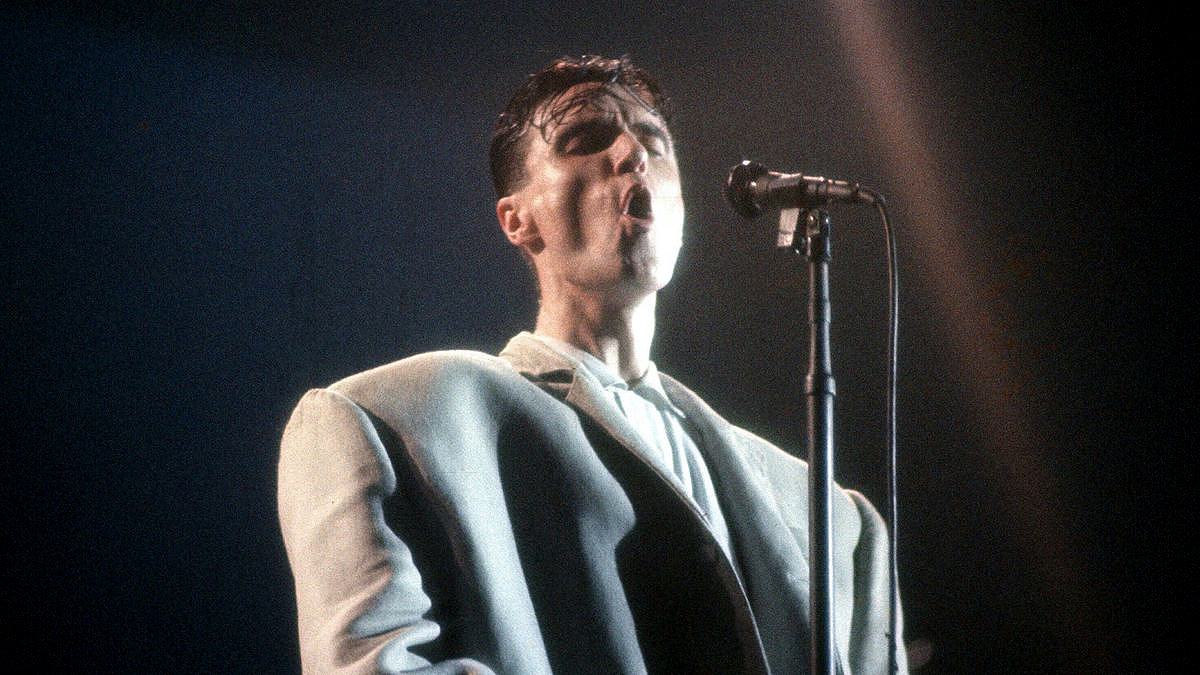
The trailer makes the stage feel unfinished on purpose
The most useful thing to notice is how little the film seems to need ordinary concert-film proof. It does not rush to audience reaction as validation. It does not start by telling us that the event is already huge. It lets the stage look provisional. That matters because Stop Making Sense is organized around a visible build: equipment appears, bodies multiply, lighting grows more complex, and the performance space becomes richer by degrees.[1][3]
That build is the movie's plot. A conventional music documentary often cuts away from performance to biography, backstage access, interviews, or crowd testimony. Demme and Talking Heads make a different wager. They ask whether the performance itself can generate development without needing explanatory interruption. The New Yorker's origin story is useful because it treats the film as a deliberately shaped collaboration, not just a lucky record of a band at its peak.[5] The concept is stronger than the icon, though. The suit lands because the film has already trained us to read bodies as design elements, not because oversized tailoring is funny by itself.
The trailer's restoration polish can make the film look effortless, but the underlying system is strict. At the beginning, the stage reads almost like a rehearsal room: exposed, spare, not yet sealed into spectacle. As musicians arrive, the image does not simply become busier. It becomes more relational. Guitar, bass, percussion, backing voices, and keyboards do not merely add volume; they alter the geometry of attention. The viewer keeps learning how to scan the frame. That is why the film still feels cinematic rather than archival. It gives the eye new jobs as the songs acquire new bodies.
Byrne's body is treated as a moving set piece
The big suit is famous enough to become shorthand for the whole film, but shorthand can flatten the idea. In the trailer, the suit reads as both costume and stage object.[1] It changes Byrne's proportions. It makes shoulder, head, elbow, and leg line strange again. It turns ordinary pop-frontman movement into something closer to sculpture in motion. The joke is visible, but the joke is not the point.
The point is that the body becomes legible from farther away. In a concert hall, that matters practically. In a film, it matters formally. Byrne can jog, pivot, lean, or stand near a microphone and still read as a graphic shape. That lets Demme hold attention without constantly breaking performance into frantic coverage. The camera can respect the stage because the stage has already made the performer visually precise.
This is where Stop Making Sense differs from a recording of charisma. Byrne is charismatic, but the movie does not rely on charisma as an unexamined resource. It designs conditions around him. The suit, lighting, microphone stands, empty space, and later ensemble density all turn personality into structure. A24's page lists the full expanded lineup alongside the four core Talking Heads members, and that list matters because the film's pleasure comes from watching individuality become collective motion.[2] Byrne starts as a solitary nervous figure; by the time the ensemble is in full force, his oddness has become one part of a larger rhythmic organism.
The concert has a story because arrangement becomes causality
Byrne's BFI comments about concert-film arc are useful because they separate Stop Making Sense from the idea of a neutral setlist capture.[4] The film is arranged so that each addition feels causal. A performer enters, and the world changes. A rhythm thickens, and the frame changes. A costume alters the body, and the movie's scale changes. That is not plot in the usual dramatic sense, but it is progression.
The trailer's challenge is that it must sell the famous high points without flattening the buildup that makes those high points work.[1] It mostly succeeds because even in compressed form, the images suggest a system becoming more complete. The bare-stage premise is not abandoned once the movie gets bigger. It remains the memory that makes the largeness meaningful. The audience can feel that the final energy had to be assembled, not simply switched on.
That assembly is why the film survives changes in music-video grammar, concert staging, and home-viewing technology. A faster modern edit could show more angles. A bigger modern tour film could show more spectacle. But Stop Making Sense has a rarer advantage: it lets spectacle have an origin. The viewer watches the show discover its own scale. That makes the film feel alive even when the songs, clothes, and lighting belong unmistakably to the early 1980s.
Restoration clarifies the old discipline rather than replacing it
A24's 4K restoration campaign understandably emphasizes return, anniversary, and renewed theatrical presence.[2] Restoration can tempt us to treat the film as an object rescued from the past. The better reading is sharper: the restoration makes the original discipline easier to see. A cleaner image helps the black stage space hold its depth. Better detail makes the suit's fabric, sweat, microphone hardware, and stage light feel newly physical. But the restoration is not creating the film's energy after the fact. It is clearing a path back to decisions that were already there.
The New Yorker's account of the film's origin and afterlife helps explain why the reputation is not just a matter of fan enthusiasm: the movie is a record of collaboration at the exact point where staging, band dynamics, and cinematic form all had to hold together.[5] The trailer shows the formal version of that claim. The film solves a real problem: how do you make a live performance cinematic without constantly proving it through cutaways, commentary, or biographical explanation? Demme's answer is to trust the stage, but only because the stage has been made into a machine for change.
That is the key annotation to carry into the full film. Watch how little has to be explained when arrangement does the explaining. Watch how the film turns entry into event, costume into architecture, space into rhythm, and ensemble into narrative. The restoration trailer is brief, but it points to the larger achievement cleanly: Stop Making Sense endures because it builds a concert before it performs one, then makes that building process feel like cinema.
Sources
- A24, "Stop Making Sense | Official Trailer HD," YouTube video.
- A24, "Stop Making Sense" film page - restoration context, credits, Pantages Theater performance note, cast lineup, and photographic release materials.
- Wired, "Jonathan Demme's Stop Making Sense Is Still the Concert Film All Others Try to Be" - retrospective on the film's stage buildup and concert-film method.
- BFI / Sight and Sound, "David Byrne on his concert doc American Utopia" - interview context comparing concert-film structure with Stop Making Sense.
- The New Yorker, "The Origin Story of Stop Making Sense" - account of the film's production context, collaboration, 1984 arrival, and 4K reissue afterlife.