Safi Faye is often introduced by a necessary first: with Kaddu Beykat (Letter from My Village), she became the first woman from sub-Saharan Africa to direct a commercially distributed feature. The distinction marks how much institutional ground she had to break. It can also become a tidy way of stopping before her films begin.[2][3]
What matters inside those films is not simply that Faye reached the director's chair. It is how she redistributed the authority attached to it. A village resident can be a performer, witness, historian, and critic at once. A filmmaker can speak in the first person without claiming the final word. A staged romance can carry evidence about drought and agricultural policy; an interview can become a portrait shaped by pauses, work, and song. Faye did not solve the unequal relationship between observer and observed by pretending the observer had vanished. She made the relationship audible.
That is the through-line from the black-and-white fields of Kaddu Beykat to the women of Selbé et tant d'autres, the Senegalese students of Man sa yay in Berlin, and the tragic fiction of Mossane. Across documentary, docufiction, essay, and drama, Faye's cinema keeps returning to one question: who is allowed to describe a life, and what responsibilities begin when somebody else listens?
The milestone can hide the method
Faye grew up in Fad'jal, a Serer village south of Dakar, and worked as a schoolteacher before studying ethnology and filmmaking in Paris. She had met Jean Rouch at the First World Festival of Negro Arts in Dakar in 1966 and later appeared in his Petit à petit. She made her first short, La Passante, in Paris in 1972.[2][3]
This path gave her more than a résumé spanning education, anthropology, acting, and direction. It placed her on both sides of a longstanding representational border. French colonial nonfiction had treated African people as material to be classified for viewers elsewhere; even later ethnographic cinema could preserve an outside expert's privilege to explain. Film scholar Rachel Gabara locates Faye among the West and Central African filmmakers who challenged that inheritance not only by changing what appeared on screen, but by refusing its claim to uncomplicated objectivity.[5]
Faye's difference from Rouch was therefore not a simple reversal in which an “insider” automatically possesses truth. She had lived between village, capital, and European institutions. She had training, mobility, and an editing room unavailable to many of the people she filmed. Her work is powerful because it acknowledges mediation rather than disguising it. The voice behind the image has an accent, a history, and a relationship to the person in front of it.
A letter, not a report
Kaddu Beykat announces that relationship in its form. Faye frames the film as a letter and invites viewers to spend time in her home village. The address is intimate, but it is not a claim that village life needs no interpretation. A letter has a sender, a recipient, a reason for being written, and the possibility of an answer. It replaces the anonymous authority of a report with a named exchange.[1][5]
Within that frame, Ngor wants to marry Coumba but cannot afford the bride-price. Drought has reduced the harvest; a colonial legacy of peanut monoculture has left farmers exposed; Ngor goes to Dakar looking for work. The romance gives movement to the film without turning the village into scenery for two exceptional people. Agricultural labor, family discussion, policy, weather, and migration keep widening the couple's difficulty into a shared economic condition.[1]
Faye shot in Fad'jal with a small crew over three weeks and worked with villagers, including her grandfather. The resulting film does not alternate between “real” documentary passages and a fictional plot as if one form validates the other. Daily activity and performed story occupy the same field. A resident's enacted role can disclose an actual pressure; an observed routine is still selected, framed, and placed in sequence. Faye later called works of this kind “reenacted documentaries,” a phrase that refuses purity without surrendering evidence.[1][5]
The method also changes the spectator's position. The opening invitation makes us guests, not owners of what we see. Guests may notice, learn, and be moved, but they enter an existing network of obligations. The village does not begin when the film arrives, and its people do not become legible only when a distant audience recognizes them.
Fiction and evidence share the same ground
In Fad'jal (1979), Faye again braided fictional and nonfictional strategies around a Serer community facing contemporary social and economic pressure. The film belongs to the same inquiry as Kaddu Beykat, but the repeated return is important: a home place is not a single subject that can be captured once. It changes with seasons, policy, memory, departures, and the filmmaker's own distance from it.[5]
That is why “ethnography” is too small if it means a stable record of custom, while “fiction” is too small if it means invention detached from material life. Faye's work treats both as arrangements of encounter. Recollection may need performance; an interview may expose how a question has organized an answer; a village history may exist across several speakers rather than in one authoritative chronology.
Her position here is neither anti-form nor naively spontaneous. The form is the ethics. First-person address identifies a standpoint. Nonprofessional performance gives participants room to shape how social facts become scenes. Patient attention to work restores duration to activities that an informational film might compress into evidence. The films do not merely say that rural life has political meaning. They build a viewing situation in which labor and speech take time from the spectator.
Faye's international festival history confirms that this formally exacting rural cinema traveled without ceasing to be locally grounded. Fad'jal screened in Un Certain Regard at Cannes in 1979 and returned in Cannes Classics in 2018; the later recognition did not transform it into a newly important work so much as reveal how incomplete the circulating map of film history had been.[7]
Listening is also a form of editing
Selbé et tant d'autres (1982) makes the politics of attention especially clear. Its subject is Selbé, a thirty-nine-year-old mother of eight in Fad'jal whose husband has left to seek work. She and other women carry the labor that continues in the men's absence. Her recurring song accompanies that work and gives the film a cycle rather than a ladder: effort does not steadily resolve into liberation, and a woman's voice does not become valuable only when it delivers a neat thesis.[3]
Faye remains off camera while interviewing Selbé. That choice does not erase the filmmaker; her questions, cuts, and listening presence shape the encounter. But the arrangement denies the familiar hierarchy in which an expert narration translates a silent subject. Selbé's speech and song do more than supply testimony for a prewritten argument. They determine the film's movement.[3]
Faye also resisted reducing this method to the slogan that she simply “put women at the center.” She insisted that women live within communities and could not be separated from them as isolated emblems. The distinction matters. Selbé shows gendered labor, but it also follows the economic structures that send men away, redistribute work, and make one person's exhaustion a condition of collective survival.[3]
Community, in Faye's cinema, is neither a sentimental refuge nor an excuse to dissolve individual experience. It is the scale at which a voice acquires consequences. Selbé speaks as herself, yet her circumstances open onto migration, agriculture, marriage, and the unequal distribution of time.
The village and Berlin belong to one map
Man sa yay (I, Your Mother, 1980) tests the method far from Fad'jal. Senegalese students in West Berlin study engineering, take precarious work, encounter racism, and receive letters carrying news and demands from home. Distance does not split the film into an African origin and a European present. Correspondence keeps both places active in the same frame of responsibility.[4]
The students are expected to earn qualifications that might help their communities, yet unemployment and exclusion narrow their lives abroad. At the same time, strikes, price increases, illness, and family need continue in Senegal. The pressure runs in both directions. Migration is not represented as a clean exit from rural hardship or as a simple betrayal of home; it is a relay through which economic policy, aspiration, racism, and obligation intensify one another.[4]
The return to letters is revealing. In Kaddu Beykat, Faye writes outward from the village to invite a spectator in. In Man sa yay, letters arrive from home and make absence materially present. In both films, communication refuses the fantasy of a view from nowhere. Every account comes from somewhere and asks something of its recipient.
Mossane does not abandon the earlier cinema
Faye's final feature, Mossane (1996), is more openly dramatic and mythic. Its fourteen-year-old heroine, promised to a wealthy man, loves a poor university student and refuses the arranged marriage on her wedding day. The film screened in Un Certain Regard at Cannes, nearly two decades after Fad'jal appeared in the same section.[2][6]
It would be easy to describe this as a move away from ethnographic work into “pure” fiction. Faye's career makes that border difficult to maintain. Mossane uses a shaped tragic story, but the conflict between desire, family obligation, wealth, gender, and community belongs to the same ethical field as the earlier films. Conversely, Kaddu Beykat was never an unshaped record. The romance of Ngor and Coumba already showed how fiction could concentrate forces that exceed an individual plot.
The shift is therefore one of register, not responsibility. Faye could work through interview, letter, song, reenactment, or legend because none of those forms guaranteed truth by itself. Their value depended on what relationship they established among filmmaker, participant, character, and audience.
The author does not disappear
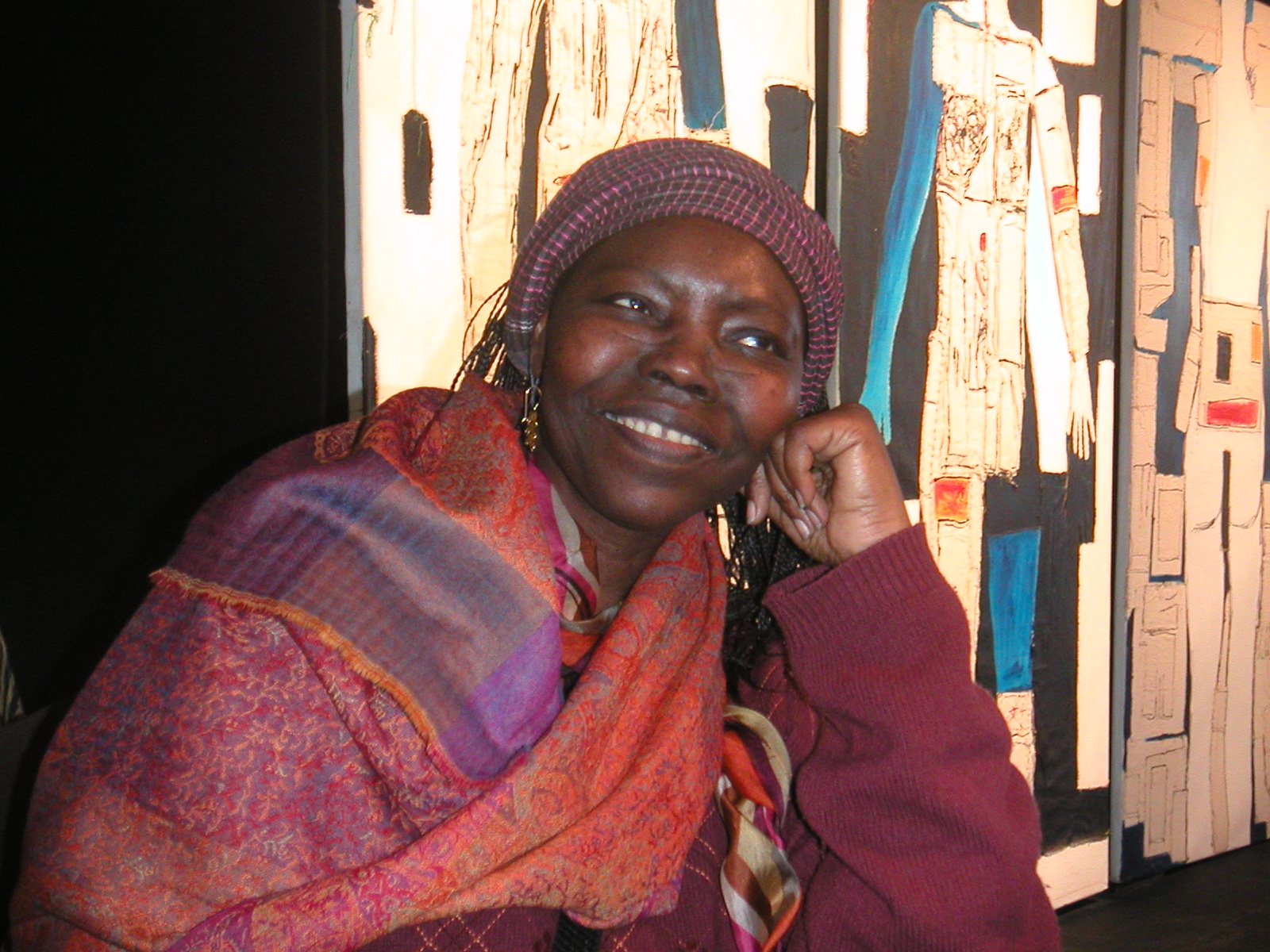
The portrait above was taken at an African cinema festival in Apt, France, in 2004.[8] Faye is not posed as an invisible observer. She is unmistakably present—smiling, looking beyond the lens, framed by the public life through which films meet audiences. That presence is a useful key to her authorship.
Her cinema never asked directors to become absent. It asked them to become accountable: to name the route by which they arrived, to distinguish invitation from possession, to let other people's duration alter the work, and to acknowledge that editing is an exercise of power even when it is practiced with care. First-person narration could be more honest than anonymous expertise. Staging could reveal a material truth that passive observation missed. Listening could shape a film without claiming ownership of the voice heard.
Faye's pioneering status should remain part of film history. It should not be allowed to stand in for watching her films. The deeper first is renewed each time one of them begins: before deciding what a community means, the cinema must ask who is speaking, who is listening, and what makes the exchange possible.
Sources
- Arsenal Institute for Film and Video Art, “Kaddu Beykat” — letter structure, drought and monoculture context, participatory three-week production in Fad'jal, credits, biography, and 1976 Forum history.
- Cinéma du réel Archives, “Safi Faye” — early work with Jean Rouch, studies in France, first films, rural concerns, and selected filmography.
- Nene Aïssatou Diallo, “Safi Faye: Selbé et tant d'autres,” MoMA post, January 11, 2023 — education, feature-film milestone, participant-observer position, song, women's labor, interview method, and community framing.
- Chrystel Oloukoï, “Pride under Pressure,” Arsenal Institute for Film and Video Art — letters, migration, racism, engineering students, family obligation, and Senegalese economic context in Man sa yay.
- Rachel Gabara, “From Ethnography to Essay: Realism, Reflexivity, and African Documentary Film,” in A Companion to African Cinema, Wiley, 2019 — colonial nonfiction context, African reflexive documentary, Faye's fiction/nonfiction practice, and “reenacted documentaries.”
- Melbourne International Film Festival archive, “Mossane” — central conflict, production history, 1996 release, and Un Certain Regard presentation.
- Charlotte Pavard, “Safi Faye recounts Fad,Jal,” Festival de Cannes, May 16, 2018 — official account of the film's Un Certain Regard selection in 1979, Cannes Classics presentation in 2018, rural setting, oral-history structure, and restoration.
- Olivier Barlet, “Safi Faye.jpg,” Wikimedia Commons — source page, date, festival setting, dimensions, and license for the 2004 portrait.