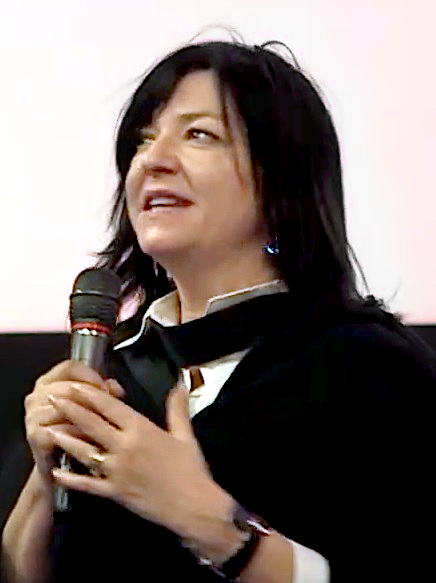

Lynne Ramsay's films are often described with words that sound atmospheric before they sound technical: haunting, tactile, elliptical, violent, tender. Those words are not wrong, but they can make her method seem like temperament alone. The BFI's 2025 London Film Festival Screen Talk is useful because it restores the work behind that atmosphere. Ramsay talks as a director who began with photography, short films, bodies in rooms, and the stubborn knowledge that a scene can tell the truth before dialogue catches up.[1][2]
The Screen Talk was hosted by Danny Leigh as part of the 2025 BFI London Film Festival, and BFI's player page frames Ramsay's career around working-class Scottish life, escape, motherhood, trauma, and the young woman at the center of Die My Love.[2] That is a precise way to enter her cinema. In Ratcatcher, childhood grief presses through water, rubbish, housing estates, and a sudden wheatfield. In Morvern Callar, mourning becomes a mixtape, a supermarket aisle, a holiday image, and an opaque refusal to perform normal sorrow. In You Were Never Really Here, trauma arrives through fragments of sound, surveillance images, hammers, flash cuts, and a body that seems to carry history before it speaks.[3][4][5]
That is why this video should be watched less as a promotional interview than as a guide to attention. Ramsay does not build scenes by explaining psychology first and then decorating it with details. She often works the other way around: an object, a sound, a gesture, a face, a color, or a withheld transition becomes the emotional event. The viewer learns character through sensory pressure. Plot matters, but it arrives after the image has already begun thinking.
Watch for the photographer's patience
The first viewing habit is to listen for how often Ramsay's filmmaking begins with looking. BFI's guide to where to begin with her work places Ratcatcher at the center of that entry route, describing the feature debut through the child's accident, the Glasgow setting, and the ecstatic image of James moving through an unfinished house into a field of wheat.[3] Criterion's listing for Ratcatcher makes a related point, calling attention to the film's mixture of urban decay, interior hope, unexpected humor, and elusive imagery.[4] Put those summaries beside the Screen Talk and a pattern appears: Ramsay's realism is never just a record of social conditions. It is social reality altered by a child's perception.
That distinction matters. A weaker film about poverty could treat setting as proof and character as explanation. Ramsay treats setting as pressure. The garbage strike, tenement spaces, canal water, damaged homes, and half-built council housing are not background facts waiting for a plot to use them. They are the material through which James experiences fear, guilt, escape, shame, and brief release.[3][4] The camera does not simply show where he lives; it lets the viewer feel how a place changes the scale of a child's secret.
This is where Ramsay's photographic background becomes a directing ethic rather than biographical trivia. She gives objects enough time to become charged without turning them into symbols that can be decoded once and filed away. A curtain, a sink, a toy, a body in water, a supermarket fluorescent wash, or a hotel corridor can keep more feeling alive than an explanatory speech. The Screen Talk's value is that it lets a viewer connect that patience to a career-long method: trust the image until the image becomes morally complicated.
Ellipsis is an emotional structure
Ramsay's ellipses are not gaps where story has gone missing. They are structures that make the viewer experience the instability of the characters' own knowledge. BFI's overview of her work points from Ratcatcher to Morvern Callar, We Need to Talk About Kevin, You Were Never Really Here, and Die My Love as films about people whose inner lives do not settle neatly into the public world around them.[2] BAMPFA's retrospective note makes the same idea more broadly, describing Ramsay as interested in shifts of perception that change a person's relationship to the world and to themselves.[6]
That is the key to watching the Screen Talk. When Ramsay discusses process, the important claim is not simply that she likes mystery. It is that mystery can be more truthful than orderly exposition when a character is living through shock. Morvern Callar is the cleanest example. If the film explained Morvern's behavior too thoroughly, it would reduce grief to motive and motive to case study. Instead, the film makes her actions legible through rhythm, music, withholding, and movement. The viewer does not receive a diagnosis. The viewer is asked to inhabit a drift.
The same principle intensifies in You Were Never Really Here. Jonathan Romney's Sight and Sound review emphasizes the film's hardboiled nightmare terrain, Joaquin Phoenix's weighted performance, and the telegraphic editing of its opening.[5] That word, telegraphic, is useful because Ramsay's editing often behaves like a signal sent under pressure. A flash of childhood, a sound cue, a surveillance monitor, a body slumping in public, a violent act half-seen from the wrong angle: the film gives the viewer enough to register trauma without converting trauma into a neat backstory.[5]
Ellipsis, then, is not coyness. It is ethics and sensation at once. Ramsay refuses the false comfort of complete access. Her characters are not puzzles whose correct answers will unlock them. They are people under pressure, and the form honors that pressure by letting some things remain jagged.
Sound keeps memory from staying private
The embedded talk is especially worth hearing with Ramsay's sound worlds in mind.[1] Her films often make music and noise behave like memory escaping containment. BFI's "Where to begin" guide singles out the use of 1950s and 1960s American pop in Morvern Callar, especially the disjunction between romantic music and private devastation.[3] That is a useful example because Ramsay does not use songs as emotional labels. She uses them as collisions.
In a conventional scene, a song might underline what a character already feels. In Ramsay, a song can make feeling stranger. It can turn a public room into a private trance, make grief seem temporarily social, or expose how badly a character's inner state fits the surrounding world. Sound becomes a place where memory refuses to stay internal.
This is also why You Were Never Really Here feels so physically abrasive. The film's violence is not only in what happens but in how sound, cut, and body fail to separate cleanly. A hammer can be a tool, a weapon, a memory trigger, and a rhythm. A television image can become a screen inside a screen. A piece of music can carry tenderness and dread at the same time. Ramsay's cinema keeps asking whether a character is remembering, perceiving, or being invaded by sensation. Often the answer is all three.
What the Screen Talk gives a first-time viewer
The best use of the BFI video is not to look for a master key. Ramsay's films resist master keys on purpose.[1][2] The better use is to gather watching habits. First, treat sensory detail as argument. If a Ramsay image lingers on texture, sound, color, or a body at rest, assume the film is doing narrative work there. Second, do not rush to fill every ellipsis with a tidy explanation. The gap may be the point. Third, pay attention to place as an emotional system. Glasgow, a supermarket, a nightclub, a family home, a New York street, or a public corridor can act on a character as forcefully as another person does.[3][4][5][6]
Those habits also explain why Ramsay's small filmography feels larger than its count. Since Ratcatcher in 1999, the films have not repeated a single surface formula.[2][3] Yet they share a confidence that cinema can register what ordinary explanation misses: childhood's distorted scale, grief's irrational logistics, maternal fear, dissociation, violent memory, bodily unease, and the uneasy comedy of people trying to keep moving while feeling has not found a clean form.
The Screen Talk matters because it puts that confidence back in the working director's voice.[1] Ramsay's cinema can look elusive from a distance, but the elusiveness is built from concrete decisions: where to put the camera, when to cut away, which sound to let dominate, which gesture to leave unresolved, and when to trust a face more than a line. Her films do not hide meaning. They make meaning arrive before explanation can flatten it.
That is the central lesson to carry into a first or returning watch. Do not wait for a Ramsay film to tell you what a character means. Watch how the film lets the character be touched by light, music, weather, memory, rooms, and sudden fragments of danger. In Ramsay, feeling often arrives first as evidence from the senses. Plot comes later, trying to keep up.
Sources
- BFI, "Lynne Ramsay interviewed by Danny Leigh | BFI London Film Festival Screen Talk 2025," YouTube video.
- BFI Player, "Watch Lynne Ramsay Screen Talk | BFI London Film Festival 2025 online," page with host, subject, accessibility, and career framing.
- BFI, "Where to begin with Lynne Ramsay," viewing guide covering Ratcatcher, Morvern Callar, and recurring motifs in Ramsay's work.
- The Criterion Channel, "Ratcatcher" film page, with synopsis, runtime, credits, and notes on Ramsay's early shorts and interviews.
- Jonathan Romney, "You Were Never Really Here review: Joaquin Phoenix storms Lynne Ramsay's kidnap thriller," Sight and Sound / BFI, updated April 15, 2018.
- BAMPFA, "The Films of Lynne Ramsay," 2024 retrospective page with career overview and film notes.
- Wikimedia Commons, "File:Lynne Ramsay at ADIFF 2018.jpg" - real festival photograph used as the article image.