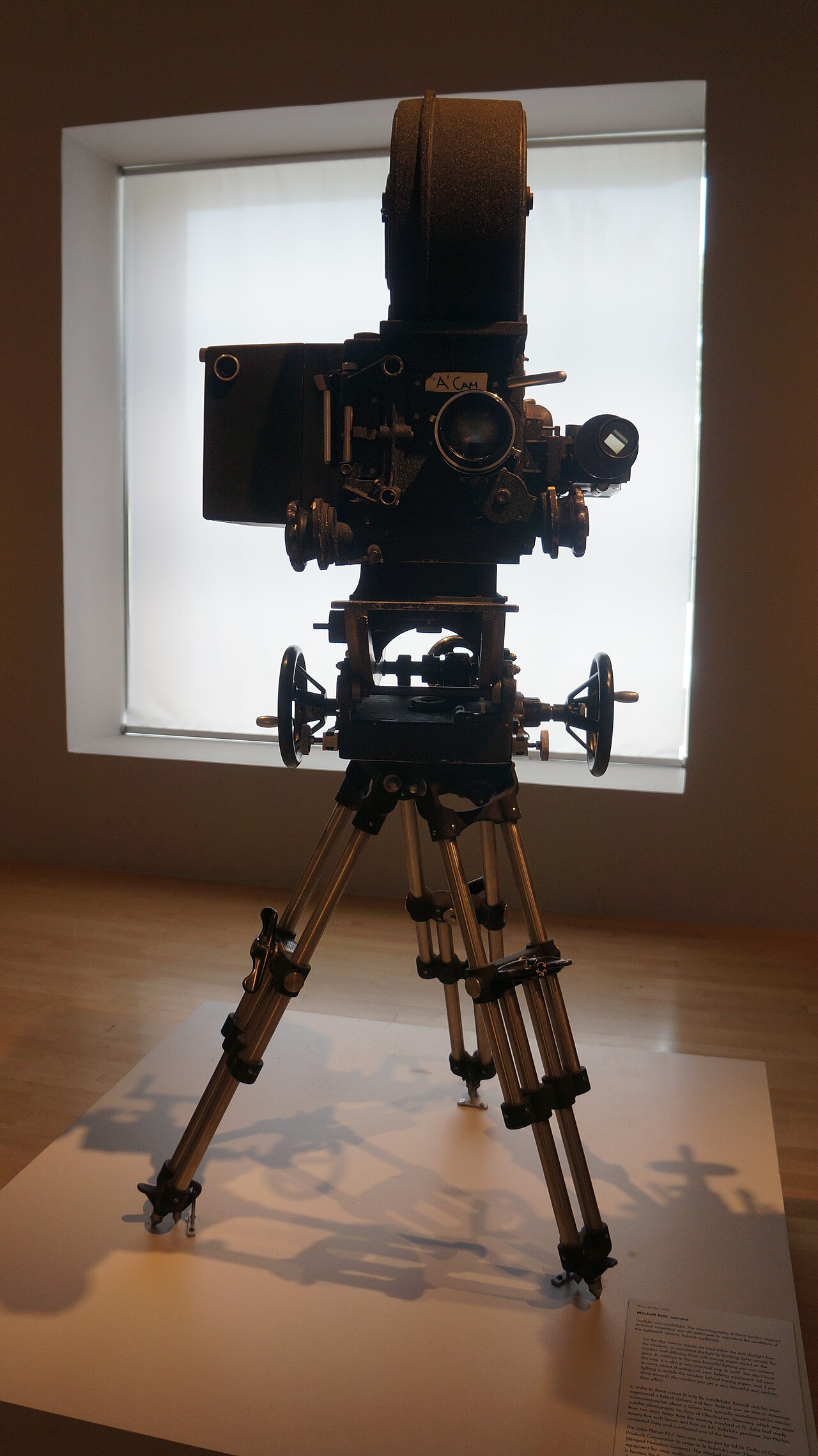
The Mitchell BNC matters because it made silence part of the camera body. The first years of talking pictures did not merely add microphones to an existing craft. They changed the physical rules of cinematography. A silent-era camera could whir, chatter, and move freely because nobody needed to record usable dialogue beside it. Once synchronized sound became normal, that same mechanical life became a defect.
The early fix was crude: isolate the camera. Cooke's history of the BNC describes the first sound-era solution as the enclosure of cameras in soundproof booths, a move that protected microphones while trapping camera movement.[3] The Cinematheque francaise catalogue makes the same industrial problem visible from the equipment side: Mitchell cameras were already preferred by studios for sound films from 1927 because they were quieter than Bell & Howell rivals, but they still had to be enclosed in a custom soundproof blimp.[1] In other words, the talkies did not make the camera obsolete. They made the camera's noise, access, and mobility newly expensive.
The BNC's breakthrough was not that it became small. It did not. It was a substantial 35 mm studio camera, built for crews, dollies, marks, magazines, motors, and controlled sets. The breakthrough was integration. Instead of treating silence as an external box around the camera, the Mitchell BNC folded sound insulation into the machine's working form. That changed the operator's problem from "how do we hide this noisy machine?" to "how do we use this quiet machine without giving up the discipline of studio photography?"
From Booth To Body
The initials usually get explained too quickly. BNC stood for a blimped, noiseless Mitchell camera. The important word is not just "noiseless"; it is "blimped." In earlier practice, the blimp was often an added shell or even a booth-scale compromise. The BNC made that containment part of the camera's own architecture. Cooke emphasizes that the design packaged optics, soundproofing, stability, and operation in one unit rather than leaving the crew to fight a separate acoustic enclosure.[3]
That is why the machine's bulk is not a failure of design. It is the design's premise. The BNC did not promise documentary agility or handheld looseness. It promised that a production-sound camera could become usable studio equipment again. A camera operator could work with controls, follow-focus routines, mounted magazines, and dolly movement without treating the camera as a dangerous noise source at every setup.
The Cinematheque catalogue preserves the BNC as a working object, not only a legend. Its 1967 Mitchell BNC R record lists a 35 mm camera with motor speeds from 12 to 32 frames per second, a 1000-foot feed-and-take-up magazine under blimping, reflex viewing on the later converted model, an exterior parallax-corrected finder, a matte box, footage and frame counters, and closed dimensions of 85 by 55 by 60 cm.[1] Those details matter. A camera is an interface as much as an image-making box. The BNC's authority came from giving the crew a quiet, stable, repeatable interface for sound-era studio work.
Stability Was Part Of Silence
Silence alone would not have made the BNC a Hollywood standard. The image also had to stay steady. The same catalogue links the BNC to Mitchell's NC eccentric movement, a film-transport system with claws and registration pins that later Mitchell cameras inherited.[1] Cooke's account likewise treats the NC mechanism as the engineering base that let the BNC combine low noise with rock-solid registration.[3]
This is where the BNC differs from a simple acoustic device. The camera did not merely stop contaminating the soundtrack. It gave cinematographers a dependable platform for controlled images while sound was being recorded nearby. That combination explains why the camera became associated with high studio craft rather than with a transitional gadget.
The American Society of Cinematographers' preservation page for BNC 2 turns the general claim into a specific production history. The ASC identifies that 1935 camera as Gregg Toland's Mitchell BNC, used on films including Citizen Kane, Wuthering Heights, The Grapes of Wrath, The Long Voyage Home, and The Best Years of Our Lives.[2] The page also notes the camera's later restoration to working condition and describes its precision movement as reliable, rock-steady, and very quiet.[2] That is almost the whole BNC argument in one object: the sound era needed a camera that could be trusted both by microphones and by cinematographers.
The Camera Still Had A Point Of View Problem
The BNC solved one major problem while preserving another. Early BNCs did not have reflex viewing. The operator could not simply look through the taking lens during exposure in the modern sense. Cinematheque's historical note points to that missing reflex viewfinder as the BNC's major limitation and identifies the BNCR as the 1967 answer.[1] Cooke's article explains the older rackover routine: the camera could be shifted so the operator viewed through the lens for focus and framing, then shifted back to put the film gate in shooting position.[3]
That workflow sounds cumbersome now, but it clarifies the camera's real world. The BNC was not a magic box that made studio shooting effortless. It was a compromise engineered around the best available priorities: sound silence, image steadiness, lens precision, magazine capacity, and crew access. The price was weight, procedure, and a slower relationship to framing than later reflex cameras would allow.
This limitation also keeps the BNC from being confused with a later mobility revolution. The Arriflex 35, the Eclair NPR, and other portable reflex cameras changed the camera's relation to streets, shoulders, and documentary motion. The Mitchell BNC changed a different relation: camera to microphone, camera to dolly, camera to studio floor. It made the sound-stage camera viable as a creative instrument again after the first talkie solutions had threatened to turn it into furniture.
Why Toland Matters Here
Gregg Toland's association with BNC 2 is more than a famous-name footnote. Toland's 1930s and 1940s work depended on exacting control of focus, depth, lighting, and camera placement. The BNC did not create those ambitions, but it gave them a sound-era machine. Citizen Kane is often remembered through deep focus, ceilings, low angles, and expressive staging; the ASC's preservation record anchors that visual ambition to a particular quiet, steady Mitchell body.[2]
The point is not that one camera explains the film. No single piece of equipment does that. Lighting, lenses, stock, art direction, lab practice, blocking, and Toland's own judgment mattered enormously. The better claim is narrower and stronger: the BNC helped make high-control studio cinematography compatible with production sound. It reduced the penalty that talking pictures had imposed on camera placement.
That penalty was not trivial. A camera inside a booth protects sound but punishes the shot. A camera inside a crude blimp may become less accessible, harder to operate, and more awkward to move. A camera that integrates quietness into its working body gives some of that control back to the crew. This is why the BNC should be understood as an operations breakthrough, not merely a hardware milestone.
A Heavy Camera With A Long Afterlife
The BNC's long use also depended on adaptability. Cinematheque's catalogue notes that many BNC cameras were later converted to reflex viewing before and after the BNCR model appeared, and that outside repair and modification shops also converted BNC bodies.[1] That afterlife is important. The camera did not survive because it was frozen. It survived because the body, movement, and accessory ecosystem were valuable enough to revise.
Cooke's account presents the same pattern through preservation and display: the BNC is remembered not only as an antique but as a complete production system whose magazines, lens mounts, controls, and soundproofing show how studio cinematography was organized.[3] The Commons photograph used here, taken at LACMA's Stanley Kubrick exhibition, has that same museum-object force.[4] The camera stands like a dense piece of industrial furniture, but its shape is all function: magazine above, lens and finder at the operator's side, tripod and head below, acoustic mass wrapped around the mechanism.
That shape helps explain why the BNC's legacy is easy to miss. Modern cameras make quietness feel normal. Digital bodies do not chatter like 35 mm movements, and sync sound no longer requires the same war between microphone and film transport. But the historical problem remains useful: every production technology decides where friction goes. The early talkies put friction between sound and movement. The BNC moved that friction into engineering.
So the Mitchell BNC should not be remembered as a graceful camera. It is too heavy for that. It should be remembered as a camera that restored grace to the set. By making quietness structural, by keeping the image steady, and by giving operators a usable sound-stage machine, it turned the noisy mechanics of film into something that could once again move with actors, lights, and dialogue. In the sound era, that was not a convenience. It was a new body for studio cinema.
Sources
- La Cinematheque francaise and CNC, "Camera film 35 mm (AP-12-2775)" - catalogue record for a Mitchell BNC R, including patents, mechanism notes, dimensions, BNC/BNCR history, and Mitchell background.
- American Society of Cinematographers, "ASC Museum Minute: Mitchell BNC Camera" - preservation note on Mitchell BNC 2, Gregg Toland, Citizen Kane, restoration, and display at the ASC Clubhouse.
- Cooke Optics, "The Legendary Mitchell BNC: A cinema revolution, now on display at the Cooke Gallery, London" - technical and historical account of the BNC, sound-era camera booths, integrated blimping, magazines, rackover operation, and production use.
- Wikimedia Commons, "File:Stanley Kubrick The Exhibition - LACMA - Mitchell BNC Camera (8998529347).jpg" - photographic source for the article image, showing a Mitchell BNC displayed at LACMA's Stanley Kubrick exhibition.