Spoiler note: this essay discusses the opening Turkish-bath sequence, the Berlin duel, Theo's wartime speech, and the ending.
Michael Powell and Emeric Pressburger's The Life and Death of Colonel Blimp is often introduced as a satire of old-fashioned British military values, which is true only if the word "satire" is allowed to carry a great deal of tenderness.[1][2][3] The film certainly knows how ridiculous Clive Wynne-Candy can look: bald, walrus-mustached, red in the face, and steaming with indignation in a Turkish bath while younger soldiers ignore the rules of an exercise and arrest him before midnight.[2][4] But Powell and Pressburger are doing something more difficult than mockery. They build an entire emotional world out of the code that has formed Candy, then show how history turns that code into both a beauty and a handicap.
That is why the film remains stranger and sadder than a mere patriotic corrective or anti-military joke.[1][3][4][5] The BFI's capsule description gets to the center of it when it calls the film a rich, witty, sympathetic yet surprisingly critical portrait of a man altered by time and by his encounters with Edith Hunter and Theo Kretschmar-Schuldorff.[1] Ronald Haver's Criterion essay sharpens the political edge by arguing that the film's whole point is that gentlemanly conduct has become an anachronism in a war shaped by Hitler.[3] Put together, those readings make the film's real subject clearer. Colonel Blimp is not simply about one obsolete officer. It is about what happens when a person has organized love, friendship, honor, and national identity around rules that history no longer agrees to respect.
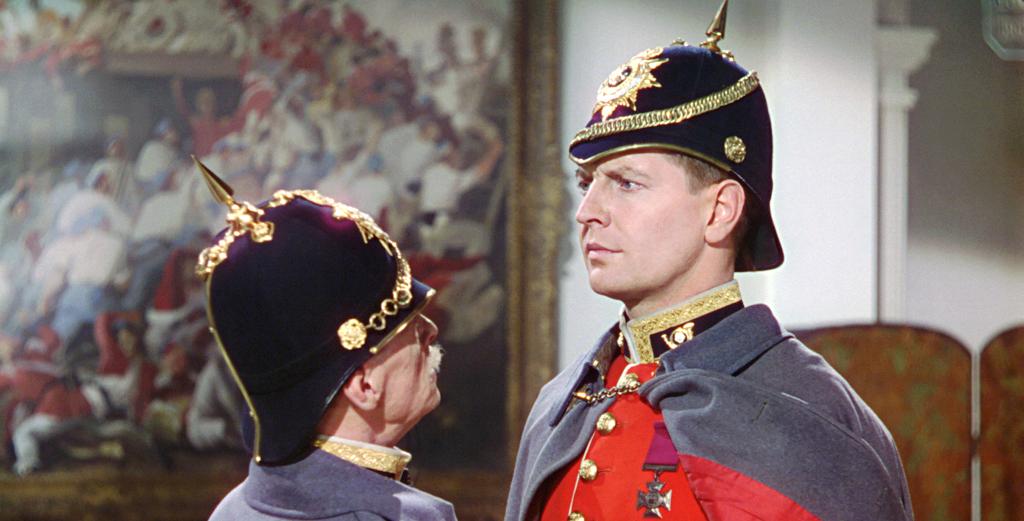
Image context: the lead image uses a real BFI still of Roger Livesey as young Clive Candy in formal red uniform.[1][2] It belongs here because the film's argument begins by making Candy's world look magnificent. The tragedy does not come from exposing him as a fraud. It comes from showing how much feeling, loyalty, and self-respect were genuinely invested in a style of conduct that later proves unequal to the century.
The Turkish bath is comic, but it is also the film's clearest statement that time has changed the rules
The opening bath sequence matters because it refuses to separate humiliation from historical argument.[2][4][5] Molly Haskell notes that the film begins with a clash between modern urgency and Candy's nostalgia, and that is exactly the right frame.[4] The young soldiers on motorcycles do not merely interrupt an old man's comfort. They invade an entire moral schedule. Candy keeps insisting that "war starts at midnight" because procedure is part of how he knows the world. The younger men, trained for a different conflict, already understand that the enemy will not wait for clocks, etiquette, or sporting declarations.[3][4]
This is what makes the flashback structure so powerful.[3][4][5] The film does not tell us in abstract terms that Candy was once young. It hurls us backward so we can see that the old buffer in the bath was once dashing, impulsive, and even romantic in his belief that honor can be defended through proper forms.[1][3] TCM is especially useful on the narrative design here, describing the film's leap across decades as a kind of Citizen Kane-like examination of a life.[5] That structure matters because it turns generational conflict into self-comparison. Candy is not simply defeated by the young. He is defeated by time's decision that his own virtues now belong to another war.
The bath therefore does not just ridicule the old officer's bulk, temper, or moustache.[2][4] It states the film's central wound. Candy has spent a lifetime believing that fair procedure and personal decency are part of civilization itself. The twentieth century has other plans. He is not wrong that something valuable is being lost. He is wrong to think that value alone can still organize action.
The Berlin duel turns honorable form into both friendship and blindness
The duel sequence in Berlin is where Powell and Pressburger first make Candy's code feel genuinely alluring.[1][3][5] As Haver recounts, the quarrel leads to a duel that gives Candy his famous wound, his lifelong moustache, his German friend, and the loss of Edith all at once.[3] That compression is extraordinary. A single ritual event creates the outward look of Colonel Blimp, the inward attachment that will define his emotional life, and the first proof that rules can carry enormous personal consequence without protecting anyone from pain.
The beauty of the duel is that the film does not film it like an action climax.[3][4] What matters is not victorious technique but the almost absurd density of ceremony around male violence. Candy and Theo become intimate precisely by obeying a ritual that ought to keep them formal. Friendship emerges out of injury and etiquette at the same time. That paradox stays with the film for the next forty years. Candy's moral universe is not empty bombast. It has produced a real bond with Theo, a bond strong enough to survive world wars, national division, and exile.[1][4]
Yet the same code also leaves Candy unprepared to recognize how incomplete his understanding is.[1][3] He loses Edith not through villainy but through timing, reserve, and the assumption that feelings will somehow find their proper place if conduct remains proper enough. The duel is therefore the first great lesson in the film: form can make meaning, but it can also displace direct knowledge. Candy experiences love, rivalry, and friendship through ritual before he fully experiences them as speech. He becomes admirable in the same movement that he becomes blinkered.
Deborah Kerr's three roles make memory look beautiful, but they also reveal Candy's failure to change
Deborah Kerr's triple casting is one of the film's boldest devices because it turns repetition into a historical argument.[1][4][5] Haskell calls attention to the film's layering effect, with Kerr multiplied across generations, and the effect is not merely romantic.[4] Each recurrence of her face asks what, exactly, Candy has carried forward. Is he honoring a lost woman, or is he preserving a private ideal while the world around him has become unrecognizably different?
The repeated face gives the film much of its emotional softness.[1][4] Candy does not age into bitterness alone; he ages into remembrance. Edith, Barbara, and Johnny are not interchangeable characters, and the film is too intelligent to collapse them into one male fantasy. But the recurrence does tell us something exact about Candy. He keeps meeting history through resemblance. He notices continuity more readily than rupture. The face he loved in Berlin returns as if time were offering him gracious revisions, and he responds by deepening his attachment to pattern rather than revising his assumptions about the age he lives in.[4]
That is why the device is so moving and so quietly critical.[1][4] It allows the film to grant Candy genuine emotional depth without surrendering to his worldview. He is not simply a pompous relic; he is a man who has made a home inside echoes. The trouble is that fascism, mechanized war, and exile do not arrive as echoes. They arrive as breaks. Kerr's three faces therefore become one of the film's most elegant ways of showing how personal fidelity can drift into historical misreading.
Theo's rebuke completes the film by separating human decency from outdated rules
The film's decisive moral clarification comes through Theo, not Candy.[1][2][4][5] BFI is right to stress that Theo teaches Candy that little is fair in love and war.[1] That lesson is not cynical in the cheap sense. Theo does not argue that honor is worthless. He argues that honorable habits cannot be treated as universal laws when facing Nazism. Haver and Tatara both underline how provocative this was in wartime Britain: Powell and Pressburger were effectively saying that a decent society might have to abandon old gentlemanly assumptions in order to survive a barbaric enemy.[3][5]
This is what saves Colonel Blimp from nostalgia.[2][3][4] The film loves what Candy represents too much to sneer at him, but it is also too politically alert to let that love become endorsement. Theo, the German exile who sees more clearly than the English officer, becomes the vehicle for the film's hardest truth: civilization cannot defend itself by pretending the rules remain symmetrical. Candy's tragedy is not that he values fairness. It is that he confuses fairness with an adequate reading of the present.
The ending therefore lands with unusual force because it does not ask us to choose between affection and critique.[1][2][4] Powell and Pressburger let Candy remain touching, brave, funny, and exasperating. They also let history pass judgment. What falls away is not only one officer's prestige but an entire rhythm of confidence: the idea that breeding, patience, formal challenge, and personal uprightness can by themselves keep the world intelligible. The Life and Death of Colonel Blimp lasts because it understands how painful that loss is, and because it refuses the simpler comfort of saying the old code was either pure wisdom or pure stupidity. It was honorable enough to shape a life, beautiful enough to survive in memory, and inadequate enough to lose a century.[1][2][3][4][5]
Sources
- BFI, "The Life and Death of Colonel Blimp (1943)" film page.
- Sam Wigley, "The Life and Death of Colonel Blimp: Powell & Pressburger's 74-year-old classic hasn't aged a day," BFI.
- Ronald Haver, "The Life and Death of Colonel Blimp," The Criterion Collection.
- Molly Haskell, "The Life and Death and Life of Colonel Blimp," The Criterion Collection.
- Paul Tatara, "The Life and Death of Colonel Blimp," Turner Classic Movies.