Children of Men (dir. Alfonso Cuarón, released in 2006) is often praised as a “long-take masterpiece,” but that label is too small. The film’s craft achievement is not simply that shots are long; it is that camera movement, edit strategy, and sound perspective are fused into one pressure system. The technique keeps the viewer inside events long enough that policy violence, crowd panic, and moral hesitation become hard to watch from a safe distance.
Spoiler note: this essay discusses staging and technical construction in several major sequences.
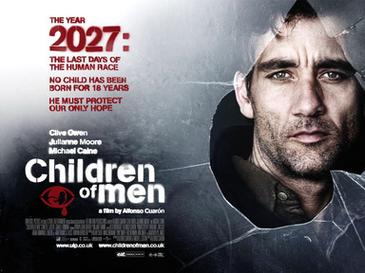
Image context: the cover image uses the official theatrical poster as a release-era anchor (2006), not as scene evidence for the sequence analysis below.
The core craft decision: duration as ethics, not decoration
Most action films manage stress by cutting quickly and controlling what the audience can process at each instant. Children of Men often does the opposite. It lets space stay legible, then forces bodies to survive inside that legible space.
That shift changes meaning. In a rapidly cut scene, danger can feel abstracted into rhythm. In Cuarón’s longer moving shots, danger feels continuous and directional: bullets come from somewhere, vehicles have weight, people block exits, and hesitation costs time. Technique becomes worldview.
How the “single-shot” feeling is actually built
The movie’s signature sequences are frequently discussed as pure one-take bravura. In practice, many are hybrid constructions: long practical camera moves, tightly pre-blocked actor choreography, and digital stitching where needed.
That hybrid design is the point. The film wants uninterrupted experience, not a purity contest. The viewer should feel trapped in unfolding time, not invited to audit whether every frame is literally from one negative.
Three craft layers keep that illusion stable:
- Spatial continuity — camera path and blocking preserve orientation.
- Kinetic continuity — movement vectors (cars, bodies, smoke, debris) carry momentum across stitch points.
- Acoustic continuity — sound perspective glues the shot emotionally even when image seams are invisible.
Sequence breakdown 1: the car ambush and rotating interior camera logic
The car ambush sequence is a technical blueprint for constraint-driven invention. The shot had to move between front and back seats, hold multiple speaking actors, survive sudden violence, and preserve geographic logic once the road attack begins.
The practical solution involved a specially modified car environment with camera mobility designed into the vehicle itself, not bolted on as an afterthought. This design choice matters: instead of filming coverage and manufacturing continuity in editing, the production engineered continuity physically.
On screen, the result feels immediate for a precise reason: when the camera glides within a cramped cabin and then reorients toward exterior threat, we read threat timing and body response in one breath. You are not watching a “scene assembled from angles.” You are trapped in a moving problem.
Sequence breakdown 2: Bexhill urban battle and controlled visual overload
The late urban warfare sequence is famous for scale, but its deeper achievement is channel management. The frame is crowded with armed actors, civilians, military vehicles, dust, and dynamic background action, yet the viewer still tracks Theo’s path.
That coherence comes from choreography plus lens discipline. The camera does not wander; it commits to a navigational line. Environmental chaos is layered around that line, so confusion remains emotional, not topographical. You feel disoriented as a person in danger, but rarely disoriented about where motion is headed.
Even the widely discussed blood hit on lens functions as craft logic, not gimmick. It keeps the camera inside the blast radius rather than granting spectator immunity. The film refuses to let style become distance.
Sequence breakdown 3: the birth scene and digital-human credibility threshold
The birth sequence demonstrates a different craft challenge: intimate realism under minimal-light conditions. Framestore’s work on the digital baby, discussed publicly by both the vendor and VFX trade coverage, was not ornamental. It was narrative-critical because a single artificial-looking gesture could collapse the scene’s emotional contract.
What makes the sequence hold is integration, not rendering bravado: body contact timing, skin response under available-light aesthetics, and compositing choices that preserve the film’s documentary-like visual roughness. The shot does not suddenly become glossy to show off effects work. It stays inside the movie’s established visual ethics.
Why this film’s craft still feels current in 2026
The movie has become a case study because current production pipelines still wrestle with the same tradeoff: spectacle versus orientation. As budgets grew and digital tools got stronger, many blockbusters gained compositional freedom but lost consequential geography.
Children of Men remains useful because it proves a harder path is possible:
- Keep environment readable.
- Let events unfold in sustained time.
- Use digital intervention to protect lived continuity, not to advertise manipulation.
That philosophy also explains its afterlife. The film premiered at Venice in 2006, entered awards-season discourse with major Oscar nominations, and became a recurring reference point in cinematography and VFX craft writing long after its initial theatrical run underperformed relative to budget.
A practical viewing protocol for filmmakers
If you want to study this film as craft rather than reputation, rewatch with these constraints:
- Track when the camera is solving a blocking problem versus when editing is solving it.
- Mark moments where sound perspective changes before image perspective; those are often the tension handoffs.
- Note where digital intervention likely exists but does not alter texture or tone.
- Ask whether each technically complex move increases moral proximity, not just excitement.
That final question is the real lesson. In Children of Men, technique is not there to impress you from outside the scene. It is there to remove your escape hatch.
Sources
- American Society of Cinematographers — “Children of Men: Humanity’s Last Hope”
- FXGuide — “Children of Men - Hard Core Seamless vfx”
- Framestore project page — Children of Men
- BFI feature — “Children of Men: why Alfonso Cuarón’s anti-Blade Runner looks more relevant than ever”
- BFI film page — Children of Men (2006)
- Box Office Mojo — Children of Men
- Academy Awards ceremony page (79th Oscars, films released in 2006)
- Wikipedia overview (release timeline, credits, production context)
- Wikipedia file page for poster used