People still call Buster Keaton a great comedian, which is true but incomplete. The sharper description is that he was a director of physical systems: he turned space, momentum, and danger into a visual grammar that audiences can read almost instantly.
That is why Keaton still feels modern. His films do not depend on one-liners or topical references, and they are not sentimental about stunt work. They are built around a harder idea: if the camera can hold enough space, and if the performer can move through that space with exact timing, then comedy and dread can happen in the same shot.
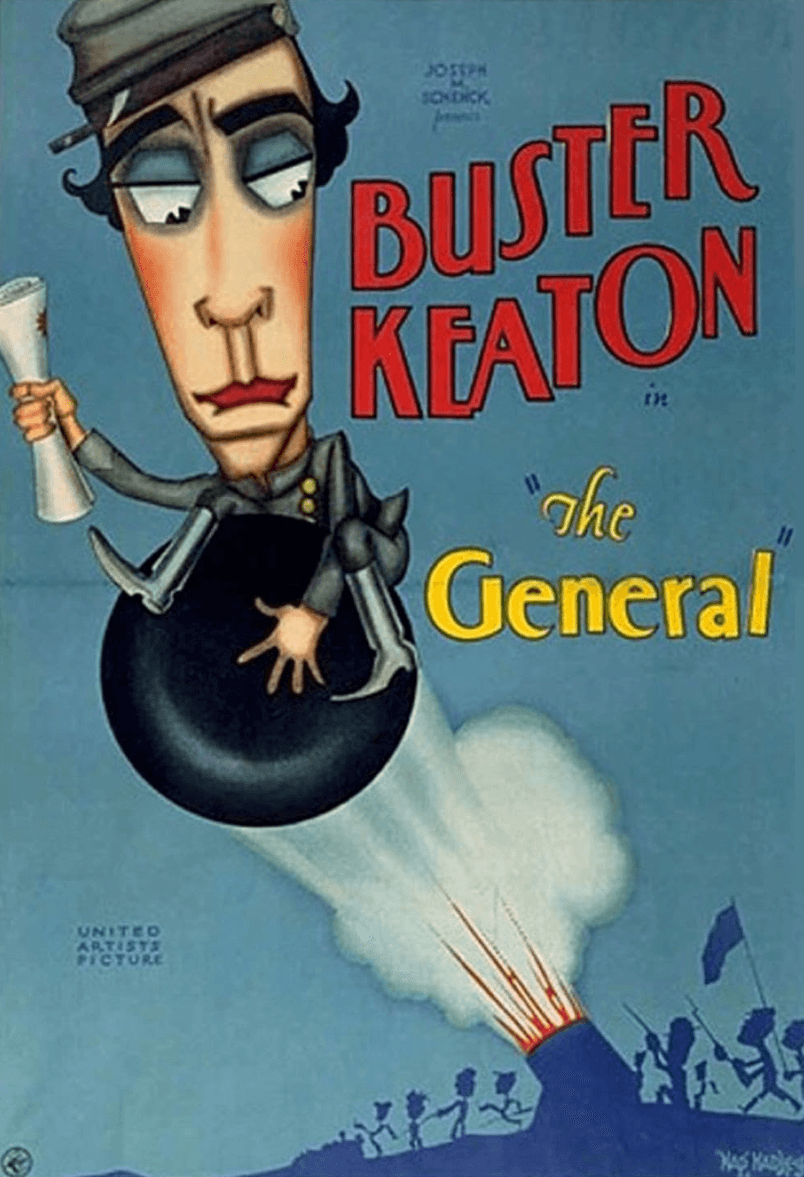
Image context: the cover uses the original The General (1926) poster as release-era historical context; scene-level directing claims below are based on the cited film analysis sources, not on poster imagery.
What Keaton directed that others often delegated
Keaton’s best-known work sits in the 1920s silent era, especially Sherlock Jr. (1924), The General (1926), and Steamboat Bill, Jr. (1928). In all three, the directorial signature is less about narrative twist and more about spatial legibility.
He tends to do three things repeatedly:
- Keep the frame wide enough for the audience to judge risk for themselves.
- Let action unfold in longer beats than later studio comedies usually allow.
- Build gags as cause-and-effect chains, not isolated punchlines.
That combination gives viewers two experiences at once: laughter at the absurdity and a constant low-level awareness that bodies are genuinely exposed to impact, height, speed, or weight.
The Keaton method: precision first, expression second
The “Great Stone Face” persona can look emotionally flat if you only track his face. If you track his blocking, the opposite is true. Keaton communicates feeling through trajectory: when he commits, when he hesitates, when he re-routes around failure.
That directorial choice matters because it shifts emotion out of close-up acting and into choreography. He does not tell you panic with performance inflation; he lets panic appear as a small timing miss inside a larger machine.
In practical film-language terms, Keaton often privileges:
- distance over coverage,
- movement geometry over cutting frequency,
- staging logic over dialogue logic.
For contemporary filmmakers, this is a useful reminder that tension does not always require aggressive editing. Sometimes it requires the opposite: enough visual honesty that the audience can verify the risk.
Why The General is still the cleanest blueprint
If one film explains Keaton’s directing mind clearly, it is The General. Released in 1926 (U.S. release in early 1927), it runs about 79 minutes depending on version and was famously expensive at around $750,000 for its time.[2][3]
The movie is often taught as a silent-action classic, but for directing craft, three details are more important:
1) Motion is written across full landscapes
Train movement is not treated as background realism. It is the compositional spine. Keaton stages action so that speed, track direction, and object weight are always readable. You are rarely confused about where danger sits in relation to the body.
2) Escalation comes from engineering constraints
Many sequences feel “inevitable” because each beat forces the next. A failed maneuver produces a material consequence; that consequence becomes the next problem. The result is comedic flow that behaves like mechanical logic.
3) Spectacle is framed as proof, not decoration
The famous bridge-collapse sequence is remembered because it is not only large but legible. The shot design lets the audience process scale and commitment in real time. The scene lands as evidence that the film is willing to spend real resources and physical precision for a coherent visual payoff.
The cost of independence, and what changed at MGM
The General underperformed at initial release relative to its budget and contributed to a major career turn: Keaton lost creative independence and moved into a more restrictive studio structure at MGM.[2]
That transition matters in director-profile terms. Before MGM, Keaton operated with unusually high control over stunt design, shot logic, and production rhythm. Under the studio system, that control narrowed. The films become historically interesting for different reasons, but the pure Keaton architecture of risk is most concentrated in the independent period.
So his career arc is not just a biographical rise-and-fall story. It is also an industrial lesson: directorial style can depend on production governance as much as on talent.
Why Keaton’s directing still converts in 2026
Keaton remains relevant because current filmmaking keeps rediscovering his core principles:
- Action directors still chase clarity of geography.
- Physical-comedy filmmakers still need cause-and-effect staging.
- VFX-heavy productions still struggle with weight and consequence when framing gets too fragmented.
Keaton’s films are a durable benchmark for all three. They show how to preserve spectacle without sacrificing orientation, and how to make danger readable without turning every sequence into noise.
That is also why restoration culture and canon polling keep him central. The General entered the U.S. National Film Registry in 1989, and Keaton’s status in modern canon-building has remained durable across restoration and repertory cycles.[5][6]
A practical viewing protocol for directors and editors
If you are studying Keaton as a director rather than as a performer, watch one film with this checklist:
- Pause every major stunt setup and mark what spatial information the frame gives you before movement starts.
- Track how long the camera waits before cutting once risk begins.
- Map the chain of consequences in one sequence: what exactly causes each next beat?
- Note where close-ups are withheld and ask what that withholding does to tension.
Most viewers discover the same thing: Keaton is not old cinema that “still works.” He is a case study in directing discipline that many modern productions still fail to match.
Sources
- Encyclopaedia Britannica — Buster Keaton
- Wikipedia — The General (1926 film)
- AFI Catalog — The General (movie details)
- International Buster Keaton Society — The General
- Library of Congress — National Film Registry title list (includes The General)
- Criterion Collection — The General
- Wikimedia Commons file used (poster)