W. B. Yeats's "The Lake Isle of Innisfree" is often remembered as a soft pastoral wish: a cabin, bean-rows, bees, lake water, evening light.[1][2] That memory is accurate, but it is incomplete. The poem does not begin in calm. It begins in resolve. "I will arise and go now" is a self-issued instruction, and translation quality depends on whether that imperative pressure survives.[1][3] If Chinese makes the opening too dreamy, the lyric stops sounding like a decision made against urban pressure and starts sounding like generic nature nostalgia.
That distinction matters because the last stanza returns the poem to the city. Yeats hears lake water "in the deep heart's core" while standing on the "roadway" and the "pavements grey."[1] The poem's real structure is therefore double: an imagined departure, and a present scene that never fully disappears.[1][3] Yeats later recalled the London moment behind the poem as a sudden inward recovery of Sligo sound while he was surrounded by street surfaces and shop-window water noise.[3] Good translation has to keep both locations alive at once.
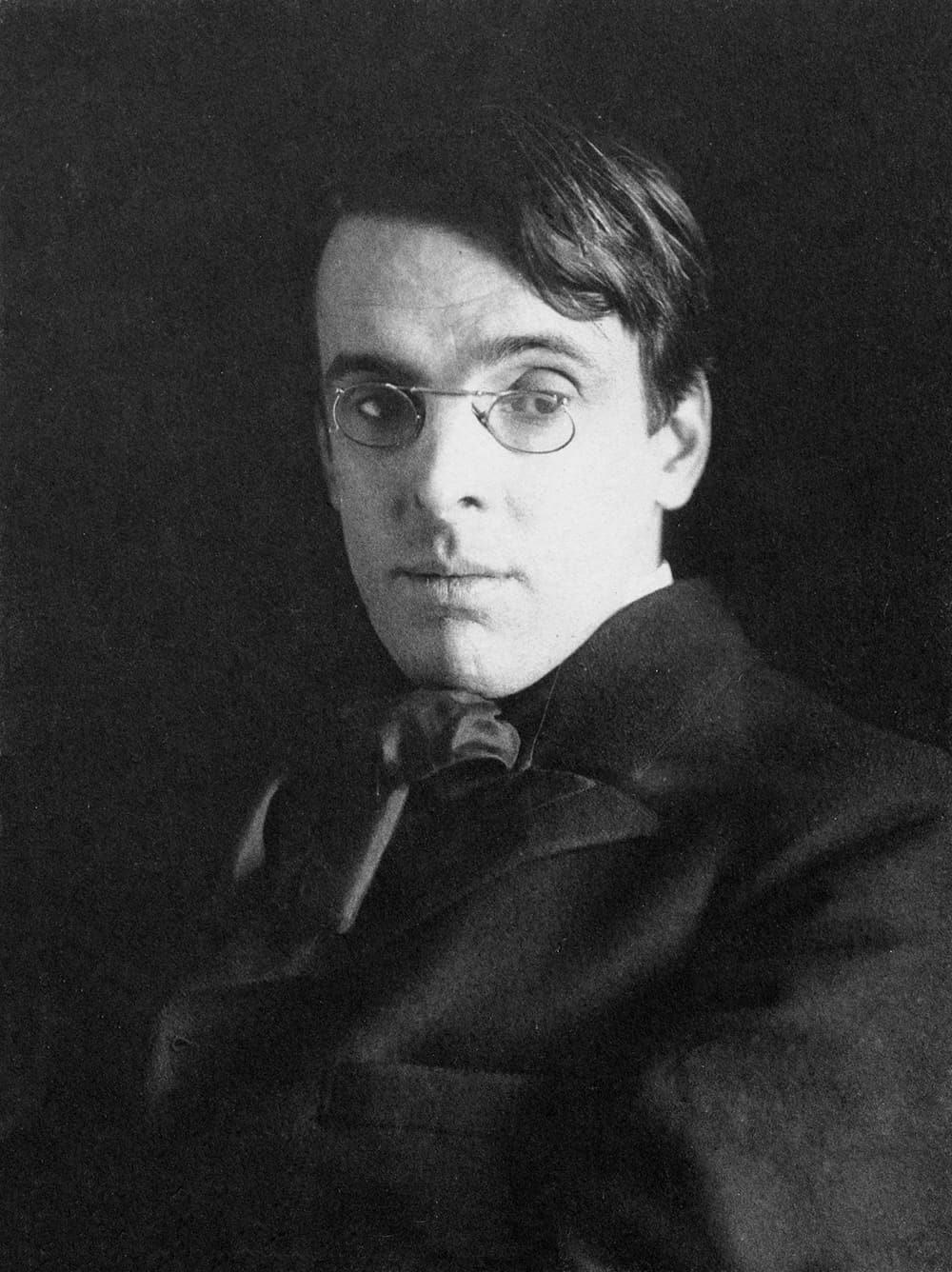
Image context: the cover uses Alice Boughton's 1903 archival portrait of Yeats. That is the right visual here because this article is about lyric posture, about how a poet turns recollection into an audible act of self-command rather than merely describing a landscape.[6]
The first line is a command, not a sigh
The opening pressure sits in the verb phrase "I will arise and go now."[1] In English, the line carries two kinds of force at once. "Will" gives intention; "arise" lifts the diction above ordinary conversation without becoming grandiose; "now" keeps the sentence from floating into vague desire.[1][3] In Chinese, each piece is vulnerable. If the line becomes too colloquial, the poem loses its ritual lift. If it becomes too elevated, Yeats sounds like he is proclaiming doctrine rather than tightening his will.
The most common translation error is to preserve destination while weakening motion. A version that lands mainly on "I want to go to Innisfree" gives the reader the poem's topic but not its pulse. Yeats does not start from preference. He starts from decision.[1][3] That is why the line keeps its voltage even before the cabin or the lake arrive. The poem's first music is volitional music.
"Bee-loud glade" is a compression test
The middle of the poem presents a second, more technical challenge. Yeats writes "nine bean-rows," "a hive for the honey-bee," and then the famous phrase "bee-loud glade."[1] The temptation in Chinese is to unpack everything into explanatory smoothness: rows of beans, a bee box, a grove filled with buzzing. That can make the imagery clear, but it also removes the poem's compactness. "Bee-loud" is not a neutral description; it is a pressure-packed compound that lets sound arrive before the place is fully visualized.[1][4]
This is where translation needs discipline. "Glade" is not a dark forest and not simply a meadow. It is a clearing, an opened pocket inside a larger natural field.[1] If Chinese turns it into generic "woods" or generic "grassland," the poem's spatial delicacy disappears. The same is true of the cabin. Yeats gives "clay and wattles made," a phrase that keeps the dwelling handmade and light.[1][2] When translation upgrades the cabin into something sturdier or more picturesque than the poem allows, the lyric becomes decorative. Yeats wants sufficiency, not rustic luxury.
Peace in this poem falls, it does not merely arrive
The poem's most delicate sentence may be "And I shall have some peace there, for peace comes dropping slow."[1] That line is easy to understand and easy to flatten. The crucial word is not only "peace." It is "dropping." The calm Yeats imagines is gradual, particulate, almost meteorological. It descends through "the veils of the morning" and moves with cricket song, midnight glimmer, and evening flight.[1] A Chinese version that renders peace as something simply obtained or possessed loses the poem's slow-release method.
This is also the point at which sound takes over from paraphrase. Even readers who do not consciously scan the line can hear the softness of "peace comes dropping slow."[1][4] The consonants loosen; the vowels lengthen; the sentence begins to imitate the condition it names. Translation cannot reproduce the exact English sound pattern, but it can preserve the governing principle: this peace is falling into the body by stages. If Chinese chooses hard, clipped diction here, the stanza stops breathing.
The last stanza must keep the city flat and the inward hearing deep
Many weaker translations become most sentimental at the end. Yeats does not. He writes of hearing lake water while he stands "on the roadway, or on the pavements grey."[1] Those are plain, urban, almost drab surfaces. Their flatness matters because it gives the last line its force: the water is not physically present, but it remains acoustically present "in the deep heart's core."[1][3] If Chinese beautifies the roadway, the contrast collapses. If it romanticizes "heart's core" into soft emotional uplift, the inwardness loses its hard center.
The final line is not simply about memory. It is about inner audition.[1][3] Yeats Trail's account of the poem remains useful here because it preserves the autobiographical trigger: city pavement outside, remembered water inside.[3] That is why the ending still feels modern. The poem does not say the speaker has escaped. It says he can hear another place without leaving the current one. Translation succeeds when that doubleness remains intact.
Why this poem still matters in translation practice
"The Lake Isle of Innisfree" remains a strong translation test because its language looks simpler than its effects. The vocabulary is mostly ordinary. The syntax is lucid. Yet the poem depends on a precise sequence: command, making, acoustic thickening, gradual peace, then urban return.[1][2] Remove the command, and the poem turns slack. Blur the sound-work, and the landscape turns generic. Lose the roadway, and the ending becomes souvenir lyric instead of pressure lyric.
For bilingual readers, the cleanest way to test a Chinese version is to track three things only: whether the first line sounds like a decision, whether "bee-loud" and "peace comes dropping slow" still move by sound rather than explanation, and whether the last stanza preserves the hard contact between grey pavement and inward water.[1][4][5] When those three survive, Yeats's poem keeps its real shape. It is not a postcard of retreat. It is a lyric of commanded return.
Sources
- Academy of American Poets, "The Lake Isle of Innisfree" by William Butler Yeats.
- Project Gutenberg, The Collected Works of William Butler Yeats, Vol. 4: The Wanderings of Oisin and Other Poems.
- Yeats Trail, "Innisfree" (place context and Yeats's later recollection of the poem's origin).
- Poetry Foundation, "Deep Heart's Core Sound: A Discussion of William Butler Yeats's 'Lake Isle of Innisfree'".
- The Nobel Prize, "William Butler Yeats - Facts" (career and prize context).
- Wikimedia Commons, "File:Yeats Boughton.jpg" (Alice Boughton's 1903 portrait of W. B. Yeats).