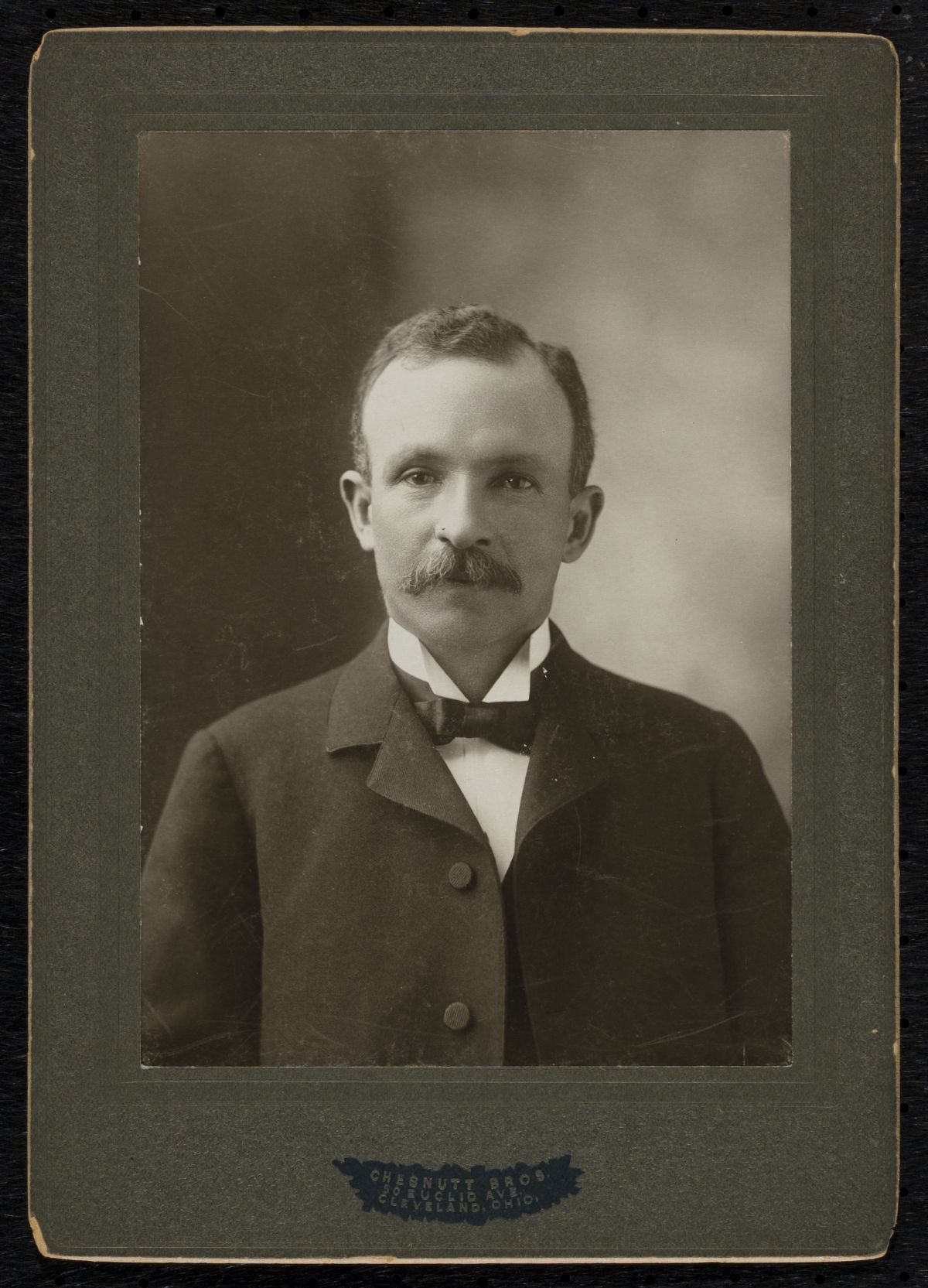
Charles W. Chesnutt's “The Wife of His Youth” ends with a revelation, but the revelation is not the story's most daring move. Readers can guess well before the final sentence that the polished Mr. Ryder is Sam Taylor, the young man Liza Jane has spent twenty-five years seeking. The harder question is why Ryder does not simply tell her on his shaded porch. Instead, he waits until his ball is bright with guests, converts Liza's history into an after-dinner speech, asks the most selective Black social circle in town what her husband ought to do, and only then opens the adjoining door.[1]
That delay is not merely suspense. It changes recognition from a private feeling into a public act. Ryder has built his adult life by managing what other people may see: his uncertain age, his incomplete education, his ascent from railroad messenger to clerk, his light complexion, his literary taste, his social authority. Liza arrives carrying evidence of the self beneath that arrangement. To acknowledge her in private would recover a marriage. To lead her into the ballroom forces the whole Blue Vein Society to acknowledge the history it has trained itself to keep tastefully out of sight.
Chesnutt does not make the gesture innocent. Ryder still controls the house, the program, the story, and the timing. He gives Liza no speech at the ball. Yet he uses those privileges against the exclusions they once maintained. The same man who planned the evening to advance toward a younger, lighter-skinned bride turns it into a tribunal of his own respectability. The story's moral intelligence lies in that conversion.
A society with no rule and a visible test
Section I introduces the Blue Veins through a running contradiction. The society says that “character and culture” determine admission. Outsiders notice that its members are generally light-skinned and mostly free-born. Members deny any complexion test while quietly producing the result such a test would create.[1] Chesnutt's irony is exact: prejudice has learned to speak the language of standards.
Ryder is not merely caught inside this system; he curates it. He is the “custodian” of its traditions, the person who revives interest, shapes policy, and decides when social “liberality” has become laxity.[1] His proposed marriage to the educated, financially secure Mrs. Molly Dixon would be both romantic success and institutional statement. As he explains it, people of mixed ancestry face either “absorption by the white race” or what he calls a backward step. “Self-preservation,” he concludes, “is the first law of nature.”[1]
The sentence reveals how exclusion protects itself from moral scrutiny. Ryder does not call his preference contempt; he calls it survival. The Blue Veins do not say darker people lack worth; they say lighter members have had better opportunities to acquire culture. Structural advantage is converted into evidence of merit, then merit is used to justify preserving the advantage.
The ball is meant to make that logic beautiful. Ryder wants it to “mark an epoch” in Groveland's social history, and every choice—guest list, palms, music, supper, literary program—will display collective arrival.[1] This matters at the ending. When Liza enters, she does not interrupt a random party. She enters an event designed to announce who represents the future.
Tennyson supplies the wrong woman
Section II begins with Ryder rehearsing. He sits on the porch with Tennyson's A Dream of Fair Women, searching for lines suitable for his toast to “The Ladies.” He tests an image of a woman “divinely tall,” rejects “pale Margaret” as tactically unwise, and settles on Queen Guinevere in green silk. Then the gate clicks and Liza Jane stands before him: small, elderly, dark-skinned, dressed in faded colors, and carrying a history no borrowed courtly image can hold.[1]
The juxtaposition can look cruel because the narrator renders Liza through a period vocabulary of physical difference. But its formal target is Ryder's prepared imagination. He has been leafing through English poetry for a woman who will fit the room he plans to command. Liza arrives from another archive: slavery, an illegal attempt to sell a free man, forced separation, unpaid work, migration, memory, and the stubborn promise of reunion.
Her account is not sentimental mist. It is logistical. She names Missouri, New Orleans, Atlanta, Charleston, and Richmond. She explains that warning Sam of the planned sale led to her whipping and sale “down de ribber.” She has supported herself by cooking while searching across the South and then the North. Even her tenderness includes judgment: Sam loved her, she says, but he was never much of a worker, and she may have to support him when she finds him.[1] The joke matters. It gives her a memory more intimate than sainthood.
Ryder responds by testing every exit available to the absent husband. Sam might be dead. He might have remarried. A slave marriage might not count. He might have “outgrown” her. Liza rejects each possibility, not with abstract moral argument but with knowledge of a particular man. Her confidence corners Ryder more effectively than accusation would.[1]
The daguerreotype and the mirror
Liza's most powerful object is an old daguerreotype. She wears it on a string around her neck, wrapped in layers, and says she would know Sam among a hundred men. Ryder studies the faded portrait, returns it slowly, and claims no knowledge of anyone by that name. After she leaves, he writes her address on the flyleaf of Tennyson. Then he goes upstairs and looks for a long time at his own face in the mirror.[1]
Chesnutt places three technologies of recognition in one short sequence. The poem supplies an inherited ideal of beauty. The photograph preserves the face of an escaped young man. The mirror confronts the successful older man with whatever continuity remains between them. Ryder's crisis is therefore not a struggle to discover a fact. The daguerreotype has made the fact legible. His struggle is over which image will govern his next public appearance.
The writing on Tennyson's flyleaf is a small but decisive act. Liza's address enters the book Ryder had been using to furnish his courtship. Her history is literally inscribed inside his literary performance. By the time he faces the mirror, “A Dream of Fair Women” can no longer be only a source of elegant quotations. It now holds directions back to the life his elegance has edited out.
Whether Liza recognizes Ryder on the porch is left unresolved. The story says she is certain she could not be mistaken, then shows her handing him the photograph without naming him. One recent critical account reads both Liza and Ryder through trickster traditions, complicating the view of her as only a passive vehicle for his sacrifice.[3] The text does not let us settle her strategy. That withholding is productive: Ryder cannot depend on being exposed, and the reader cannot reduce Liza's knowledge to whatever he admits.
Ryder has chosen before the room answers
At first glance, the ballroom speech seems like an elaborate way to outsource conscience. Ryder retells Liza's history as a hypothetical and asks his guests what the husband “ought” to do. Mrs. Dixon answers first: “He should have acknowledged her.” The room agrees.[1] Only after securing the verdict does Ryder reveal himself.
But one stage direction changes the scene. When the vote is complete, Ryder walks to a closed door and returns almost immediately with Liza “neatly dressed in gray.”[1] She is already inside the house. Someone has found her, brought her into the adjoining room, and prepared her entrance before he asks the question. Ryder has made his choice; what he seeks from the audience is not permission to recognize Liza but participation in the recognition.
That distinction makes the speech both braver and more manipulative. Ryder protects Liza from a cold first response by making the guests sympathize before they see her. He protects himself by telling his story in the third person until the room has pronounced its rule. He also binds the Blue Veins to their answer. They cannot dismiss Liza on sight without repudiating the fidelity they applauded seconds earlier.
Ryder accomplishes this through voice. The narrator says he repeats Liza's account in “the same soft dialect,” before shifting into the polished hypothetical language of legal argument and literary quotation.[1] Two social registers that the Blue Veins keep apart occupy one speech. Liza's spoken history reaches the supper table through the mouth of its recognized leader; his cultivated voice must carry the words by which his cultivation is judged.
The structure resembles a hearing. Ryder states the facts, supplies mitigating circumstances for the husband, poses a question, and lets the community return a judgment. It is tempting to connect that form too neatly to biography, but the context is suggestive: Chesnutt built financial security in Cleveland through stenography, law, and a court-reporting firm while pursuing publication.[4] He knew professionally as well as artistically that public language can turn a private history into a record.
“I am the man” changes the pronoun and the institution
The last sentence is famous because it performs its own correction: “this is the woman, and I am the man.”[1] Throughout the speech, Ryder has hidden behind suppose, he, and him. The ending returns to this and I. Recognition happens grammatically before it happens socially.
His introduction also gives Liza a title the room must accept: “the wife of my youth.”[1] Earlier, Ryder had invoked the weak legal status of a slave marriage as one possible escape. Now he names the relationship in the ceremonial language of the event. The host who controls admission uses his authority to admit not a charity case or a servant but his wife.
Yet Chesnutt stops at the threshold. We do not see the dance, Mrs. Dixon's later response, Liza's domestic future, or whether Ryder can turn one magnificent acknowledgment into daily companionship. The omission prevents the ending from proving too much. Public speech can revise the room's visible order; it cannot refund twenty-five years of labor or guarantee that social prejudice has dissolved.
Liza's silence at the ball sharpens that boundary. Ryder's act matters, but it remains his act. He translates her story, dresses her for presentation, and speaks the final words. A modern reader can admire the conversion of his authority while noticing that the story leaves her experience after recognition almost entirely unwritten. That tension is not a reason to discard the ending. It is the reason to read its choreography closely.
From “remarkable” sacrifice to managed recognition
“The Wife of His Youth” first appeared in The Atlantic Monthly in July 1898 and became the title story of Chesnutt's 1899 collection of “stories of the color line.”[1][2] The publication was a breakthrough within a career already pressing against the narrow roles available to Black writers. Library of America's account notes that the story's acclaim helped prompt Houghton Mifflin to issue two Chesnutt collections in quick succession; in 1900, the influential William Dean Howells called it “a remarkable piece of work.”[2]
That early language of remarkable moral sacrifice catches something real and something incomplete. Ryder does surrender the future he had planned, at least in the form he planned it. But to read only sacrifice makes Liza the cost of his nobility. The story is sharper when read as a struggle over recognition: who possesses the evidence, who controls the telling, which audience must answer, and what a declaration can change.
The original Atlantic pages make the final spatial movement especially plain. Liza passes from porch to adjoining room to illuminated ballroom; Ryder passes from Tennyson's imagined women to a photograph, a mirror, a hypothetical man, and finally “I.”[1] The Blue Veins pass from judging an absent moral case to facing the woman their own standards would have kept outside.
That is why the ending still lands even when its reconciliation feels too swift. Chesnutt does not merely unmask a husband. He makes an institution listen to the history beneath its polish and pronounce a standard it cannot evade once the door opens. Recognition becomes public because the forgetting was public too.
Sources
- Charles W. Chesnutt, “The Wife of His Youth,” The Atlantic Monthly 82 (July 1898), pp. 55–61—scan-backed first publication and primary text for the three-section close reading.
- Library of America, “Story of the Week: The Wife of His Youth”—publication history, the response to the story, and its place in Chesnutt's first collections.
- Yuki Miyazawa, “A Marriage between Tricksters: Literary Heritage in Charles W. Chesnutt's ‘The Wife of His Youth,’” Mississippi Quarterly 74, no. 3 (2022), pp. 271–287—critical context on Liza, Ryder, and the story's joined literary traditions.
- Charles W. Chesnutt Archive, “Biographical Sketch”—Chesnutt's education, move to Cleveland, work in stenography and law, Atlantic publications, and 1899 books.
- Cleveland Public Library Digital Gallery, “Charles Waddell Chesnutt, 40 Years Old”—catalog record and archival source for the 1897 or 1898 studio portrait used as the article image.